
GBTV - Where the Truth Lives

Election Season 2014

And it has brought us to this trainwreck called ObamaCare and we have bankrupted our kids and grandkids!

We are now headed into the 2014 Election Season and common sense and conservatism are on the rise. Please stand-up and be counted!

Reading Collusion: How the Media Stole the 2012 Election is a great place to start!

The Founding Father's Real Reason for the Second Amendment

And remember the words of Thomas Jefferson "The strongest reason for the people to retain the right to keep and bear arms is, as a last resort, to protect themselves against tyranny in government." See Video of Suzanna Gratia-Hupp’s Congressional Testimony: What the Second Amendment is REALLY For, below (u-tube HERE).

The Leaders Are Here... Palin, Cruz, Lee, Paul, Chaffetz....

T'S A WONDERFUL LIFE

Can You Really Still Believe That None of These People Would Have Done a Better Job???

Bloggers' Rights at EFF

SIGN THE PETITION TODAY...

Showing posts with label Stimulus Bill. Show all posts

Thursday, September 17, 2009

It’s Official - The Stimulus Didn't Work

The data show government transfers and rebates have not increased consumption at all.

This failure added to past history of government’s inefficiencies plus the growing lose of “TRUST” in Obama’s honesty, choices, radical ideology, questionable associates and ability to do the job could be the tilting point in defeat of ObamaCare… and should be!!

It's Official: The Stimulus Didn't Work

It's Official: The Stimulus Didn't Work

Is the American Recovery and Reinvestment Act of 2009 working? At the time of the act's passage last February, this question was hotly debated. Administration economists cited Keynesian models that predicted that the $787 billion stimulus package would increase GDP by enough to create 3.6 million jobs. Our own research showed that more modern macroeconomic models predicted only one-sixth of that GDP impact. Estimates by economist Robert Barro of Harvard predicted the impact would not be significantly different from zero.

Now, six months after the act's passage, we no longer have to rely solely on the predictions of models. We can look and see what actually happened.

Consider first the part of the package that consists of government transfers and rebates. These include one-time payments of $250 to eligible individuals receiving Social Security, Supplemental Security Income, veterans benefits or railroad retirement benefits--and temporary reductions in income-tax withholding for a refundable tax credit of up to $400 for individuals and $800 for families with incomes below certain thresholds. These payments, which began in March of this year, were intended to increase consumption that would help jump-start the economy. Now that a good fraction of these actions have taken place, we can assess their impact.

[Taylor Chart]

The nearby chart reviews income and consumption through July, the latest month this data is available for the U.S. economy as a whole.

Consider first the part of the chart pertaining to the spring of this year and observe that disposable personal income (DPI)--the total amount of income people have left to spend after they pay taxes and receive transfers from the government--jumped. The increase is due to the transfer and rebate payments in the 2009 stimulus package. However, as the chart also shows, there was no noticeable impact on personal consumption expenditures. Because the boost to income is temporary, at best only a very small fraction was consumed.

This is exactly what one would expect from "permanent income" or "life-cycle" theories of consumption, which argue that temporary changes in income have little effect on consumption. These theories were developed by Milton Friedman and Franco Modigliani 50 years ago, and have been empirically tested many times. They are much more accurate than simple Keynesian theories of consumption, so the lack of an impact should not be surprising.

Indeed, one need not have looked any further than the Bush administration's Economic Stimulus Act of 2008 to find plenty of evidence that temporary payments of this kind would not jump-start consumption. That package made one-time payments and rebates to people in the spring of 2008, but, as the chart shows, failed to stimulate consumption as had been hoped. Some argued that other factors such as high oil and gasoline prices caused consumption to fall during this period and that consumption would have been even lower without the stimulus, but no significant impact of these rebates is found even after controlling for oil prices.

Consider next the government-spending part of the stimulus package. The Obama administration points to the sharp reduction in the decline in real GDP from the first to the second quarter of 2009 as evidence that the package is working. Economic growth was minus 6.4% in the first quarter and minus 1% in the second quarter, so the implied improvement of 5.4 percentage points is indeed big. But how much of that improved growth rate can be attributed to higher government spending due to the stimulus? If we rely on predictions of models, again we see disagreement and debate. According to our research with modern macroeconomic models, the increase in government spending would add less than a percentage point, a relatively small portion. The model predictions cited by the administration's economists suggest a much larger portion: two to three percentage points. Prof. Barro's model predicts zero.

So let's look at the data on the contributions of government spending and other components of GDP to the 5.4 percentage-point improvement. By far the largest positive contributor to the improvement was investment--which went from minus 9% to minus 3.2%, an improvement of 5.8% and more than enough to explain the improved GDP growth. Investment by private business firms in plant, equipment and inventories, rather than residential investment, were the major contributors to the investment improvement. In contrast, consumption was a negative contributor to the change in GDP growth, because consumption growth declined following the passage of the stimulus package.

One is hard put to see what specific items in the stimulus act could have arrested the decline in business investment by such a magnitude. When one looks at monthly investment indicators--such as new orders for nondefense capital goods--one sees a flattening out starting early in the first quarter of 2009, well before the package went into operation. The free fall of investment orders caused by the financial panic last fall stabilized substantially by January, and investment has remained relatively stable since then. This created the residue of a very large negative growth rate from the fourth quarter of 2008 to the first quarter of 2009, and then moderation from the first quarter to the second of 2009. There is no plausible role for the fiscal stimulus here.

Associated Press

Taylor

Direct evidence of an impact by government spending can be found in 1.8 of the 5.4 percentage-point improvement from the first to second quarter of this year. However, more than half of this contribution was due to defense spending that was not part of the stimulus package. Of the entire $787 billion stimulus package, only $4.5 billion went to federal purchases and $17.7 billion to state and local purchases in the second quarter. The growth improvement in the second quarter must have been largely due to factors other than the stimulus package.

Incoming data will reveal more in coming months, but the data available so far tell us that the government transfers and rebates have not stimulated consumption at all, and that the resilience of the private sector following the fall 2008 panic--not the fiscal stimulus program--deserves the lion's share of the credit for the impressive growth improvement from the first to the second quarter. As the economic recovery takes hold, it is important to continue assessing the role played by the stimulus package and other factors. These assessments can be a valuable guide to future policy makers in designing effective policy responses to economic downturns.

By JOHN F. COGAN, JOHN B. TAYLOR AND VOLKER WIELAND – Wall Street Journal

By Mr. Cogan - a senior fellow at the Hoover Institution, was deputy director of the Office of Management and Budget under President Ronald Reagan. Mr. Taylor, an economics professor at Stanford and a Hoover senior fellow, is the author of "Getting Off Track: How Government Actions and Interventions Caused, Prolonged and Worsened the Financial Crisis" (Hoover Press, 2009). Mr. Wieland is a professor of monetary theory at Goethe University in Frankfurt, Germany.

We cannot afford ObamaCare style healthcare reform!!  We cannot afford Cap and Trade!!  And the remaining unspent funds left form the stimulus bill fiasco must be returned to the people or put back into the general coffers (with over-sight) to keep down tax increases… not to be used for the aforementioned programs to allowed to be siphoned off by the Obama Administration for Americorp, ACORN, SEIU, Green Programs or to other of their liberal programs and supporters.

Wednesday, August 19, 2009

Whose Medical Decisions? – Thomas Sowell

There was a time when rushing a thousand-page bill through Congress so fast that no one has time to read it would have provoked public outrage. But now, this has been attempted twice in the first 6 months of a new administration.

The fact that they got away with it before, with the "stimulus" bill, may have led them to believe that they could get away with it again.

But the first bill simply spent hundreds of billions of dollars. The current "health care" bill threatens to take life-and-death decisions out of the hands of individuals and their doctors, transferring those decisions to Washington bureaucrats.

People are taking that personally-- as they should. Your life and death, and that of your loved ones, is as personal as it gets.

The mainstream media are again circling the wagons to protect Barack Obama, but this time it may not work. One of those front-page editorials disguised as a news article in the New York Times begins: "The stubborn yet false rumor that President Obama's health care proposals would create government-sponsored 'death panels' to decide which patients were worthy of living seemed to arise from nowhere in recent weeks."

Nowhere? Dr. Ezekiel Emanuel is "Special Advisor for Health Policy" for the Obama administration. That's nowhere? He is also co-author of an article on Americans' "over-utilization" of medical care in the June 18, 2008 issue of the Journal of the American Medical Association. Is that nowhere?

Dr. Emanuel's article points out that Americans do not visit doctors or go into hospitals more than people in other industrialized countries. In fact we go to both places less often than people do in those other countries, which include countries with government-controlled medical care.

As the article points out, "It is more costly care, rather than high volume, that accounts for higher expenditures in the United States."

There are more Magnetic Resonance Imaging (MRI) devices per capita in the United States, more coronary bypass operations and Americans use more new pharmaceutical drugs created within the past 5 years.

Americans also have more of what the article calls "amenities" with their medical care. "Hospital rooms in the United States offer more privacy, comfort and auxiliary services than do hospital rooms in most other countries."

In other words, it is not quantity but quality that is different-- and more expensive-- about American medical care. This is what Dr. Emanuel's "over-utilization" consists of.

At one time, it would have been none of Dr. Emanuel's business if your physician prescribed the latest medications for you, rather than the cheaper and obsolete medications they replaced. It would have been none of his business if you preferred to have a nice hospital room with "amenities" rather than being in an unsanitary ward with inadequate nursing care, as under the National Health Service in Britain.

The involvement of government gives Dr. Emanuel the leverage to condemn other Americans' choices-- and a larger involvement of government will give him the power to force both doctors and patients to change their choices.

As for a "death panel," no politician would ever use that phrase when trying to get a piece of legislation passed. "End of life" care under the "guidance" of "some independent group" sounds so much nicer-- and these are the terms President Obama used in an interview with the New York Times back on April 14th.

He said, "the chronically ill and those toward the end of their lives are accounting for potentially 80 percent of the total health care bill out there." He added: "It is very difficult to imagine the country making those decisions just through the normal political channels. That is why you have to have some independent group that can give you guidance."

But when you select people like Dr. Ezekiel Emanuel to give "independent" guidance, you have already chosen a policy through your choice of advisors, who simply provide political cover. The net result can be exactly the same as if those providing that guidance were openly called "death panels."

Thomas Sowell :: Townhall.com Columnist by Thomas Sowell - a senior fellow at the Hoover Institute and author of The Housing Boom and Bust. Thomas Sowell is considered one of the purest thinkers and authors of our time.

And let us not forget: Co-Op = Public Option = Single Payer

Related Resource:

*Judge Andrew Napolitano, Jay Seculo: Attorney for the American Center of Law and Justice and Tim Lynch from The Cato Institute stated earlier today that the act of government taking over health care is “unconstitutional” The powers granted to the federal government are enumerated in the Constitution. Speak up America and keep up the pressure.

“It is only when the Congress feels the heat that they see the light!”. Nancy Pelosi said earlier today that Healthcare Reform without a Public Option was unacceptable. It was going to be all or nothing, and you can be sure that she/they will try to ram this bill through without the Republican’s input and against the wishes of the people.

Armey: We’ll March on Washington Against Obamacare - See Video: Former House Majority Leader Dick Armey talks about the movement to defeat Obamacare - Click Here Now

Posted: Knowledge Creates Power

Thursday, August 6, 2009

John Cornyn embraces declining President Obama polls… As He Helps Recruit GOP Candidates – Rand Paul Throws Hat in Ring

John Cornyn (R-Texas), the Senate GOP campaign chief, says Barack Obama's declining popularity is helping Republican recruiting and boosting the party's prospects for 2010.

“I don’t have to tell you about the general environment,” said Cornyn, chairman of the National Republican Senatorial Committee. “President Obama is now looking like a mere mortal, as opposed to someone who previously exceeded gravity.”

“I think there will be a significant number of voters who, leading up to 2010, will wonder if they voted for someone they didn’t get.”

Cornyn didn’t hesitate to jab Obama, saying that the president had achieved little in his first months in office. And the Texas Republican called Obama’s economic stimulus package “ill fated.”

Cornyn also touted recruiting successes in a handful of states, including Florida (Gov. CharlieCrist) and Illinois (Rep. Mark Kirk), and said it was evidence of the party’s success in the first part of the 2010 election cycle.

As NRSC chairman this cycle, Cornyn has history on his side — the party in power historically loses seats in the midterms — so he is more confident than his predecessors in the last two election cycles.

“While we’ve had some good successes in candidate recruitment, Democrats have had some notable failures,” Cornyn said, noting Democrats’ inability to woo Illinois Attorney General Lisa Madigan into a Senate bid. “I am optimistic.”

But with Supreme Court nominee Sonia Sotomayor headed for a vote later this week, Cornyn was also peppered with questions from reporters about whether his party’s strident opposition toward her candidacy would hurt Republican prospects among Hispanic voters.

Cornyn responded that, her ethnicity aside, Republicans had focused on Sotomayor’s record as a federal judge.

“One thing I do think is important is that we treated her with respect,” Cornyn said.

Cornyn — who has faced criticism in his heavily Hispanic state for coming out in opposition to Sotomayor — also said the GOP’s failure to win Hispanic support in 2008 was not necessarily a harbinger of things to come.

“I think it’s myopic to read too much into 2008 and Republican appeal among Hispanic voters,” Cornyn said, arguing that Hispanic voters would be more interested in Democratic policies headed toward 2010.

Cornyn was also asked whether he would support Sen. John Ensign should the embattled Nevada senator seek reelection in 2012.

“I’m really not going to comment on 2012 right now,” Cornyn said.

Cornyn defended protesters who were speaking up at Democratic town hall events across the country, saying it was wrong for the Democratic Party to “demonize” them.

“It’s part of our political process for people to express ... whatever they feel,” Cornyn said.

Republican Rand Paul, the son of 2008 presidential candidate Ron Paul, is ramping up to run for the Kentucky Senate seat currently held by Jim Bunning.

Paul announced his formation of an exploratory committee last night on MSNBC’s "Rachel Maddow Show," where he declared that the Republican party has “lost its mojo" on fiscal issues. He said that he supports Bunning, but is skeptical that the senator is planning to run for re-election.

“I’m happy tonight to announce on 'The Rachel Maddow Show' that I’m forming an exploratory committee to run for the U.S. Senate,” Paul said.

“I’ve gone around the state saying good things about [Bunning]. I think the problem is every time a reporter asks Jim Bunning are you running, their follow-up question is, ‘Jim are you really running?'”
Bunning has said he still plans on running for a third term, but Kentucky Secretary of State Trey Grayson has formed a Senate exploratory committee in case he changes his mind.

On MSNBC, Paul raised the possibility that Grayson and Bunning struck a private deal to ensure that Grayson would not face any Republican opposition on the primary ballot — and speculated that Bunning may announce his retirement right before the state’s filing deadline.

“What I hate to see is a politician who might go all the way up to the deadline and pull their papers out an hour before, and then you have one candidate and there’s no real primary,” Paul said.

By Josh Kraushaar

Source: Politico

Monday, July 20, 2009

$23.7 Trillion to Fix Financial System?

In New Report, Neil Barofsky Says It's Possible Government Could Spend $23.7 Trillion to Fix Financial System

Sitting down?

Photo: In New Report, Neil Barofsky Says It's Possible Gov't Could Spend $23.7 Trillion To Fix Financial System

In a July 2009 report on government efforts to fix the financial system, Neil Barofsky, the special inspector general for the TARP, says total government support has the potential to reach $23.7 trillion.

(Brendan Hoffman/Getty Images)

"The total potential federal government support could reach up to $23.7 trillion," says Neil Barofsky, the special inspector general for the Troubled Asset Relief Program, in a new report obtained Monday by ABC News on the government's efforts to fix the financial system.

Yes, $23.7 trillion.

"The potential financial commitment the American taxpayers could be responsible for is of a size and scope that isn't even imaginable," said Rep. Darrell Issa, R-Calif., ranking member on the House Oversight and Government Reform Committee. "If you spent a million dollars a day going back to the birth of Christ, that wouldn't even come close to just $1 trillion -- $23.7 trillion is a staggering figure."

Granted, Barofsky is not saying that the government will definitely spend that much money. He is saying that potentially, it could.

At present, the government has about 50 different programs to fight the current recession, including programs to bail out ailing banks and automakers, boost lending and beat back the housing crisis.

Barofsky's estimate means that if each federal agency spends the maximum potential amount involved in these 50 different initiatives -- if the Federal Reserve ends up spending $6.8 trillion on its programs. If the Treasury Department spends $4.4 trillion, if the Federal Deposit Insurance Corporation spends $2.3 trillion, and so on -- then the numbers add up to a total of $23.7 trillion.

That figure, Barofsky notes, is designed to "suggest the scale and scope of these efforts and not to provide a firm financial statement." It is not a figure that has been evaluated to give an estimate of likely net costs to the American taxpayer. "The actual potential for losses," he says, "is likely to be lower."

But in his new quarterly report to Congress that will be released Tuesday, the watchdog warns that hundreds of billions of taxpayer dollars could be lost if the government does not make certain changes to these programs. The Treasury Department, he cautions, needs to increase the transparency of the $700 billion TARP program, which he says has grown to an unprecedented scope and scale.

"Although Treasury has taken some steps toward improving transparency in TARP programs, it has repeatedly failed to adopt recommendations that SIGTARP believes are essential to providing basic transparency and fulfill Treasury's stated commitment to implement TARP with the highest degree of accountability and transparency possible," Barofsky says in the report.

Barofsky said his office currently has 35 ongoing civil or criminal investigations.

Treasury Should Require TARP Recipients to Report on Use of Funds, Says Barofsky

Barofsky notes that there are currently four specific recommendations that the Treasury Department has not adopted. The department, he believes, should require all TARP recipients to report on their use of funds. The department should also report on the values of its TARP portfolio so taxpayers know about the value of their investments; disclose the identity of any TALF borrowers; and disclose tradings, holdings and valuations of assets of the public-private investment funds that will be buying toxic assets from banks.

This public-private investment program is a key source of concern for the watchdog. In the program, a handful of selected funds will purchase toxic assets -- like mortgage-backed securities -- from banks in an effort to cleanse their balance sheets and help them increase lending.

In his last quarterly report in April, Barofsky cautioned that many aspects of the toxic asset program left it vulnerable to fraud, waste and abuse, such as conflicts of interest for fund managers, collusion with fund managers, money laundering and misuse with the Fed's lending program, known as the TALF.

Since then, Treasury has incorporated many of the watchdog's recommendations, so now "the program has a significantly improved compliance and fraud-prevention regime than that initially proposed," Barofsky says. However, he warns that "there remain some significant areas in which Treasury's plan for PPIP falls short."

One such area is the lack of an informational barrier -- or a wall -- between fund managers making investment decisions on behalf of the program and employees of the fund management company who manage funds that are not part of the program. A fund manager, Barofsky warns, "could generate massive profits in its non-PPIF funds as a result of an unfair advantage."

Treasury has declined to put such a wall in place.

"Failure to impose a wall will leave Treasury vulnerable to an accusation that has already been leveled against it -- that Treasury is using TARP to pick winners and losers and that, by granting certain firms PPIF manager status, it is benefiting a chosen few at the expense of the dozens of firms that were rejected, of the market as a whole, and of the American taxpayer," Barofsky says. "The reputational risk is not one that can be readily measured in dollars and cents, but is rather a risk that could put in jeopardy the fragile trust the American people have in TARP and, by extension, their Government."

"Such transparency not only dissuades misconduct and promotes sound management but also promotes a better understanding of PPIP and thus enhances the credibility of PPIP and TARP more broadly," he says. "Even more importantly, the most significant investors in each PPIF, the American taxpayers, have a right to know the status of their investments. The lack of transparency as to what use TARP funds were put by recipients in other TARP programs, in SIGTARP's view, has damaged the credibility of TARP and therefore may have threatened its viability. Treasury should not repeat that apparent error with PPIP."

However, the department, Barofsky says, plans to disclose "no more than the bare minimum required by statute."

With nearly $24 trillion potentially flying out of federal coffers, the watchdog wants the government to do a lot more than just "the bare minimum."

When Barofsky testifies before the House Oversight and Government Reform Committee on Tuesday, Congress is expected to sound off on the watchdog's findings.

In a separate report released Monday, Barofsky said he obtained responses from banks on what they did with TARP funds, something that the Treasury Department has refused to do. Many of the banks, he said, used some funds to make investments, buy other banks and pay off debts.

"This administration promised an 'unprecedented level' of accountability and oversight, but as this report reveals, they are falling far short of that promise," Issa said. "In fact, the Treasury Department is actively obstructing transparency. The American people deserve to know how their tax dollars are being spent -- especially considering they are the ones who are footing the bill."

Source: abcnews.go.com/Business/Politics / Fox Nation

Posted: Knowledge Creates Power

Monday, June 29, 2009

President Trump? What If?

What if Donald Trump were President? What would he do?

images1

As a guest on Greta Van Susteren’s show, on Fox News tonight, Donald Trump said that OPEC is laughing at us and the banks aren’t lending… and both are killing us financially!

He said that there is oil sitting in tankers everywhere and OPEC will dump it rather than sell it to us at a decent rate. HMMMM… so much for Obama’s cow-towing (and bowing) to the Arabs having any positive effect for America… in any arena!!

When Greta asked Donald Trump what he’d do if he were President he said he would force the banks to loan the stimulus money that we, the taxpayers, have given them. He said no matter how wealthy you are, you cannot go out and get a loan. The banks are just sitting on that money, covering their bottom-line.

Then Trump added that he would get the smartest and toughest guy he knew… a businessman, not a politician, to get over to the Middle East to negotiate, as well as splitting up OPEC. OPEC is a monopoly that would be illegal by the standards of most countries and they have destroyed many countries in the process by their greed. Trump said that OPEC has taken advantage of us for years; oil should be $20 a barrel, not $70.

There is an old blog post online from 2005 where Trump was saying these same things. Amazing how we don’t listen to people who know how to make and how to manage money?!? It is like the old adage: Those that can… do. Those that can’t… teach. The same goes for government: Those that can… do. Those that can’t… go into government service; just take a look at the Obama Administration.

Trump said that some of the smartest people he knows say if oil costs more than $20 to $30 a barrel, you have a problem. Last year OPEC pushed oil over a $100 a barrel, now it is at $70, and America can't afford it! He closed by saying, "Very few people, except me, are telling you that or trying to do anything about it". Perhaps you need to ask yourself why?!?

Ask Marion – Knowledge Creates Power

Tuesday, June 16, 2009

Expert: Stimulus Fraud May Hit $50 Billion (Updated)

dollar-sign-money Any large government endeavor is susceptible to fraud, and that’s certainly the case with the $787 billion fiscal stimulus package.

Up to $50 billion of that total could be siphoned off by fraudsters in current months, says David Williams, who runs Deloitte Financial Services Advisory.

He estimates that $500 billion of the package will flow through the traditional government procurement network.

"The rule of thumb typically is that of the… money that's going to run through the procurement process, somewhere between 5 percent and 10 percent… usually finds its way into potential problems," Williams tells MarketWatch.

"That's sort of the benchmark that I use."

The fact that the money flows electronically puts companies even more at risk of being ripped off, Williams points out.

"We're telling our clients to be very careful and to make sure their firms are resilient in terms of dealing with the potential opportunities for fraud and waste," he says.

"It becomes ever more important that firms remain diligent about their data."

FBI Director Robert Mueller also warns of fraud stemming from the stimulus package.

“These funds are inherently vulnerable to bribery, fraud, conflicts of interest, and collusion,” he said last month.

Many experts oppose the stimulus for issues far removed from fraud and corruption.

“It’s just a grab bag of every spending proposal that’s been banging around Congress for years,” publisher Steve Forbes told Bloomberg TV.

Tuesday, June 16, 2009 11:54 AM
By: Dan Weil – Newsmax

Next stop… Nationalized Medicine… If we don’t stop government run healthcare, this fraud will look like a ‘walk in the park’… while medical services become more and more restricted, the number of doctors and nurses diminish and government decides who qualifies for what services… or that you don’t qualify at all because you are too old etc etc, the fraud will be rampant!


Glenn Beck: Eye on the Stimulus - Joe 'Amtrak' Biden


June 16, 2009 - 11:39 ET

America's March to Socialism: Why we're one step closer to giant missile parades
is now available as an audio book...

VOICE: The Glenn Beck program presents more truth behind America's March to Socialism.

GLENN: Well, you'd think when the government provides a list of all the pet projects kicked off by the stimulus, more people in the media might be digging through the report, but I haven't ‑‑ we aren't even already to number 10 on the list and we have found two shady projects already and now you can add yet another one to the list.

Here we go, this is number 6 on the list of 100 projects in 100 days. This list comes from the White House. But first on Page 1 of this report is a note about the wonders of the stimulus, signed by none other than "Stand up, Chuck" Joe Biden himself. Joe Biden, of course, is overseeing the stimulus. He's the watchdog the administration has set loose (making guard dog sounds). He's the one that's just going to watch every penny that goes out. Oh, and he's tough, too (making guard dog sounds). Maybe that's why Project Number 6 exists because of "Pit bull" Biden. Infrastructure, in Wilmington and Bear, Delaware. Whoa, there's ‑‑ wait a minute. The Number 6 project is from Delaware? Who else is... (making barking noises). Infrastructure in Wilmington and Bear, Delaware, Amtrak ‑‑ I swear to you I'm ‑‑ I'll hemorrhage to death. Amtrak is using $22 million in Recovery Act funding to restore, restore two superliner cars, three P40 locomotives and four Amfleet train cars. Oh. So Amtrak is restoring nine cars in Wilmington, Delaware at a cost to you of about $2 million per car. Huh. I wonder whose idea it was to send the funds that way, you know, Amtrak in Delaware. Could these people be any more transparent?

Secondly, what in the world are you doing to these cars for $2 million a pop? Are you painting Joe Biden murals in them? Are you having extra super reserved seating for Barbara Walters and Whoopi Goldberg? What is it? Is it going to be Joe's exclusive vice presidential express car? What is Amtrak doing with the $1.5 billion per year in taxpayer money we already give to them? Don't answer that question. Don't answer it. Just know that America is on the path to recovery and Biden is there watching every dime and dollar and, well, in this case $22 billion, you know, in Delaware. And just know that we're creating 600 trillion new jobs by the end of the summer, I think, maybe mid‑September, 600 trillion new jobs just having money losing train cars to carry vice presidents around (making guard dog sounds).

VOICE: That was even more overwhelming evidence that we are destined to be a bunch of socialist pigs very, very soon on the Glenn Beck program.

Posted: Knowledge Creates Power - Updated 6.16.09 2:37PM-

Books Everyone Must Reed

American Progressivism

Liberal Fascism

Glenn Beck's Common Sense

Liberty and Tyranny

Tuesday, June 9, 2009

Banks to return $68 billion in bailout money


New York buildings are reflected in the window of a Capital One bank office window. The Treasury Department said Tuesday it will allow 10 of the nation's largest banks to repay $68 billion in government bailout money. (AP File)

Ten of the nation’s biggest financial companies got a green light Tuesday to return $68 billion in federal bailout money — freeing the banks from limits on executive pay and leaving the government with a small gain on the rescue cash.

While the paybacks could be a signal that the banking industry is stabilizing, analysts say it is far from a clean bill of health, and some said it was too soon to let the banks give back the money.

Presidential spokesman Robert Gibbs said the returned money would go “back into general revenue” and could even be used to bail out banks again. (And this seems to be the plan… Many banks have wanted to repay stimulus money before but were not allowed because they weren’t ready… per the administration. But now that people are starting to get fed up and money sources are drying up, they need the money, they will take the pay back and do it all again.

Still, the government has collected $1.8 billion from dividends on shares of preferred stock it received in exchange for bailout money, he said. And the government still holds warrants to buy shares of bank stock at cut-rate prices in the future.

The $68 billion in paybacks would be the largest since the $700 billion Troubled Asset Relief Program took effect eight months ago at the peak of the financial crisis. Specifically, the money comes from a $250 billion slice of the $700 billion bailout package.

Other chunks of the $700 billion will be harder, if not impossible, to recover. Some of it, such as $70 billion funneled to failed insurer American International Group Inc., ended up in the pockets of healthier banks that did deals with AIG.

And even the banks getting out from under the TARP still rely on government support, including debt guarantees from the Federal Deposit Insurance Corp. and credit lines from the Federal Reserve.

The banks chafed under restrictions on executive pay imposed by the government for banks that took bailout cash, arguing they were losing top talent to other firms. The administration is expected to roll out new executive pay rules Wednesday that would apply to banks that still have TARP money.

“It’s our obvious hope that additional money is not going to have to be used to stabilize banks,” Gibbs said. “I certainly wouldn’t rule it out.”

Indeed, banking experts stressed that the payments do not signal an end to the financial crisis. In fact, they say, most banks approved to pay the money back never needed it in the first place.

And three major banks that have not been approved by the government to pay the money back — Citigroup Inc., Bank of America Corp. and Wells Fargo & Co. — could need federal help for years to come.

“When a troubled bank is capable of repaying, that would be significant,” said Barry Ritholtz, head of the financial research firm FusionIQ. “But we’re not going to see that anytime soon because they can’t afford it.”

Among the banks approved to pay back their bailout cash are eight that passed the government “stress test” earlier this year: JPMorgan Chase & Co., American Express Co., Goldman Sachs Group Inc., U.S. Bancorp, Capital One Financial Corp., Bank of New York Mellon Corp., State Street Corp. and BB&T Corp.

Those banks had to show they could raise private capital without federal guarantees before getting permission to pay back TARP money.

Morgan Stanley did not pass the test, but got approval to return its bailout money after quickly raising enough capital. And Northern Trust Corp. did not undergo the “stress test” but said it also had received permission to repay its bailout money.

President Barack Obama welcomed the news but said: “This is not a sign that our troubles are over — far from it.”

Indeed, the repayments carry risk. Some say it could create a banking system of winners and losers, with weaker banks stuck with federal restrictions and finding it harder to compete for customers and talent against rivals that operate more freely.

Others say the repayments could conceal problems in the banking industry. Smaller banks are still saddled with billions in risky commercial real estate loans. And large banks still hold the toxic mortgage-backed assets at the heart of the financial crisis.

Paying the government back leaves banks with less protection against future losses, said Christopher Whalen, managing director of the consulting firm Institutional Risk Analytics. And with less capital on hand, they may have to scale back lending.

Other critics said it was dangerous to allow the money to be paid back before the administration overhauls the regulatory framework that governs banks.

“The credit crisis made it clear that the banks acted in irrational and greedy ways. I don’t believe that enough changes have really happened yet,” said Donald Thomas, an independent research analyst.

Adding to the concerns, a report released Tuesday by the congressional panel overseeing the bailout said the hypothetical scenarios used in the “stress tests” might have been too rosy.

That raises the troubling possibility that even raising enough capital to satisfy the government won’t guarantee banks can withstand a deeper recession. And that means the banks might have to seek more federal aid.

Citi and Bank of America, two of the most troubled financial institutions, have taken $45 billion each in bailout money. Wells Fargo said it has not asked for permission to pay back $25 billion in TARP money.

Banking analyst Bert Ely said it could be years before those banks disentangle themselves from the government.

More than 600 banks have received a total of almost $200 billion from the TARP, and 22 smaller banks have already paid the money back. The $1.8 billion in dividend money includes stock the government owned in these smaller banks.

Besides the preferred-stock dividends, the banks that took bailout money issued warrants that give the government the right to buy bank stock at a fixed price later. Bank stocks have been battered but are expected to rise as the economy recovers, so the warrants could deliver substantial profits to taxpayers.

Or the government could sell the warrants back to the banks “at fair market value,” the Treasury Department said — presumably also locking in profits for the taxpayers.

Testifying before a Senate panel, Treasury Secretary Timothy Geithner said the value of the warrants for banks permitted to repay TARP funds are in the “several billion dollar range.”

But it sounds like Secretary Geithner’s understanding might not always be right on…~ Geithner said, after his visit to China that “the Chinese have justifiable confidence in our economy”. Yet other reports, including from Illinois Congressman Kirk, say that China is very uneasy and concerned about the U.S. economy. A telling moment was when a round of laughter broke out as Tim Geithner was speaking in China and said “your investments are secure”; the rudeness of laughing at someone virtually never happens in China. M~

By: Stevenson Jacobs and Daniel Wagner - Associated Press
06/09/09 7:44 PM EDT

This week we will be selling treasury bonds (T-bills). The question is who will buy them… Who wants to luck up their money our future for 30-years? Who buys those bills could make a huge difference in all our lives!

Related Articles:

Posted: Knowledge Creates Power

Monday, June 8, 2009

US trading partners complain about Protectionism

dollar-sign-money

America's largest trading partners are warning that protectionist moves by Congress could poison global trade relations, despite President Barack Obama's assurances that he wants to keep U.S. markets open.

Businesses in the European Union and Canada complain they have been shut out of U.S. markets because of the "Buy American" provision in the massive stimulus bill, passed in February, which requires the use of U.S.-manufactured products.

EU and Canadian officials worry the practice is widening, as Congress is considering adding similar measures to other spending bills.

Buy American supporters want to make sure that the billions of U.S. taxpayer dollars being spent to revive the economy create jobs at home. The U.S. unemployment rate is at its highest level in 25 years.

Many U.S. exporters fear the provisions will backfire, costing American jobs as other countries retaliate. Some municipalities in Canada have begun organizing boycotts of U.S. products, and EU and Canadian officials say they are reviewing their options.

The Obama administration is looking for ways to reassure trading partners as it prepares to detail its trade policy in coming weeks.

Though much of the trading partners' ire is aimed at Congress, there also is uncertainty about Obama's commitment to free trade. As a candidate seeking support from working-class voters, Obama had criticized some U.S. trade agreements.

The EU Commission's ambassador to Washington, John Bruton, said he would like to see the White House take a harder line with Congress on the issue.

"My concern is increasing because we are seeing protectionist measures being introduced under the guise of other measures," Bruton told The Associated Press. "I think it is something that arose from the presidential and congressional election. We saw heated election rhetoric, and I suppose that that is now reflected in Congress."

The Obama administration says it is committed to keeping the U.S. market open but has limited influence over Congress.

"We will continue to work closely with Congress to craft and implement the best trade policy possible," said Carol Guthrie, a spokeswoman for the U.S. trade representative, Ron Kirk. "President Obama has been very clear about the United States' commitment not to turn inward."

The Buy American provision in the stimulus bill favored U.S. steel, iron and manufactured goods for government projects financed by the bill. Obama negotiated a softening of the bill to ensure that trade agreements would not be violated.

However, the trading partners say that even without violating agreements, such legislation could spark tit-for-tat retaliation that could poison global trade relations and lead to rising protectionism. They argue that the United States, which has the world's largest economy, must lead the world out of its current economic troubles. They point to the role that protectionism played in deepening the Great Depression in the 1930s.

Canadian Industry Minister Tony Clement urged the United States to reverse Buy American during a trip to Washington last month and warned of repercussions for American businesses.

"If this continues, it's going to be injurious to us, but it's also going to be injurious to them," Clement said.

In response to the Buy American policy, Canadian mayors passed a nonbinding resolution Saturday that could shut out U.S. bidders from city contracts. Two weeks ago Ontario's city council passed a policy that prohibits American bids on local work after companies complained they were being shut out of American markets.

Bruton said he worries that Buy American is spreading. He cited bills being considered on improving water quality and improving environmental efficiency in public schools that would also favor U.S. companies.

"There is a real sense that this approach has now become the default position," he said.

Of course, the United States is not alone in seeking to protect its manufacturing industries. Tension has emerged recently within the EU as some countries have sought to bail out companies and guarantee local jobs.

In the United States, the Buy American provisions are supported by labor groups that have long been among the most important constituencies for Democrats, who control both chambers of Congress as well as the White House.

The Democratic lawmaker behind the Buy American provision in the schools bill, Rep. Pete Visclosky of Indiana, said it will be a big boost to U.S. steelworkers, whose industry has been hard hit.

"We must do everything possible to ensure that American taxpayer dollars are going to build American schools with American steel," Visclosky said in a statement he issued after the bill passed the House last month.

Some U.S. companies say they have been hurt by Buy American requirements. They say their foreign subsidiaries are unable to bid on projects, and confusion over what counts as a foreign-manufactured product has prevented some U.S.-based units from winning contracts.

"Good companies are hesitant to bid," said Dawn Champney, president of the Water and Wastewater Equipment Manufacturers Association, a Washington-based industry group. "Buy American has had a completely stifling impact for our market so far."

She added that many of the export companies she represents are cautious about expanding their payrolls because they fear impending retaliation by foreign governments.

By DESMOND BUTLER - Associated Press Writer

Posted – Knowledge Creates Power

Wednesday, May 27, 2009

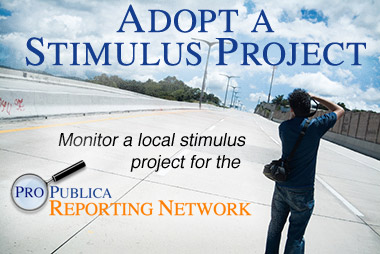
Adopt-A-Stimulus-Project

Hot Topics:

Adopt-A-Stimulus-Project

We need your help in watching stimulus projects nationwide

It is never too early to start watchdogging one of the largest spending bills in U.S. history – the American Recovery and Reinvestment Act of 2009. It includes $27 billion to repair America’s roads and bridges.

Monitoring thousands of construction sites around the country is an impossible task for a single reporter. Or a handful of reporters. That’s why we need your help.

Search for stimulus projects in your state below, then pick one to monitor over the next few months. We’ll send you suggestions and tips on how to watchdog your project. Use this form to send us reports (we'll also send you a link to it by email when you sign up).

Email Amanda Michel at amanda@propublica.org for more information. If you don’t see a project in your area join ProPublica’s Reporting Network; we’ll notify you when projects get started in your county.

Your State: Alabama Alaska Arizona Arkansas California Colorado Connecticut Delaware District of Columbia Florida Georgia Hawaii Idaho Illinois Indiana Iowa Kansas Kentucky Louisiana Maine Maryland Massachusetts Michigan Minnesota Mississippi Missouri Montana Nebraska Nevada New Hampshire New Jersey New Mexico New York North Carolina North Dakota Ohio Oklahoma Oregon Pennsylvania Puerto Rico Rhode Island South Carolina South Dakota Tennessee Texas Utah Vermont Virginia Washington West Virginia Wisconsin Wyoming

88 results were found for Wisconsin check out your state.   Click on the column heads to sort at:  http://www.propublica.org/special/adopt-a-stimulus-project

Posted:  Knowledge Creates Power

Friday, March 13, 2009

Broken Earmark Promises

Wednesday -- behind closed doors -- President Barack Obama signed his 2009 Omnibus spending package, calling it an "imperfect" bill. With 8,570 disclosed earmarks worth $7.7 billion "imperfect" is an understatement.

It's bad enough that our president was in an irresponsible rush to spend hundreds of billions with his "stimulus" package ($787 billion), and soon $350 million in the second half of the TARP funds, $32 billion -- at least -- for his new SCHIP program, and now $410 billion in his "imperfect" omnibus bill, but on top of that, he's been dishonest.

Just two weeks before Obama took office he told reporters that his plans would set a “new higher standard of accountability, transparency and oversight. We are going to ban all earmarks.”

On the campaign trail, ironically almost a year ago today, Obama co-sponsored an amendment that would establish a one-year earmark moratorium for 2009 (the bill failed to pass).

“We can no longer accept a process that doles out earmarks based on a member of Congress' seniority, rather than the merit of the project," Obama said. "The entire earmark process needs to be re-examined and reformed.”

“I pledge to slash earmarks by more than half when I’m president of the United States of America,” said Obama again on the trail in September.

During a debate with McCain in Mississippi, Obama famously said “Absolutely we need earmark reform, and when I’m president I will go line by line to make sure we are not spending money unwisely.”
Obama’s entire campaign was formed around the mantra of hope and change, “earmark reform” came out of his mouth almost as often as “um.”
And then, in his sort-of State of the Union address drum roll… “I’m proud that we passed a recovery plan free of earmarks” said Obama.

“There was just a roar of laughter -- because there were earmarks,” ultra liberal Sen. Claire McCaskill, (D-Mi) told reporters. Actually, there were bunches, gobs of them. 
So define earmark? The Washington Post writes that none of the items in the recovery package “are traditional earmarks -- funding for a project inserted by a lawmaker bypassing the normal budgeting process -- according to the White House and Democratic leaders.”

Though the Post did report that despite pledges, the recovery package did have pork in it. No “earmarks” but “pork.”

Republicans were responsible for stripping the bill of some of its most wasteful spending (the best definition). $1.7 million for a honey bee factory, $20 million for the removal of fish passage barriers, and $300 million for “green” golf carts, just to name a few. (Republican earmarxists were responsible for others that are arguably just as bad.)

"I know that there are a lot of folks out there who've been saying, 'Oh, this is pork, and this is money that's going to be wasted,' and et cetera, et cetera. Understand, this bill does not have a single earmark in it, which is unprecedented for a bill of this size. … There aren't individual pork projects that members of Congress are putting into this bill," said Obama.

Tomato, tomahto, “earmark” or “pork” … Let’s call the whole thing off; it’s unnecessary spending of our tax dollars.

The day after Obama’s address to the nation, the House passed another $410 billion spending bill with 8,570 disclosed earmarks, and Obama signed the bill despite all the earlier promises.

$52.1 million for Vice President Joe Biden’s earmarks as a senator from Deleware, $8.3 million for Rahm Emanuel as a House member from Illinois, and Transportation Secretary Ray LaHood, formerly a Republican congressman from Illinois, $26.5 million --  just to name a few.

So what does the Obama administration say now?

"We want to just move on. Let's get this bill done, get it into law and move forward," Budget Chief Peter Orszag told reporters.

“That's last year's business,” said Obama Chief of Staff Rahm Emanuel.

And why, precisely, do we believe that next year would be any different?

by Michelle Oddis, Assistant Managing Editor at HUMAN EVENTS

Related Articles: 

Tuesday, February 17, 2009

Stimulus Verdict: A $3.27 Trillion Porker

The gargantuan stimulus bill Congress has rubber-stamped with virtually no Republican support contains tens of billions of the very spending projects that made the legislation a lightning rod for criticism.

And although the bill is generally described as costing $787 billion, the Congressional Budget Office reports the actual figure is now closer to $3.27 trillion.

That stems from the $744 billion it will take to pay for the additional debt the legislation will create, and $2.527 trillion in increased spending from the new and expanded programs the bill will spawn over the next decade.

To view the letter to Nancy Pelosi, go here.

The bill now spans more than 1,000 pages. While Democrats removed some provisions that fiscal conservatives objected to, most of the pork remains. Among them:

  • The plan has more than $3 billion in “neighborhood stabilization” and Community Development Block Grant funding, much of which may go to benefit ACORN, a low-income housing and voter registration “community” organization that is under federal investigation for its suspicious voter registration practices.
  • $1.3 billion to bailout AMTRAK, the perennial money-loser railroad.
  • $1 billion for educational programs, including courses on sexually transmitted diseases.
  • $30 million for restoration of wetlands to be spent in the San Francisco Bay Area – House Speaker Nancy Pelosi’s district. The money will go in part to protect the endangered salt marsh harvest mouse.
  • $200 million for a low-pollution, coal-fired power plant in President Barack Obama’s home state of Illinois.
  • $45 million for ATV four-wheeler trails, and government office renovations, according to RNC Chairman Michael Steele.
  • $200 million to provide computers to community colleges.
  • $50 million for the National Endowment of the Arts.
  • Over $650 million in coupons to help consumers buy digital TV converter-box coupons.
  • A reported $300 million for hybrid vehicles and electric-powered cars. According to the Washington Times, this item will include buying golf carts for federal workers.

    GOP Sen. John McCain summed up his view of the bill: “This measure is not bipartisan. It contains much that is not stimulative.”

    Some of the criticisms of the bill, however, center on policy rather than cost.

    The Heritage Foundation, for example, reports the bill reverses the bipartisan welfare reforms achieved during the Clinton administration.

    Also, opponents have slammed the bill for being “anti-religious,” because it expressly prohibits the use of stimulus funds for faith-based schools, schools of divinity, facilities used for “sectarian worship,” or places of religious worship.

    Saturday, February 14, 2009 9:40 AM
    By: David A. Patten © 2009 Newsmax

    The Dems rushed the vote on this bill pushing the urgency button.  Then we find out that Pelosi and 7 other Dems virtually immediately headed to the airport to board military taxpayer paid planes to Italy... on a so called working trip?!?  We also see that after not allowing the members of either the House of Senate to read "the Bill" because of the "so-called" urgency, President Obama waits four days to sign "The Bill" today, Tuesday, so that the White House can make it another media event...  Sounds a bit odd... or maybe not!?!

    Hmmm... are we being had?  You betcha!  $3.27 trillion that will put our children and grandchildren into debt... for a bill that nobody really knows what it contains and that experts are saying more and more will give us... Main St or the little guy, very little for the cost... and probably won't work.  And all the while after incurring a $3.27 trillion dollar debt the President has asked the military, fighting two wars, to cut their budget by 10% when they have projects stacked up and needs that would produce immediate jobs that could stimulate the economy.

    "They" also don't want us to be side-tracked by the facts... like both John McCain and Mitt Romney had actual 'Stimulus Bill" options that would have cost us half the money and created double the jobs and quicker  Wow, what a concept.

  • Friday, February 13, 2009

    Stimulus Bill Passes in House of Representatives Without a Single Congressperson Having Read the Bill...

    There is really nothing that can be said to that action... if you have even an ounce of common sense!!

    We have just passed a trillion-dollar Stimulus Bill in the House of Representatives that 'nobody' is sure will work and most people are doubtful or flat think it can't work and will bankrupt our children and grandchildren. Yet no Congressman or Senator has read it or understands it.  The Bill grew overnight from an 800 plus page bill to almost an 1100 page bill and nobody knows what has been added in those 300 pages or what was removed.   And the entire process in the House of Representatives was hurried along instead of slowed for consideration and review by the leader of the House, Nancy Pelosi, so she can go on her European Vacation and protect the pork, both added for herself and friends like Harry Reid.  It should be noted that the Bill was passed in the House without a single Republican voting for it.

    Everyday we find out more and more about how there is no record of  how the first half of the TARP money, the previous bailout bill, that has already been dispersed was spent and how what is trackable of that TARP money was used to bail out banks that should have been allowed to fail.  Not a penny of that money has trickled down to Main Street and the new partnerships have just given the National Government more and more power, putting us on the road to socialism.  And if any of you think this is the right road, perhaps you should review the "state" of Great Britain after Tony Blair. 

    Now the Stimulus Bill, re-named by most as the 'Spending Bill', is in the Senate, where it is expected to pass with the votes of only three Republican Senators, whose motives and incentives are questionable.  The Obama administration is supplying a special plane to a Democratic Senator dealing with personal problems in order to guarantee their desperately needed 60 votes, hardly a bipartisan bill or even an Obama or Democratic victory.

    Last week Obama promised there would be no earmarks in the Spending Bill, now we hear there are many that will not create any new jobs, plus there are many many pet projects, like the Fantasyland Express, packed into this massive un-reviewed bill that has been repackaged several times, including behind doors by the light of last night's mid-night oil, leaving no time for a review.  In this computer age bills are normally provided to the members of the House and Senate as a computer file that can be easily searched, but not this time.  They got it at the last minute, old school... 1100 printed pages.  Any flags there??  And is anyone yelling "waste of paper"  "tree killers" or what happened to "go-green"?  Certainly not your usual Dems! 

    The Republican Plan... both John McCain's and Mitt Romney's would cost half of this present bill and would create double the jobs... and much more quickly, yet the Democrats would only have it their way.  If this Bill turns out to be the fiasco that it promises to be, it will destroy the United States as we know it.  Even if it were a success, in three weeks after Obama's Inauguration, we have become a socialistic Country.  And although there will be no joy is saying "I told you so..."  the responsibility for the outcome of this mis-guided and hurried through plan will fall completely on the Democratic Party and President Obama.

    Somewhere in the chanting and search for hope and change, we have lost our common sense, our values and our principles.  Let us hope we don't lose all our rights before we come back to our senses.

    By:  Marion Algier

    Join Glenn Beck's WE Surround Them...

    Glenn Beck: Pelosi rushes vote so she can go on 8-Day European Vacation

    GLENN: Representative John Culberson of Texas claims the stimulus bill must be urgently voted on today because speaker Nancy Pelosi is leaving at 6:00 p.m. for an eight-day trip to Europe. No way. Get him on the phone. Get Culberson on the phone. Pelosi is hoping to lead a delegation to Europe. There she is with the Pope getting an award from an Italian legislative group. Calls to Pelosi went unreturned. Democrats have now broken their promise to have the public see the proposed bill for 48 hours before any vote. I believe, um, this is obscene. I believe Obama said that five days, that he would make things public before they would be turned into law. Senator Frank Lautenberg, democrat from New Jersey, predicted that none of his Senate colleagues would have a chance to read the final version of the bill before it comes up for the final vote. Here it is, 1,071 pages. None of his Senate colleagues would have the chance. This is obscene. There is no emergency that is so important that we pass this without reading it. There is absolutely no excuse! You know what? You call up your congressman, you call up your senators today. I swear to you, you might want to vote for it, you can wait. Nancy Pelosi can wait. You can wait until you've had a chance to read the damn thing! Who in their right mind would do this in business? Who in their right mind would do this with your own home? Damn it, it is our country! Who are these alien life forms? How fast do they have to read it? If they're going to vote today, they have to read 640 words per minute. Now, I'm going to show you, I'm going to read a page of the stimulus package and I'm going to show you how I would have to read it. Now, I'm not the sharpest knife in the drawer, but I'm guessing there are some people a little less bright than me in congress. This is the way that I would do it. I would assemble my team, stu, we would have what, I would have my, you know, my aides around me, I guess. I got Joe, who is one of the smartest legal guys, so you can speak legalese.

    STU: Right. And this is 150 words here.

    GLENN: Only doing 150 words. Here we go. And I'm supposed to read 640 words per minute to be able to read this whole thing and get to the vote and have read it.

    STU: And so Nancy Pelosi can catch her plane.

    GLENN: There's no way, there is no way that's true. There is absolutely no way.

    STU: She's getting an award, though.

    GLENN: You ready? Stu, you're going to time me?

    STU: Yes.

    GLENN: Okay. You time me for a minute.

    STU: See how long it takes you to read these 150 words.

    GLENN: Okay, all right. Let me know when we hit a minute and we'll just keep going. Ready? Go. 37, watershed rehabilitation program, for an additional amount for watershed rehabilitation program, let's just assume I'm a regular person and I don't know what the watershed rehabilitation, can you find out what the watershed rehabilitation program is please? $50 million, have to count the zeros, for necessary expenses to carry out rehabilitation of structural measures. What does that mean, Joe? Necessary expenses to carry out rehabilitation of structural measures? Buildings and stuff?

    JOE: That could be dams, bridges, any structure.

    GLENN: Provided that section 1106 of this act shall not apply to this appropriation. Can you find out what section 1106 says?

    JOE: And at this time, the congressman or senators are getting an aide to go get that section because they don't know either.

    GLENN: Okay. Provided further that priority in the use of such funds shall be given such projects. [Buzzer]

    STU: That's one minute.

    GLENN: Provided further that the priority in the use of such funds shall be given to such projects that can be fully funded and completed with the funds appropriated in this act. So in other words, as long as it can be completed with the money that is in here, that project gets a priority. Right? Okay. And to activities that commence promptly following the enactments. Or if you can at least start it right away, correct?

    STU: Or both.

    GLENN: Okay. Rural development programs, rural community advancement program, including transfers of funds. For an additional amount of gross obligations for the principal amount of direct and guaranteed loans as authorized by sections 306 and 310-B, and described in sections 381 ED-1, 381 ED-2 and 381 ED-3. [Buzzer]

    STU: That's two minutes.

    GLENN: Of the consolidated, hang on, I don't even know, for an additional amount of gross obligations. So in other words, what is obligations? Understand how that word's being used. For an additional amount of gross obligations. Are they saying for an additional amount of money not in this act.

    JOE: Right, if you can start the project and finish the project with the moneys allocated, that's fine, but there will still be long-term costs that are not operational costs.

    GLENN: Okay, I see. Gross obligations for the amount of principal and direct guaranteed loans as authorized, find out what's in 306, 310, 381 ED-1, 2, and 3, of the consolidated farm and rural development act, what the hell is that? To be able from the rural community advancement program as follows, $5,838,000,000, zero, zero, zero.

    STU: Right. And conveniently timed. [Buzzer] That's 3 minutes. Again, you didn't resolve any of the questions that you have.

    GLENN: No, I just have questions.

    STU: You just have questions like what are these act that we're spending $5 billion on. You have not allocated in your mind whether that's a good thing or a bad thing, you at least know you have to check them. That's not how you actually need to read the bill because you need to get the answers, check them, and come back and say, yes, this is good or this is bad.

    Glenn Beck is seen here on the Insider Webcam, an exclusive feature available only to Glenn Beck Insiders. Learn more...

    GLENN: Now, let me try to read those hundred words, how fast do I have to read those hundred words.

    STU: It's 150 words. You'd have to read it in about --

    GLENN: 10 seconds?

    STU: 12 seconds.

    GLENN: 12 seconds, okay. So I want to read before I vote, if I want to read this bill, I can't even read this in 12 seconds.

    STU: You haven't tried. Just read it as fast as you can.

    GLENN: Ready? Tell me when to go.

    STU: Three, two, one.

    GLENN: [reading fast] Provided that section 1106 of this act shall not apply to this proposeration --

    STU: Stop.

    GLENN: I'm two sentences in.

    STU: What's the word you got to here?

    GLENN: Provided further. Let me try to read it faster. I'm on line 5 of 24. You have it?

    STU: Yeah, ready? Three, two, one.

    GLENN: [reading fast] Provided that section 1106 of this act shall not apply to this appropriation. To begin projects... [Buzzer] There's no way. There's absolutely no way to read this. I mean there's no way to read this.

    STU: The fastest you read there, I don't know, it seems like about a third as fast as you'd need to read it.

    GLENN: Dan, can you take what I just did and speed it up, take what I read the act, I read it to the $5 trillion last hour and I read it quickly, but not really, really fast.

    STU: Right. You did 150 words in about a minute there.

    GLENN: That was the first time I read it. In fact, Dan, can you just play it at normal speed here on what I did last hour, when I just read it at normal speed? Because I was reading it cold just like somebody would, you turn the page, and here you read it cold. Here you go.

    GLENN: For an additional amount of watershed rehabilitation program, $50 million for necessary expenses to carry out rehabilitation of.

    STU: Stop.

    GLENN: Okay. I'm not reading it slowly. Now, can you cut that, it needs to be 12 seconds, so cut that to 30 seconds. Dan: Okay.

    GLENN: [reading fast - unintelligible]

    GLENN: That's 30 seconds. Can you get it, will the computer take you down to 12 seconds?

    DAN: The computer actually does not let me take it down to 12 seconds. It won't even go that far.

    GLENN: It won't time compress, it will not allow, the computer will not allow this amount to be compressed into 12 seconds. What's as fast as you can get it?

    DAN: The fastest it will go is 15 seconds.

    GLENN: Run 15 seconds. [reading fast - unintelligible]

    GLENN: Oh, okay. I got it. How about you? You ready to vote?

    STU: And you only have to do that for, you know, the whole night.

    GLENN: Yeah. You only have to do that from 7:00 p.m. to 9:00 a.m., straight, no potty breaks, nothing.

    STU: If you kept your laptop with you, you could keep scrolling while you were going to the bathroom maybe.

    GLENN: It's obscene, it's obscene. This is the change we were looking for? This is the change? Where are the damn democrats? Where are the good American democrats? You want to pass this thing, pass it! But know what's in it. Where are all the people that were screaming about the patriot act? Screaming? You people, look, democrats, I'm begging you, you know this isn't a stimulus package, fine. Fine. You want to roll back the, you want to roll back all the Clinton welfare stuff, fine, roll it back. But know what else is in it. We are just handing our sovereignty over. People say character doesn't matter. Yes, it does. This is why character matters. Because anyone can character would say, wait a minute, this is the future of our country. Anyone with character would say I don't care what my own party says, I wouldn't care what Nancy Pelosi says, I don't care. I'm reading it. I was sent here to do a job. And that is to represent the people in my district. And I can't represent them, I can't look them in the eye and say, well, okay, I just passed it, it was a hurry. You vote no! Even if it doesn't mean it stops it, you vote no! This is obscene. I tell you, I'm, I'm, George Washington would call us enemies of the state. George Washington would call us enemies of the state. He would. Here was the indispensable man, here was a man full of honor, here was a man who stepped down. Here was a man who said no. It's Mr. President. They wanted to make him king. Whose liberty are you just throwing around? Whose liberty are you just treating with such disregard? Mine, yours, our children's. These guys have a sacred responsibility to protect us. To protect the constitution of the United States. They can't even read it fast enough! The largest bill ever? The last huge stimulus bill was how much? This is, this dwarfs everything. We have found so many things in it at the last minute, all of a sudden, health care, universal health care, where we're telling our seniors that there are some things you're just going to have to get used to, universal health care czars are tucked into this thing? We've got, what was it, 20 or $30 million for the salt marsh mouse in Nancy Pelosi's district? How dare you? How can you sleep at night! Some of us, some us actually care about our country. And I will not hear, I will not accept any, no more, I will not accept hearing anyone say how dare you tell me I don't love my country. You can vote for this bill and love your country. but you can't vote for this bill if you haven't read the damn bill and love your country! You love your party over country. And I'm tired of it. I am tired of the republicans, I am tired of the democrats. George Washington told us that these two parties, he was against the two-party system. He said it would be the death of us. You got to get yourself away from these parties. That's not me. That's George Washington. Well, now we see how far ahead of his time he was. We don't need a third party. We need Americans that may disagree, that vote for the stimulus package and against the stimulus package, but agree that they need to read the damn bill first. Boy.

    STU: Don't try and act like the founders read the entire Declaration of Independence before they signed it.

    GLENN: These people put their lives, their fortunes, and their sacred honor, these people in Washington, some of these people don't even have sacred honor, wouldn't recognize it if it came up and slapped them across the face. And believe me, sacred honor would slap a lot of these clowns across the face. Their lives? They would never put their lives on the line for this constitution, they'd never put their -- you're going to put your life, you are signing this bill, you might as well be putting your life on the line for the country. You better know what the hell is in it. Because -- the CBO says it's going to make things worse. You might say it makes things better. Well, you better damn well know. Just the arrogance.

    STU: Glenn, we have to stop here for a break. But just before you do, think about this for a minute. Did George Washington ever get an award from an Italian legislative group?

    GLENN: No, he didn't.  But he would have probably left before the vote. I can't read this whole declaration thing. Constitution, whatever. You know what, John? Just sign big, so my name, you know, there's no room for me in there? I got to go. I'm getting an award tonight.

    Last Night as of 11PM EST nobody even had a copy of this disaster to review, even if they were willing to stay up all night with a full staff and try to read it.  Now Pelosi is pushing for an immediate vote so she can go on a European vacation.  Call your Congress Representatives, Senators and the White House now!!  Stop this bill !!  Look at the Republican plan (McCain's or Romney's);  Half the cost and creates double the jobs.  Or consider doing nothing at all and let the economy right itself.  The average recession only lasts 18-months... we are halfway there and nobody thinks bankrupting our grandkids is going to help! Just look at the TARP fiasco and the same people are running and managing this…

    Keep up on the latest at:

    http://www.glennbeck.com/

    http://dailythoughtpad.blogspot.com/

    http://knowledgecreatespower.blogspot.com/

    Thursday, February 12, 2009

    E-Verify Stripped from Stimulus Bill

    Vote Below:
    American Workers Over Illegal Aliens
    or
    Illegal Aliens DESERVE Stimulus Jobs
     

    everify

    OUTRAGE?

    Congress Strips E-Verify Requirement from Stimulus

    Allows Illegal Aliens to Receive BENEFITS AND JOBS from Stimulus Bill!!

    Is This What You Want?

    The American worker has been betrayed by the Leadership in Congress and the White House, along with the Chamber of Commerce! The E-Verify program would have kept illegal aliens from receiving jobs created by the Stimulus Bill. Unfortunately it was stripped from the final bill behind closed doors!

    The E-Verify program is a quick 99.6% accurate tool that keeps illegal aliens out of U.S. jobs..

    The Chamber of Commerce is winning the right to hire illegal aliens at the same rate as in the past, and to use OUR TAX DOLLARS in the Stimulus to do it! Even though an overwhelming majority of U.S. citizens favor worker verification, our government continues to side with illegal aliens over legal workers!

    What Is YOUR Opinion?
    VOTE IN OUR INSTANT POLL

    or
    REMOVE E-Verify from Stimulus Bill

    (When you Click Your Answer above, you'll be taken to a web page
    where you will see INSTANT RESULTS. You will also be able to take action if you wish.)

    Join with 883,593 citizens who make their voices heard through
    NumbersUSA, America's largest-member immigration-reduction organization.

    We are non-profit and non-partisan.