GBTV - Where the Truth Lives

Election Season 2014

And it has brought us to this trainwreck called ObamaCare and we have bankrupted our kids and grandkids!

We are now headed into the 2014 Election Season and common sense and conservatism are on the rise. Please stand-up and be counted!

Reading Collusion: How the Media Stole the 2012 Election is a great place to start!

The Founding Father's Real Reason for the Second Amendment

And remember the words of Thomas Jefferson "The strongest reason for the people to retain the right to keep and bear arms is, as a last resort, to protect themselves against tyranny in government." See Video of Suzanna Gratia-Hupp’s Congressional Testimony: What the Second Amendment is REALLY For, below (u-tube HERE).

The Leaders Are Here... Palin, Cruz, Lee, Paul, Chaffetz....

T'S A WONDERFUL LIFE

Can You Really Still Believe That None of These People Would Have Done a Better Job???

Bloggers' Rights at EFF

SIGN THE PETITION TODAY...

Showing posts with label Earmarks. Show all posts

Thursday, December 16, 2010

The Day the Dollar Died

Our Future:  If We Don’t Stop Spending and Tighten Our Belts… Everywhere!!

Video:  The Day the Dollar Died

GOP Slams 6,000 Earmarks in Trillion-Dollar Omnibus Spending Bill

By David A. Patten  -  Wednesday, 15 Dec 2010 02:14 PM

Republicans are blasting a last-ditch Democratic effort to pass a massive spending bill laden with about 6,000 earmarks as a “smack in the face to taxpayers.”

Senate Minority Leader Mitch McConnell fired away at the bill from the floor of the Senate, saying it “repeats all the mistakes voters demanded that we put an end to on Election Day.”

“Americans told Democrats last month to stop what they’ve been doing: bigger government, 2,000-page bills jammed through on Christmas Eve, wasteful spending.”

Most Democrats are rallying around the bill, however, seeing it as perhaps their last opportunity to get pet spending projects passed before the 112th Congress takes office. In both the House and Senate, incoming Republicans have agreed to ban earmark requests.
Senate Majority Leader Harry Reid of Nevada praised the 1,924-page, $1.1 trillion spending bill Tuesday as “a very good piece of legislation.” Reid hopes to bring the bill up for a vote this week. House Democrats would vote on it on Saturday.

Steve Ellis, vice president of Taxpayers for Common Sense, tells Newsmax that virtually no member of Congress has time to read the massive omnibus legislation. Even worse, he says, is that the joint explanatory statement that explains the specifics of the spending request has not yet been published, he says. That document will be more than 1,000 pages as well.

“That’s how you actually find out how the money have been sliced and diced across the various programs and accounts,” Ellis says. “It’s clearly not going to be made available to the public much before the Senate votes on it, and we’re all being asked to buy a $1.1 trillion pig in a poke.

“They had all year to get this thing done, and done in a manner that was at least partially intelligible to the public and to the budget watchers,” Ellis tells Newsmax. “Instead, we have this enormous sausage that they’re trying to stuff through, really virtually sight unseen.”

Republicans say they will push for a continuing resolution in place of the huge omnibus bill. But the GOP push to stop the bill may fall short because of  defections from within their own caucus.
Republican senators such as Kit Bond of Missouri and Bob Bennett of Utah don’t have to worry about running for re-election. Both sit on the Senate Appropriations Committee that crafted the omnibus.
“This is exactly the kind of secretive, pork-laden, massive spending bill that’s driven approval of Congress to an all-time low, and induced a voter rebellion last month,” Brian Riedl, lead budget analyst for the Heritage Foundation, tells Newsmax.

harry,reid,earmarksLegislative experts say the omnibus bill reflects the inability of Congress to fund government operations in an efficient manner.

Because the 111th Congress was unable to pass a spending bill in a timely way, Democratic strategists rolled 12 separate bills into one omnibus measure.

Keeping everything in one bill makes it more difficult to excise specific provisions that legislators find objectionable. But it also results in a mammoth piece of legislation that may go unread until months after the bill becomes law.

Unsatisfied with the simple continuing resolution the House passed that would keep the government running until the next Congress takes over in January, the Senate is proposing the earmark-laden omnibus as one last spending hurrah before legislators leave town. Grass-roots conservatives are particularly angry that the bill includes $1 billion to fund the healthcare bill that may be unconstitutional, based on a judge’s ruling in Virginia this week.

Because the authorization for government spending is expiring, Republicans could be accused of shutting down the government if they are able to block the omnibus bill. But GOP senators say they would be happy to vote for a continuing authorization such as the one already passed by the House.

Among the 6,000 earmarks the media has uncovered so far in the massive legislation the Senate is trying to push through just weeks after Democrats sustained their work landslide of the post-World War II era:

  • Literal pork: Almost $350,000 is earmarked to study the management of swine waste in North Carolina.
  • $235,000 for the management of invasive weeds in Nevada.
  • $300,000 for the Polynesian Voyaging Society in Hawaii. Founded in 1973, the society sails a “voyaging” boat throughout the Pacific, studying how ancient Polynesian people settled far-flung lands.
  • Funds are devoted to a variety of agricultural needs, including research of maple syrup in Vermont, control of potato pests in Wisconsin, the development of virus-resistant grapes in Washington state, and peanut cultivation research in Alabama.
  • $80 million for states and Indian tribes to pay for preservation of Pacific salmon.
  • $13 million for clean-water initiatives in rural villages in Alaska.
  • $450,000 for the World Food Prize.
  • $500,000 for the Edward M. Kennedy Institute.
  • $200,000 to install solar panels at a food bank in Arizona.

If the bill passes Congress, it would be up to the president to decide whether to accept it.

Incoming House Speaker John Boehner, a longtime foe of the earmark practice, signed onto a letter last week asking Obama to veto the measure. Boehner issued a statement on Tuesday blasting the bill as a “smack in the face to taxpayers.”

There are two provisions in the bill that Obama may oppose. One would effectively block civilian trials of Guantanamo Bay prisoners in the United States, while another would allocate $450 million for development of a second engine for the F-35 Joint Strike Fighter. Defense Secretary Robert Gates has said he will urge the president to veto any bill that contains money for a second engine, which the Pentagon says it does not want.

In what some saw as a statement suggesting the president would be reluctant to veto the bill, White House press secretary Robert Gibbs said Tuesday:

“Obviously one of the things that has to be done before Congress leaves is how we’re going to pay for the operation of government going forward.”
GOP Sen. Jim DeMint of South Carolina is threatening to mount a filibuster, and may insist that all 1,924 pages of the bill be read into the record before any vote is taken.

U.S. to have Highest Corporate Tax Rate in the World

Posted December 15th, 2010 at 5:00pm in Entitlements 6Print This Post Print This Post

Most of the time being number one is good. But when it comes to having the highest tax rate in the world, it is much better for a country to be bringing up the rear.

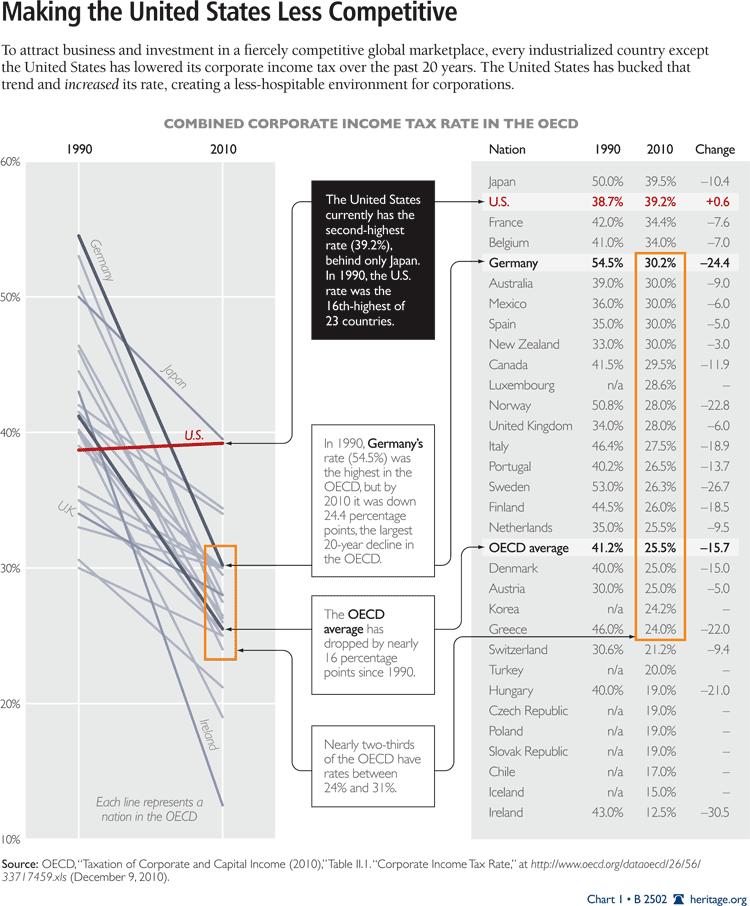
Currently Japan holds the inauspicious distinction of having the highest corporate income tax rate in the world (39.5 percent). The United States is a close second, only a few tenths-of-percentage points behind.

Japan will soon fall from the top spot because it has finally recognized what the rest of the industrialized world realized over a decade ago: A low corporate income tax rate is vital for economic growth in the global marketplace. As such, Japan just announced it will reduce its corporate income tax rate by 5 percentage points down to around 35 percent. This remains far above the 25 percent average rate of other industrialized countries, but for them it is a start.

Japan’s reduction will leave the U.S. in the uncomfortable position of having the highest corporate income tax rate in the industrialized world. Hopefully Congress will finally see fit to lower the rate now that we will hold that disreputable title.

The U.S. ended up at the top because it stood still while the rest of the world was cutting its rates. As the chart below shows, in 1990 the U.S. corporate tax rate was middle of the pack. In fact, it was lower than the global average. The years since have seen every other industrialized country aggressively lower its rate.

The top marginal corporate income tax rate is an important factor influencing economic growth and job creation, because it determines how much the tax will reduce the return the business earns from new investment. As a result, it is a large determinant when businesses decide where to locate their next venture—and where they will hire new employees.

The high rate in the U.S. is driving businesses and jobs to other countries. Those jobs will continue to flow to other countries if the U.S. insists on levying its self-defeating corporate income tax rate. It is long past time forCongress to lower the rate so it is equal or below the 25 percent average of our competitors. If it does not, businesses and jobs will continue their exodus to more friendly locales.

The Heritage Foundation  -  The Foundry

Ron Paul – Federal Reserve is a ‘Cartel’

Tuesday, February 23, 2010

Obama racks up list of broken promises

Posted: March 12, 2009 - 11:30 pm Eastern

By Chelsea Schilling © 2010 WorldNetDaily

After only two months in office, President Obama may have fallen short on a number of his campaign promises.

As a candidate, he promised to allow public comment before signing bills, eliminate capital gains taxes for small businesses, provide tax credits to businesses for hiring new employees, allow Americans to withdraw funds from 401(k) and retirement accounts without penalties, ban lobbyists from serving in his administration, reform earmarks, bring all combat troops home from Iraq in 16 months, sign the "Freedom of Choice Act," give Americans $4,000 in credits for college and run a "transparent" administration.

However, after giving his word to the American people on so many issues, Obama has yet to fulfill many commitments.

WND has compiled the following extensive list of those abandoned promises:

Broken promise No. 1: 'Sunlight Before Signing'

When Obama campaigned for the Democratic presidential nomination in Manchester, N.H., on June 22, 2007, he announced his "Sunlight Before Signing" promise.

"When there is a bill that ends up on my desk as the president, you the public will have five days to look online and find out what's in
it before I sign it," he said.

He repeated that promise on his campaign website:

"Too often bills are rushed through Congress and to the president before the public has the opportunity to review them. As president,
Obama will not sign any non-emergency bill without giving the American public an opportunity to review and comment on the White House website for five days."

However, Obama signed his first bill, the Lilly Ledbetter Fair Pay Restoration Act, on Jan. 20 – only two days after its passage.

He signed a second bill expanding the State Children's Health Insurance Program just three hours after Congress passed it.

Again, on Feb. 17, Obama signed his 1,000-page $787 billion stimulus aimed at jolting the declining U.S. economy. He did so only one business day after it passed through Congress – without allowing for five days of public comment.

Broken promise No. 2: Capital gains tax elimination

According to his comprehensive tax plan released during his campaign, Obama promised to "eliminate capital gains taxes for small businesses."

Just weeks prior to the election, Obama advisers Austan Goolsbee and Jason Furman told the Wall Street Journal that Obama planned tax cuts that included "the elimination of capital gains taxes for small businesses and start-ups."

People who invest in small businesses have only been allowed to exclude 50 percent of that gain from capital gains taxes. While Obama's $787 billion economic-stimulus package reduces that tax liability – raising the exclusion to 75 percent – it does not eliminate it.

Broken promise No. 3: New American jobs tax credit

During his transition, Obama's promised to provide a $3,000 refundable tax credit to existing businesses for every additional
full-time U.S. employee hired in 2009 and 2010.

"If a company that currently has 10 U.S. employees increases its domestic full time employment to 20 employees, this company would get a $30,000 tax credit – enough to offset the entire added payroll tax costs to the company for the first $50,000 of income for the new employees," the transition website stated. "The tax credit will benefit all companies creating net new jobs, even those struggling to make a profit."

Obama's promise was never included in the stimulus package.

Broken promise No. 4: Hiatus on 401(k) penalties

Many unemployed and financially strapped Americans have considered early withdrawals on 401(k) and retirement accounts to
survive the current recession. However, the IRS imposes strict penalties of up to 10 percent plus federal, state and local income taxes on such advances.

Workers who have taken $10,000 in early withdrawals from retirement plans have lost as much as 40 percent to taxes and penalties, depending upon tax brackets.

In October 2008, Obama released his "Rescue Plan for the Middle-Class" in which he promised to allow financially distressed Americans to withdraw up to $10,000 from their 401(k) accounts and retirement savings without having to pay penalties. They would only pay income taxes on the amount.

"Since so many Americans will be struggling to pay the bills over the next year, I propose that we allow every family to withdraw up to 15% from their IRA or 401(k) – up to a maximum of $10,000 – without any fine or penalty throughout 2009," Obama said. "This will help families get through this crisis without being forced to make painful choices like selling their homes or not sending their kids to college."

However, Obama's promise was never included in his recent stimulus package.

Broken promise No. 5: 'No jobs for lobbyists'


William J. Lynn III

Obama promised America he would loosen the grip of lobbyists on Washington.

In his Nov. 10, 2007, speech in Des Moines, Iowa, Obama declared:

I am in this race to tell the corporate lobbyists that their days of setting the agenda in Washington are over. I have done more than any other candidate in this race to take on lobbyists — and won. They have not funded my campaign, they will not run my White House, and they will not drown out the voices of the American people when I am president.

During his campaign, Obama also said, "I have done more to take on lobbyists than any other candidate in this race. I don't take a dime of their money, and when I am president, they won't find a job in my White House."

However, USA Today reported Obama's campaign fundraising team included 38 members of law firms that were paid $138 million in 2007 to lobby the federal government.


William Corr

"Those lawyers, including 10 former federal lobbyists, have pledged to raise at least $3.5 million" for Obama's campaign, the report states. "Employees of their firms have given Obama's campaign $2.26 million."

It wasn't long before he allowed at least two dozen exceptions and broke his promise.

Obama's own ethic rules barred officials of his administration from lobbying their former colleagues "for as long as I am president." He also said former lobbyists would be prohibited from working for agencies they had lobbied within the past two years. President Obama later waived his rules for at least two of his nominees – William J. Lynn III, undersecretary at the Department of Defense and recent lobbyist for Raytheon, and William Corr, deputy secretary for the Department of Health and Human Services and anti-tobacco lobbyist for the Campaign for Tobacco-Free Kids.

Broken promise No. 6: Earmark reform

As WND reports, at the first presidential debate in Oxford, Miss., Obama declared, "[W]e need earmark reform. And when I'm president, I will go line by line to make sure that we are not spending money unwisely."

However, in February, Obama passed his $787 billion stimulus aimed at jolting the declining U.S. economy. Before a joint session of Congress, Obama declared: "Now, I'm proud that we passed a recovery plan free of earmarks."

Some chuckled in amusement when he claimed the bill contained no pork.

"There was just a roar of laughter – because there were earmarks," Sen. Claire McCaskill, D-Mo., told CNN.

U.S. News & World Report found at least eight earmarks in his
stimulus bill.

Obama also signed a $410 billion omnibus bill for 2009. More than9,000 earmarks in the spending bill total an estimated $7.7 billion.

Even though the Democrat-controlled Congress crafted the bill after Obama's election, the administration claims the added pork is just "unfinished business" from last year.

The White House website states, "Obama and Biden will slash earmarks to no greater than 1994 levels and ensure all spending decisions are open to the public." However, watchdog group Taxpayers for Common Sense reports that the omnibus pork alone already totals $7.7 billion – just less than the total of $7.8 billion in earmarks in 1994 – and the figure does not include $6.6 billion in earmarks contained in three previous spending bills Congress passed amid the bailout crisis last year.

During his three years in the Senate, Obama requested more than $860 million in earmarks, according to the group. White House Chief of Staff Rahm Emanuel has 16 earmarks – worth approximately $8.5 million – in the bill.

Broken promise No. 7: Bring troops home in 16 months

On his campaign website, Obama promised he would "remove one to two combat brigades each month, and have all of our combat brigades out of Iraq within 16 months."

His commitment to bring combat troops home by May 20, 2010, and end the war gave him an edge among Democrats over candidate Hillary Clinton.

However, on Feb. 27, Obama declared, "Let me say this as plainly as I can: By Aug. 31, 2010, our combat mission in Iraq will end."

If Obama adheres to his plan, combat troops will return home months later than originally promised. The New York Times reports, Obama will withdraw only two of the 14 brigades before December.

As part of a "new era of American leadership," he also said he would leave behind a residual force of 35,000 to 50,000 troops and
remove all U.S. soldiers from Iraq by Dec. 31, 2011 – the same deadline the Bush administration negotiated with the Iraqi government last year in its Status of Forces Agreement.

Additionally, some combat units would remain in Iraq beyond Obama's declared August 2010 withdrawal. Rather than returning home, they would simply face reassignment as "advisory training brigades."

Even as combat troops are brought home, Pentagon officials have said fresh units will continue deploying to Iraq.

Broken promise No. 8: Sign 'Freedom of Choice Act'

On July 17, 2007, Obama told the Planned Parenthood Action Fund, "The first thing I'd do as president is, is sign the Freedom of Choice Act. That's the first thing that I'd do."

Obama expressed his support for the sweeping plan that would repeal all national and state regulations of abortion passed over the last 35 years.

His agenda regarding "reproductive choice" is posted on the White House website. It states, Obama "has been a consistent champion of reproductive choice and will make preserving women's rights under Roe v. Wade a priority in his Administration."

Obama chose radical pro-abortion Kansas Gov. Kathleen Sebelius to serve as the Health secretary, moved to void job protections for health workers who oppose abortion and repealed a ban on U.S. taxpayer funding of foreign abortions. While many pro-life advocates consider it a blessing that Obama has no fulfilled his promise to sign the Freedom of Choice Act, he has made no mention of the legislation since he took office.

Broken promise No. 9: $4,000 college credit

Obama pledged to make college "affordable for all Americans" when he announced his American Opportunity Tax Credit.

His campaign promise read: "This universal and fully refundable credit will ensure that the first $4,000 of a college education is completely free for most Americans, and will cover two-thirds the cost of tuition at the average public college or university and make community college tuition completely free for most students. Recipients of the credit will be required to conduct 100 hours of community service."

While the American Opportunity Tax Credit was included in the recent stimulus bill, it offers a credit of only $2,500 for up to two years and requires no commitment to community service.

Broken promise No. 10: Transparency

On the White House website, the Obama administration claims it will be "the most open and transparent in history.

The administration released a memo on Jan. 21, stating:

My Administration is committed to creating an unprecedented level of openness in Government. We will work together to ensure the public trust and establish a system of transparency, public participation, and collaboration. Openness will strengthen our democracy and promote efficiency and effectiveness in Government.

Government should be transparent. Transparency promotes accountability and provides information for citizens about what their
Government is doing. …

However, Congress and the administration hurried the $787 billion, 1,027-page American Recovery and Reinvestment Act of 2009 to a vote after allowing lawmakers just a few hours to read the bill. It was also available online in a form that could not be keyword searched.

While former administrations immediately posted transcripts of presidential speeches – including some remarks before delivery – the White House website often waits until days or even weeks after an event to release transcripts.

Also, some say recent reports of tax evasion by Obama nominees is evidence that the administration is not as transparent as promised.


Timothy Geithner

Just before Obama named Timothy Geithner to be his treasury secretary, the president of the New York Federal Reserve Bank quietly paid $26,000 in back taxes and interest due since 2001 and 2002.

Obama characterized the eight-year tax evasion as "an innocent mistake."

But as many as five of his picks defaulted on taxes, including former nominee for health and human services secretary, Tom Daschle; former nominee for chief performance officer, Nancy Killefer; U.S. trade representative nominee Ron Kirk and Secretary of Labor Hilda Solis.

Furthermore, while the president posted his own weekly "fireside chats" on YouTube during the campaign, many journalists report that he has a history of being less than welcoming to the Fourth Estate.

Columbia Journalism Review noted Obama's treatment of the press: "During the campaign, reporters' access to Obama was severely limited. On-the-record conversations with the candidate were even more so. Indeed, Obama's overall treatment of the press – not just in his general rejection of the day-to-day news cycle, but also in his tendency to shun his national traveling press corps ... created the impression that its members were, to him, a buzzing nuisance. Instead of the voice of the people."

WND's correspondent at the White House, Les Kinsolving, raised the issue in February that most of the reporters recognized for questions in the briefing room were among the same handful over and over again. Some of them had been given four or even five opportunities for questions while other reporters were not recognized at all.

Kinsolving, a senior journalist in the White House press corps, was not allowed to voice his questions on issues on which millions of WND readers have expressed an interest. There were also complaints about the time of the November election that not only did Obama rely on a few key reporters for questions, those reporters were chosen ahead of time.

And, finally, WND has reported on dozens of legal challenges to Obama's status as a "natural born citizen." The Constitution, Article 2, Section 1, states, "No Person except a natural born Citizen, or a Citizen of the United States, at the time of the Adoption of this Constitution, shall be eligible to the Office of President."


Obama's alleged Certification of Live Birth is not his original 1961 birth certificate

However, Obama has refused repeated calls to publicly release his Hawaiian birth certificate, which would include the actual hospital that performed the delivery. His campaign posted an alleged
"Certification of Live Birth" online, but it is not the same as a Hawaii birth certificate. COLBs have been issued by Hawaii to parents whose children are not born in the state.

Instead of providing the documentation to end the lawsuits, a series of law firms have been hired on Obama's behalf around the nation to prevent any public access to his birth certificate, passport records, college records and other documents. – even after more than 320,000 people signed a petition demanding that he live up to his promise of transparency by releasing the certificate to the public.

Nonetheless, during his campaign and after he took office, Obama maintained that his administration would have an unyielding commitment to transparency.

"The American people want to trust in our government again – we just need a government that will trust in us," he said in a campaign speech. "And making government accountable to the people isn't just a cause of this campaign – it's been a cause of my life for two decades."

Broken promise No. 11: Executive signing statements

During the campaign, Obama criticized President Bush for issuing "signing statements," attached letters to congressionally-passed bills that add interpretation and instruction on how to carry out the law.

"That's not part of [the president's] power," Obama told an audience in a recorded video during the campaign, further alleging it was a violation of the Constitution for the president to attach signing statements to signed bills.

On March 9, Politico reports, Obama even issued a memorandum negating Bush's signing statements by telling agencies not to follow on them without consulting with the Justice Department in advance.

Two days later, Obama attached his first signing statement to a $410 billion government spending bill, even as he signed it into law.

Obama's signing statement modified, interpreted and even dismissed dozens of statutes of the bill, including a section limiting
his ability to put U.S. troops under United Nations command.

The New York Times reports Obama said he would continue the practice of issuing signing statements, though "with caution and
restraint, based only on interpretations of the Constitution that are
well founded."

The White House declined to respond to WND's request for comment on Obama's promises.

Whether you agree or don’t agree with some of the promises above, the bottom-line is that that there are enough broken promises to go around to make both sides unhappy!!

America’s greatest deficit is not the overwhelming debt. It is a deficit in trust in the government and politicians. Any wonder?

Related:

Will This New Acorn Video Hurt Pres. Obama?

Physician: Two-thirds of ObamaCare passed in stimulus package

Monday, August 3, 2009

Pulling No Punches

John McCain is red in the face and hopping mad. I’m sitting in his office in the Senate Russell Office Building, and he’s just rushed in after delivering a speech on the Senate floor where he seethed about the earmarks in the Homeland Security Bill.

“Can you believe they are putting $6 million of pork into Homeland Security?” he asks with his trademark clenched-fists. “They promised they wouldn’t do that. Ben Nelson [the Democratic senator from Nebraska] just inserted a $200,000 museum in Omaha into the legislative branch appropriations bill. These earmarks are a creeping disease. First members condemn them, then they condone, then they embrace them.” Then Mr. McCain adds, “Eight or nine Republican appropriators routinely vote for this pork.” Shaking his head he says, “It’s killing our party.”

If you thought that the senior senator from Arizona would ride off into the political sunset last November, inconsolable after losing his bid for the presidency, think again. He’s over it. And he’s as energized and spry as ever I’ve known him.

I interviewed John McCain for these pages four years ago when he was just launching his presidential campaign. Now I’m here to see how he is coping with defeat, and what his priorities are this year.

Many feared he’d become the Obama administration’s ambassador to the Republican Party, cutting deals to get things done. On the contrary: He’s emerged as one of the lead critics of Obamanomics.

He says he has worked to keep his relations with President Barack Obama “cordial,” but he pulls no punches criticizing the president’s economic policies. “Never. Never have I seen such a transfer from the private enterprise system to the government of such massive scale,” he says. He goes through the list: car companies, banks, insurance firms owned by government, and he especially grimaces when he mentions the $787 billion stimulus package.

wintermoore

Terry Shoffner

Not much has improved because of the stimulus. Mr. McCain scoffs, “And now, the answer is, according to the Obama economists, we didn’t spend enough.” He’s referring to the notion that we should have a second stimulus. This is not something the senator favors.

Asked about the deficits, his response is blunt. “I think it’s the biggest problem we’ve ever faced.”

Ever? “Yep,” he replies. “The only time where we amassed greater debt was during World War II, and that was temporary spending. We won the world war and then cut back. But now . . . the spending is permanent.”

“Look, this is a very popular, attractive, and eloquent president,” he continues. “But I think he was elected to govern in a centrist fashion. And instead,” he says, the administration is “governing from the far left.” Mr. McCain thinks this approach will capsize. “They don’t get that this is a right-of-center nation. Sooner or later, it becomes increasingly clear to the American people that he’s out of sync with the majority.” The latest polls are already showing some of this slippage: Mr. Obama’s favorable rating is now just over 50%, down from 70% his first weeks in office.

Will Mr. Obama ever move to the center as President Clinton did? “He will try to, but he’s got an overwhelmingly liberal Congress and his political instincts are to move to the left. It’s not an accident that he has the most liberal voting record in the United States Senate,” he says, reciting a line from his campaign. On health-care reform, Mr. McCain calls the Pelosi bill “a fish in the sun” that smells more rotten the longer it sits. But he’s worried that this may end badly. The administration has “co-opted the hospitals, he’s co-opted the pharmacists; he’ll co-opt AMA [American Medical Association]. And by the way, if the pharmaceutical companies can save us $100 billion, why don’t they do it now? For the love of God, doesn’t this mean that they’ve been ripping us off?”

In the 2005 interview, Mr. McCain told me rather famously that “I don’t understand economics very well.” The Obama team echoed that phrase throughout the campaign. It’s still stuck in his craw, and it’s one of the first topics he brings up.

“Could I mention, Steve, that I kept hearing during the campaign the stuff about McCain being weak on economics. They obsessed about this in the media. They never said Obama is weak on economics. I came to Washington as a Reaganite limited government tax cutter.” He’s right about the media treatment. Neither candidate had a strong command of economics—certainly not Mr. Obama, as events have shown. Mr. McCain was simply being honest.

He seems perplexed that his pals in the media turned on him in 2008 after years of worshipful press treatment. “In 2000 [when he ran against George W. Bush] I used to go chat with reporters on the back of the bus, and we would have these long, pleasant conversations . . . . I was the underdog clawing my way up. But then in 2008, I noticed that it would be kind of a gotcha session with the press—a totally more hostile attitude.”

Yet conservatives had warned Mr. McCain that he would remain a media darling up until the moment he won the GOP nomination, at which time they would rip him apart. I’m only surprised that he was surprised this happened.

Mr. McCain is initially reluctant to talk about the campaign, but he provides me with snippets of what went right and wrong. He believes that he could have won the election had it not been for the market collapse in mid-September. “We were three points up on September 14. The next day the market lost 700 points and $1.2 trillion in wealth vanished, and by the end of the day we were seven points down. We lost the white college graduate voters, who became profoundly disillusioned with Republicans. And by the way, that was the way it ended up. We lost by seven points.”

He certainly was dealt a lousy hand. But I challenge him on whether he might have played that hand better. During the first days of the financial crisis, Mr. McCain looked indecisive and worse, a creature of Washington insider politics. Why did he suspend his campaign, and why did he vote for the $700 billion bank bailout plan, which was wildly unpopular with voters?

“You have no idea the pressure I was under,” he says. “I remember being on the phone with President Bush, Vice President Cheney, the Treasury secretary and [Fed Chairman Ben] Bernanke. They assure me the world financial system is going to collapse if I don’t vote for the bill. So I do the impetuous and rash thing by saying, look, I have got to go back to Washington and see how I can help. And by the way, so did Obama—but it was McCain that was the impetuous one. Obama came back to Washington.” Mr. McCain grumbles, “He was at the White House with me. But he wasn’t impetuous.” This is the only time in our interview he shows any bitterness about the campaign.

He feels he was misled by the Bush economic team. He wanted the focus of the rescue plan to be on housing and home owners under water—not the lenders or the big banks. “Paulson and Bernanke both told me on the phone, our primary focus is going to be on the housing crisis. That’s our primary focus. And then three days later they switched their whole priorities around.” Instead, the Bush administration got a $700 billion check from Congress to save banks, investment houses and eventually car companies.

Had he been president, Mr. McCain says he would have done things differently. “Small business has been ignored in this whole bailout. You know, I hate to use the word but it seems to me that the philosophy of Tim Geithner and Ben Bernanke is trickle down, you know? Save Wall Street, save these financial institutions and then maybe they’ll have enough money to loan to the small business person. Wall Street seems to be doing okay. The executive salaries are fine.”

He continues: “But I just came from driving down Central Avenue in Phoenix and saw closed up storefronts because they’re too small to save, but these giant banks are too big to fail.” This is vintage John McCain, the economic populist fighting for the little guy.

If the market crash was the low point, I ask him for his best memory from the campaign. “The high point, I think, was the convention, the selection of Sarah Palin, and the enthusiasm that was generated all over the country.” His fondness for Mrs. Palin and her family strikes me as from the heart; he believes she was a net asset for the ticket.

“Let’s face it,” he says, “she galvanized our base in a way that I couldn’t. Everywhere she went she drew enormous and enthusiastic crowds like a rock star.” He says his only regret in selecting the Alaska governor was that no one on the campaign predicted the ferocity of the assaults against her. “To the liberal left, particularly the feminists, she is their worst nightmare.”

Since Mr. McCain was the co-sponsor of the McCain-Lieberman bill last year to limit CO emissions through a cap-and-trade system, I ask him about the climate change bill that passed the House last month and he surprised me with his opposition. “I believe climate change is real . . . but this 1,400-page bill is a farce. They bought every industry off—steel mills, agriculture, utilities,” he says.

So you wouldn’t vote for the House bill? “I would not only not vote for it,” he laughs, “I am opposed to it entirely, because it does damage to those of us who believe that we need to act in a rational fashion about climate change.”

A s Mr. McCain keeps circling our discussion back to fiscal responsibility, I ask him if the trillion dollar deficits are a sign that America is an empire in decline. “I think there’s a risk of that . . . unless we change. I’m a student of history. The shift in power from the British to the United States took place when the economy and the world’s gold reserves shifted and Britain went from the world’s [creditor] to a world debtor. The same thing could be happening now. I emphasize ‘could.’”

My last question is about the possibility for a 2012 rematch against Mr. Obama. “No chance,” he says.

But the good news for those who admire this maverick is that he’s likely to stay in the Senate for years and is focusing single-mindedly on holding back Obamanomics. For now, that means trying to stop budget busters like ObamaCare, but also saving a few million dollars at a time by cancelling museums in Nebraska, turtle crossings in Florida, and the endless flow of dollars to Democratic Rep. John Murtha’s airport to nowhere in Johnstown, Pa.

And then Mr. McCain is out the door—running to vote on another anti-pork amendment.

By STEPHEN MOORE - a senior economics writer for the Wall Street Journal.

Newsmax Poll Shows Strong Support for Sarah Palin in 2012

An Internet poll sponsored by Newsmax.com reveals that nearly 4 out of 5 respondents would support Sarah Palin as the Republican nominee for president in 2012.

A slightly larger majority believe the then-Alaska governor helped John McCain in the 2008 presidential race — while only 31 percent think McCain did a good job running for president.

The poll drew more than 600,000 responses, and Newsmax will provide the results to major media and share them with radio talk-show hosts across the country.

Here are the poll questions and results:

1) What is your opinion of Sarah Palin? Favorable: 83 percent Unfavorable: 17 percent

2) Do you believe Sarah Palin as a running mate helped or hurt John McCain? Helped: 80 percent Hurt: 20 percent

3) In the election between McCain-Palin and Obama-Biden, who did you vote for? McCain-Palin: 81 percent Obama-Biden: 16 percent
Other: 3 percent

4) Would you support Sarah Palin as the Republican nominee for president in 2012? Yes: 78 percent No: 22 percent

5) Do you believe McCain did a good job running for president? Good Job: 31 percent Bad Job: 69 percent

6) Do you believe Barack Obama "bought" the White House by outspending McCain? Yes: 72 percent No: 28 percent

Posted: Knowledge Creates Power

Related Resources:

Friday, May 8, 2009

A Country Gone Crazy... Is $17 Bill in Budget Cuts a Lot or a Little?

Our World News report:

-- jpt - May 08, 2009 6:40 AM

Source:  ABC News/Glenn Beck

A Country Gone Crazy... An Administration Out of Control

  • $17 Billion in Budget Cuts Is Now, That The Debt And Budgets Have Doubled And Tripled, A Substantial Amount to Save, Says Obama. During The Campaign When McCain Said He Would Cut Earmarks by $18 Billion, Obama Said It Was a Drop In The Bucket.
  • With All The Violence at the Border, The Warning Of The Swine Flu Epidemic Possibilities, On-Going Terrorist Threats, And The Flo of Drugs And Guns Across The Border, Funds for Border Security Have Been Cut From Budget
    • Border Fence Not To Be Built Even Though Money Has Been Allotted???
  • Funds For Families Of Fallen Policemen Cut
  • Tax Cheat Tim Geithner Going to Head-up Task Force To Aggressively Collect Taxes
  • Peek At New Health Plan - People Will Pay Co-Pay For Their Employer Supplied Healthcare (An Employment Benefit) And Then "Taxed" on Their Benefits to Pay For Those Who Can't Afford Healthcare
  • Evidence, From Homeland Security, Shows That Nancy Pelosi Knew About EIT, But “They” Want To Prosecute People From The Last Administration Like A Banana Republic.  
  • Hmmm… What Happened To Obama’s Promise Of Tax Cuts And No New Taxes… Cap and Trade, Healthcare Coverage Tax, Higher Taxes On The Wealthy Who Create Jobs In The United States
  • Billions In Bailouts To Save The Car Companies And Now Chrysler Will Essentially Be An Italian Company After Filing For Bankruptcy… After Getting the Bailout Money and Today It Was Announce That GM Will Be Creating More Jobs And Making More Cars… In Mexico And China
  • Former Employees Of ACORN (Part Of The Board Of Directors) Are Coming Forward And Admitting To Voter Fraud and Internal Fraud.  Say ACORN Is Getting Federal And Bailout Money Through Sub-Companies.
  • Leaders of Freddie And Fannie Were At ACORN Offices During Their Bailout Period.
  • Security At Our Nation's Ports Is One Of the Proposed Budget Cuts.
  • Bloggers Are Being Threatened With Legislation For Jail Time To Silence Them.
  • Conservative TV and Radio Are Being Threatened And Targeted By The Powers That Be.
  • And The List Goes On… And On... And On
Everyone Needs To Wake Up, Pay Attention, Read... Even If You Are Not A Reader, Listen To A Spectrum and Variety of New Coverage, And Take Part In The Process.  We Need To Insist On The Transparency That We Were Promised During Obama's Campaign.

Doug Mills/The New York Times

President Obama, with Peter R. Orszag, the director of the Office of Management and Budget, and Rob Nabors, his deputy, unveiled nearly $17 billion in additional budget cuts for the coming fiscal year.


Published: May 7, 2009

WASHINGTON — President Obama on Thursday unveiled nearly $17 billion in additional budget cuts for the coming fiscal year to underscore what he called an “ongoing” effort to find savings at a time when the government’s costs for bailouts, health care and wars are mounting far faster.

“We can no longer afford to spend as if deficits do not matter and waste is not our problem,” said Mr. Obama, who was joined at the White House by Peter R. Orszag, the director of the Office of Management and Budget, and Rob Nabors, his deputy. “We can no longer afford to leave the hard choices for the next budget, the next administration — or the next generation.”

The savings for the budget year starting Oct. 1 represent the sum of Mr. Obama’s promised “line by line” scrubbing of the federal budget, and the the proposed cuts amount to about 1.4 percent of the $1.2 trillion deficit that is projected for the fiscal year 2010.

Administration advisers called the cuts just a beginning, but some Republicans said they were less than impressed.

“While we appreciate the newfound attention to saving taxpayer dollars from this administration, we respectfully suggested that we should do far more," said Representative John A. Boehner of Ohio, the House Republican leader.

The president’s 10-year budget outline, released in February, shows the deficit declining by his final year in office to $533 billion, mostly through assumptions about economic growth when the recession ends and which many economists consider somewhat optimistic.

The $17 billion would be saved by ending or reducing 121 federal programs.

Mr. Obama listed some of them: a long-range radio navigation system that costs $35 million but has been rendered obsolete by global positioning systems; a literacy program that spends half its financing on overhead, and will be absorbed by other Education Department efforts; and the position of education attaché to UNESCO, based in the United States Embassy in Paris.

“Participation in UNESCO is very important,” Mr. Obama said, “but we can save this money and still participate using e-mail, teleconferencing, and a small travel budget.”

The the 131-page budget document released Thursday showed spending in 2008 of $77,000 to rent living quarters for the attaché, and $21,000 for travel expenses, and the president noted that eliminating the position would save $632,000 a year.

An additional $142 million would be saved by ending a program to clean up abandoned mines. But eliminating the financing illustrates the difficulties the administration could face in Congress, where, as administration officials acknowledged, every program has its patrons. When Mr. Obama proposed cuts in the program as part of his budget outline, Western state lawmakers objected.

“None of this will be easy,” he said.

That is certainly true for about half of the savings that administration officials say will come from military programs. The savings proposals, outlined last month by Defense Secretary Robert M. Gates as part of a comprehensive reordering of military spending priorities, drew howls of protest from supporters in Congress and the arms industry.

Among Mr. Gates’s targets are missile defense programs, the Army’s costly Future Combat Systems, Navy shipbuilding, the advanced F-22 fighter jets and a state-of-the-art helicopter fleet for the president.

“This is a product of going through the budget line-by-line,” as Mr. Obama has promised since his presidential campaign, Rahm Emanuel, the White House chief of staff, said. “It’s a constant, cumulative effort on this front to find savings and find reductions.”

While the $17 billion in projected savings represents a small portion of the proposed budget, Mr. Obama insisted that “that’s a lot of money, even by Washington standards.” It was enough to pay for a $2,500 tuition tax credit for millions of students, for larger Pell education grants, he said, “with enough money left over to pay for everything we do to protect the National Parks.”

“For every dollar we seek to save there will be those who have an interest in seeing it spent,” the president said. “That’s how unnecessary programs survive year after year. That’s how budgets swell.”

But, he added, “We cannot accept business as usual.”

Brian Knowlton contributed reporting

There are objections and criticisms coming from "both sides of the aisle" on the proposed 2010 budget cuts. The White House released details of President Obama’s proposed budget for the 2010 fiscal year today. For anyone who would like to read it, the whole deal is online here; Here’s the proposed budget for Health and Human Services.

The WSJ is reporting that the budget includes a $300 million funding boost for the FDA, (this is not a good thing) the largest in the agency’s history.

"Time to take the 'red pill' so you can see past the Matrix, America!!"

American Progressivism

Thursday, April 30, 2009

The 100-Day Assault on America

100th Day Has it really been 100 days?

Aided by an eagerly compliant Democratic-controlled Congress, a sycophantic media, and a bunch of squishy Republicans, President Obama has taken the country on a radical, mind-boggling leap into collectivism.

Obama -- to use one of his favorite expressions -- doubled down, no, tripled and quadrupled down on Bush's "stimulus" and "rescue" packages, spending trillions of dollars to "bail out" financial institutions, too-big-to-fail businesses, and even deficit-running states. Obama promises to use taxpayer money to rescue "responsible homeowners" -- whatever that means -- from foreclosure, thus artificially propping up prices that shut out renters who would love to buy now-much-cheaper houses.

Obama proposes spending billions (or trillions?) more on "creating or saving" -- whatever that means -- 4 million, 3.5 million or 2.5 million jobs. Pick a number. Given the government's vast business expertise, Obama proposes spending gobs of money to "invest" in green jobs. And he's just warming up. He wants taxpayers to guarantee, presumably to all who request it, a "world-class education" -- whatever that means.

Firmly in charge of much of the domestic car industry, Obama effectively fired the CEO of General Motors. He threatens to fire still more executives in the parts of the financial services industry currently under the management, direction or control of Uncle Sam -- that eminent, well-regarded banker.

Obama blames the financial crisis on "greed" and the "lack of regulatory oversight." Funny thing about greed. Celebrated investor-turned-Obama-supporter/adviser Warren Buffett says, "Be fearful when others are greedy, and be greedy when others are fearful." Apparently, some practice good greed, while others engage in greedy greed.

As for regulation, the SEC already heavily regulates most of the troubled financial institutions. The world's largest insurer, AIG, operated under heavy regulation. The government-sponsored entities Freddie Mac and Fannie Mae -- blamed for irresponsibly buying, packaging and selling bad mortgages -- are regulated by a government agency, called the Office of Federal Housing Enterprise Oversight. Its sole responsibility is to oversee those two agencies. OFHEO, shortly before the government takeover of Freddie and Fannie, gave them two thumbs up.

Did the President, after campaigning against pork and earmarks, really sign bills that include both? Yes. Will the President's new budget really triple and quadruple the annual deficit? Yes. Will the President's budget really double the national debt within a few years and then increase still more beyond that? Yes. Do the President and members of Congress, many of whom never operated so much as a T-shirt concession booth, really believe that they can "modernize" health care, thus "saving" taxpayers buckets of money? Yes.

America traditionally represents the greatest possibility of someone's going from nothing to something. Why? In theory, if not practice, the government stays out of the way and lets individuals take risks and reap rewards or accept the consequences of failure. We call this capitalism -- or, at least, we used to.

Today's global downturn reflects too much borrowing and too much lending. But would borrowers and lenders -- at least in America -- have engaged in the same kind of behavior but for artificially low interest rates under the Federal Reserve System? Would borrowers and lenders have acted as precipitously but for the existence of Fannie and Freddie, which bought up their mortgages? Would banks have so readily lent money to those who clearly could not repay it but for the Community Reinvestment Act? That law pressured banks into relaxing their normal lending standards to help low-income borrowers.

Now let's turn to Job No. 1 -- national security. We no longer call the War on Terror the "War on Terror." We no longer call Islamofascist enemy detainees "enemy detainees." The President embarked on an I'm-not-Bush and we're-sorry-for-being-arrogant international tour. To the receptive, admiring G-20 nations, the President flogged America, calling us domineering and overbearing. What did the swooning leaders give in return? Virtually nothing. He wanted more assistance in fighting the war in Afghanistan. The NATO members offered more advisers and trainers, all, mind you, out of harm's way and only on a temporary basis.

The President offered a new relationship with Iran, provided Iranians "unclenched their fist." The President even sent a shout-out video to the Iranians on one of their holidays. What did he get in return? Iran promised to continue its march toward the development of a nuclear weapon and called Israel the "most cruel and racist regime."

Obama offered North Korea a kinder, gentler foreign policy. What did he get in return? The North Koreans, in violation of a United Nations resolution, attempted to launch a long-range missile. The President condemned the act. The United Nations Security Council convened an emergency session. What happened? Nothing. Well, not exactly nothing. North Korea kicked out the U.N.'s nuclear inspectors and announced the resumption of its nuclear weapons program. And North Korea, along with Iran, arrested and imprisoned American journalists.

On the other hand, Washingtonian magazine graced us with a spiffy, Photoshopped cover of a fit and toned swimsuit-wearing President Obama. So all is not lost.

At least he looks good.

Larry Elder - Townhall.com ColumnistBy Larry Elder - a syndicated radio talk show host, contributor to TownHall.com and best-selling author. His latest book, "What's Race Got to Do with It?" is available now.


Related Articles:

Friday, March 13, 2009

Broken Earmark Promises

Wednesday -- behind closed doors -- President Barack Obama signed his 2009 Omnibus spending package, calling it an "imperfect" bill. With 8,570 disclosed earmarks worth $7.7 billion "imperfect" is an understatement.

It's bad enough that our president was in an irresponsible rush to spend hundreds of billions with his "stimulus" package ($787 billion), and soon $350 million in the second half of the TARP funds, $32 billion -- at least -- for his new SCHIP program, and now $410 billion in his "imperfect" omnibus bill, but on top of that, he's been dishonest.

Just two weeks before Obama took office he told reporters that his plans would set a “new higher standard of accountability, transparency and oversight. We are going to ban all earmarks.”

On the campaign trail, ironically almost a year ago today, Obama co-sponsored an amendment that would establish a one-year earmark moratorium for 2009 (the bill failed to pass).

“We can no longer accept a process that doles out earmarks based on a member of Congress' seniority, rather than the merit of the project," Obama said. "The entire earmark process needs to be re-examined and reformed.”

“I pledge to slash earmarks by more than half when I’m president of the United States of America,” said Obama again on the trail in September.

During a debate with McCain in Mississippi, Obama famously said “Absolutely we need earmark reform, and when I’m president I will go line by line to make sure we are not spending money unwisely.”
Obama’s entire campaign was formed around the mantra of hope and change, “earmark reform” came out of his mouth almost as often as “um.”
And then, in his sort-of State of the Union address drum roll… “I’m proud that we passed a recovery plan free of earmarks” said Obama.

“There was just a roar of laughter -- because there were earmarks,” ultra liberal Sen. Claire McCaskill, (D-Mi) told reporters. Actually, there were bunches, gobs of them. 
So define earmark? The Washington Post writes that none of the items in the recovery package “are traditional earmarks -- funding for a project inserted by a lawmaker bypassing the normal budgeting process -- according to the White House and Democratic leaders.”

Though the Post did report that despite pledges, the recovery package did have pork in it. No “earmarks” but “pork.”

Republicans were responsible for stripping the bill of some of its most wasteful spending (the best definition). $1.7 million for a honey bee factory, $20 million for the removal of fish passage barriers, and $300 million for “green” golf carts, just to name a few. (Republican earmarxists were responsible for others that are arguably just as bad.)

"I know that there are a lot of folks out there who've been saying, 'Oh, this is pork, and this is money that's going to be wasted,' and et cetera, et cetera. Understand, this bill does not have a single earmark in it, which is unprecedented for a bill of this size. … There aren't individual pork projects that members of Congress are putting into this bill," said Obama.

Tomato, tomahto, “earmark” or “pork” … Let’s call the whole thing off; it’s unnecessary spending of our tax dollars.

The day after Obama’s address to the nation, the House passed another $410 billion spending bill with 8,570 disclosed earmarks, and Obama signed the bill despite all the earlier promises.

$52.1 million for Vice President Joe Biden’s earmarks as a senator from Deleware, $8.3 million for Rahm Emanuel as a House member from Illinois, and Transportation Secretary Ray LaHood, formerly a Republican congressman from Illinois, $26.5 million --  just to name a few.

So what does the Obama administration say now?

"We want to just move on. Let's get this bill done, get it into law and move forward," Budget Chief Peter Orszag told reporters.

“That's last year's business,” said Obama Chief of Staff Rahm Emanuel.

And why, precisely, do we believe that next year would be any different?

by Michelle Oddis, Assistant Managing Editor at HUMAN EVENTS

Related Articles: 

Thursday, March 12, 2009

At What Point Does the Hope and Change Begin??

Yesterday President Obama the man who ran on the promise of being a new kind of politician who was going to change the way Washington does business including earmarks quietly signed the massive $410 billion omnibus spending bill, laden with earmarks, on the heels of the recently-passed "stimulus" package. The overall total for both bills exceeds more than $1.6 trillion of taxpayer money, including interest. After signing the bill without cameras the president gave a speech about how this was the last time this would happen; that from here on out things would change, including the earmark situation, but after he had first justified the need for earmarks in certain situations. He also repeated that this was last year’s business. Excuse me… This is a new year; he is a new president and it is this year’s money! The budget didn’t pass last year because President Bush wouldn’t sign it and it has now doubled and tripled in size and earmarked projects, but Obama had no problem signing it.

‘I will stop earmarks and review the bill next time’ and ‘this is the last time I sign a bill like this’ is like an alcoholic saying I’ll stop drinking next time and I am just taking this one final drink. If President Obama was really the type of leader and politician that he promised during the elections he needed to veto this entire bill or go through it line by line and use his power of line item veto. Instead what he did prove again is that he is not the leader that his followers had hoped for and that the signs of change that we have seen have not been for the positive.

We have a man in the White House preaching to the Average American about practicing personal restraint and responsibility during these tough times who can’t stop smoking while essentially living in a non-smoking building and who can’t stop spending long enough to breathe and take account of what is going on around him.

This is not the hope and change that Obama’s followers voted for or that the American people in general hoped he would bring.

By:  Marion Algier - Ask Marion

Source:  the Daily Thought Pad

Monday, March 2, 2009

Mitt Romney: 'Pet Liberal Projects' Will Bankrupt Nation

Mitt Romney: 'Pet Liberal Projects' Will Bankrupt Nation

Former Massachusetts Governor and Republican presidential candidate Mitt Romney tells Newsmax that the Democrats’ massive stimulus package is laden with “pet liberal projects” that won’t help the economy at all.

He also asserts that President Barack Obama is actually hurting the economy in two ways — and said Republicans in the Senate are close to having “no voice whatsoever.”

Newsmax’s Ashley Martella asked Romney to discuss his ongoing efforts to help Republicans in the House who have been opposing the stimulus bill.

“There are a number of Republicans, actually all Republicans, who voted for a Republican version of a stimulus bill that actually would have created jobs on an immediate basis,” Romney responded.

“But instead Barack Obama and Harry Reid and Nancy Pelosi came out with a bill that not only had stimulus in it, but also had a lot of pet liberal projects that frankly are not going to help the economy at all.

“And those Republicans who voted against [the Democrats’] bill that are in tough districts are being targeted by the Democratic Party to get turned out. Somebody needs to stand up for what I call the undaunted dozen, the 12 congressmen and congresswomen who stood up bravely in very difficult districts and voted no for the waste and the inefficiency and the political agenda of the American left.”

Martella asked if Romney was also helping any Republican senators who will be up for re-election next year.

“I’m going to work for probably every single Senator where I can be of help in the upcoming elections in 2010,” Romney said.

“It’s too early to know which races will be the really contested races, but we’ll focus on those like we did last time.”

Last year, Romney campaigned for Saxby Chambliss in Georgia and Norm Coleman in Minnesota. In Minnesota, he added, “not only did I go there but our team has been there since to help in the recount” between Coleman and challenger Al Franken.

“We’ll focus our energies on helping get conservatives re-elected and hopefully expanding our position in the Senate, where we’re awfully close to having no voice whatsoever.”

Martella pointed out that Obama has proposed a budget of $3.6 trillion and $1 trillion in tax hikes, and asked: “Is this the way to go about bolstering the economy and encouraging job growth?”

Romney answered: “He seems to have found a way to hurt the economy in two ways.

One is, of course, by continuing to spend massively more than we take in, which will require hundreds of billions, even trillions of dollars of additional borrowing.

“That puts very much in question whether foreign investors are going to keep on lending Americans money by buying our Treasury bills, and perhaps if they don’t do that we could see a dramatic rise in interest rates and enormous economic challenges down the road.

“On the other hand, he’s also found a way to raise taxes, which will slow growth. So he’s doing two things, both of which will be harmful to the economy and the well-being of job creation in the country.

“What he should be doing instead is what he talked about, which is going through the budget line by line and cutting out the things that are unnecessary.

“Any time a family faces tough economic times they say, ‘There are a lot of things we like doing but we just can’t afford right now.’

“Well, a lot of things in this country that we do we can’t afford right now, and adding new programs and spending on things that aren’t necessary, those things have to end.”

By: Jim Meyers for 2009 Newsmax