GBTV - Where the Truth Lives

Election Season 2014

And it has brought us to this trainwreck called ObamaCare and we have bankrupted our kids and grandkids!

We are now headed into the 2014 Election Season and common sense and conservatism are on the rise. Please stand-up and be counted!

Reading Collusion: How the Media Stole the 2012 Election is a great place to start!

The Founding Father's Real Reason for the Second Amendment

And remember the words of Thomas Jefferson "The strongest reason for the people to retain the right to keep and bear arms is, as a last resort, to protect themselves against tyranny in government." See Video of Suzanna Gratia-Hupp’s Congressional Testimony: What the Second Amendment is REALLY For, below (u-tube HERE).

The Leaders Are Here... Palin, Cruz, Lee, Paul, Chaffetz....

T'S A WONDERFUL LIFE

Can You Really Still Believe That None of These People Would Have Done a Better Job???

Bloggers' Rights at EFF

SIGN THE PETITION TODAY...

Showing posts with label John Stossel. Show all posts

Tuesday, August 25, 2009

Every Critic a Racist

During the presidential campaign, Barack Obama’s supporters promised that his election would allow America to “transcend race." Among the headlines:

The Boston Globe: "Obama shows an ability to transcend race”

The Atlanta Journal-Constitution: “Obama's success suggests we can transcend race”

But of course that hasn’t happened. Jonah Goldberg writes:

It was Obama’s supporters who hinted, teased, promised, and prophesied that Obama would help America “transcend race.” But now, it is they who shrink from their own promised land…

From Day 1, Obama’s supporters have tirelessly cultivated the idea that anything inconvenient for the first black president just might be terribly, terribly racist.

Goldberg has plenty of examples:

For instance, actress Janeane Garofalo summed up the tea parties thusly: “This is about hating a black man in the White House. This is racism straight up.” Garofalo, one of the most dysfunctional far leftists around recently said, “Tea Party Protesters 'Functionally Retarded Adults'; Says 'I Want My Country Back' Code for 'I Want My White Guy Back”

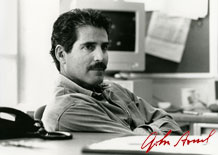
John Stossel is ABC News' Co-Anchor of "20/20" and New York Times best-selling author of Give Me A Break & Myths, Lies and Downright Stupidity. His "Give Me a Break" commentaries take a skeptical look at a wide array of issues, such as education, the economy, parenting, and more.

Source: John Stossel's Take Commentary from Co-Anchor of ABC News' "20/20"

Related Posts:

Saturday, August 1, 2009

Healthcare: Does Canada Do It Better?

John Stossel: “Government-run health care may mean waiting in line for care!”

Link to Report (7.31.09): http://abcnews.go.com/video/playerindex?id=8227482

Go to this link and you can contact your representative directly; that way you can tell them to stop this MADNESS! Make sure they know YOU vote!

http://www.congress.org/congressorg/officials/congress/

There will be a place to enter your zip code, then a place to click to write your representatives directly; it is all free...

On June 26th, John Stossel said: “Government Controlled Health Care Means Waiting in Lines, Serious Drawbacks (in his previous special):

Canadian Health Care: A Viable Model? - http://abcnews.go.com/video/playerIndex?id=7903062

President Obama said that the government is going to "fix what is broken about health care in America." It sounds like a great idea, but often what sounds good has unintended consequences.

John Stossel discovers some dead-serious drawbacks to socialized medicine.

When the government takes over, many critics say that you may not get the care and breakthroughs you need to save your life.

"The only way they can get costs down under a government-run system is to control the amount of money that is spent on health care," says Sally Pipes of thePacific Research Institute, who was born in Canada, and is wary about government taking the reins of health care in the U.S.

"We are going to have denied care, lack of access to the latest technology, and long waiting lists, just like people do in Canada and Great Britain," she warns.

In those countries, the government pays for all health care, and bureaucrats put limits on spending in order to control costs. They determine how much doctors can be reimbursed and put caps on the amount of money that can be spent on treatments.

The result of all this cost-cutting? People wait for care.

In England, shortages of dentists have caused hundreds of people to wait in line just for an appointment. The queues can be so long that some people have resorted to pulling out their own rotting teeth, using vodka and pliers as tools. One British hospital even tried to save money by not changing bed sheets. Instead of washing them, a British newspaper reported that the staff was encouraged to simply turn the sheets over. At any given time in Great Britain, there are over half a million people waiting to get into a hospital for treatments.

But Obama has said he doesn't want a government takeover of health care.

"When you hear the naysayers claim that I'm trying to bring about government-run health care," he told the American Medical Association last week, "know this -- they're not telling the truth."

drawbacks of the Canadian health care system

A national shortage of general practitioners means that 1.7 million Canadians don't have access to a regular doctor to go to for routine care. (ABC News Photo Illustration)

Public vs. Private Plans: Cost, Care, Competition

Canada and Great Britain have what's called a "single-payer" health care system: the government pays for everyone's health care using tax revenue. It's true that Obama says he doesn't want a health care system exactly like that.

Instead, he says he wants to set up a public insurance program run by the government that will compete alongside private insurance plans. However, critics warn that a plan like this won't allow private insurers to compete on a level playing field. They say the government will keep costs down for their public plan by setting payment rates for doctors below the market level, the same way that Medicare does now.

"What will happen in the long run is that private insurers will not be able to compete with the government on price," Pipes predicts, "so they will leave the market."

Critics like Pipes say that when the size and power of a government plan grow large enough, public insurers will crowd private insurers out of the health care market and American health care will become a de facto government-run system, like Canada or Great Britain.

"People line up for care. Some of them die. That's what happens," Dr. David Gratzer says of Canada's health care system.

Gratzer, a Canadian doctor, thought Canada's government health care system was great -- until he started treating patients.

"The more time I spent in the Canadian system, the more I came across people waiting for radiation therapy. Waiting for the knee replacement so they could finally walk up to the second floor of their house," he explained.

"You want to see your neurologist because of your stress headache? No problem! You just have to wait six months," he continued. "You want an MRI? No problem! Free as the air. You've just got to wait six months."

Many ER doctors in Canada agree that the system is broken. They say hospitals face a consistent shortage of bed space, and patients often have to wait.

While people in America also wait in emergency rooms, the wait is different in Canada. When patients go to the ER for treatment and are found to be sick enough to enter the hospital, they have to wait in the emergency room for an average of 19 hours before they can be given a hospital bed.

"We can't send these patients to other hospitals that have capacity because there is no other hospital in the area that has capacity," said Dr. Eric Letovsky, an ER doctor from Ontario. "Every other emergency department in the country is just as packed as we are."

Serious Drawbacks to Canadian Model

A national shortage of general practitioners in Canada means that 1.7 million Canadians don't have access to a regular doctor to go to for routine care.

The town of Norwood, Ontario, has only one family doctor available to serve the entire community. To ration the patient list, the town clerk holds a lottery once a month, drawing a few names out of a box that contains all of the people hoping to get on the doctor's patient list. She calls the lucky winners, but everyone else must continue to wait.

Serious Drawbacks to Canadian Model

A national shortage of general practitioners in Canada means that 1.7 million Canadians don't have access to a regular doctor to go to for routine care.

The town of Norwood, Ontario, has only one family doctor available to serve the entire community. To ration the patient list, the town clerk holds a lottery once a month, drawing a few names out of a box that contains all of the people hoping to get on the doctor's patient list. She calls the lucky winners, but everyone else must continue to wait.

It's true that America's partly-private, profit-driven system is expensive and sometimes wasteful, but that pursuit of profit has allowed our health care system to offer rapid delivery, great doctors, and incredible lifesaving discoveries.

"This is the country of medical innovation. This is where people come when they need treatment," said Gratzer.

Thousands come from countries with government-run health care to take advantage of the advanced care in the United States. The famous Spanish tenor Jose Carreras didn't get treated for cancer in Spain -- he went to Seattle. King Hussein of Jordan came to America for treatment. So did Italian Prime Minister Silvio Berlusconi and South African Archbishop Desmond Tutu.

"Literally, we're surrounded by medical miracles. Death by cardiovascular disease has dropped by two-thirds in the last 50 years," said Gratzer. "You've got to pay a price for that type of advancement,"

The reality is that there are always trade-offs in life. Although government "universal coverage" promises great things like equal care and that no one need worry that an illness will bankrupt them, government control also means waiting in lines and sometimes going without care.

Innovations like birth control pills, cholesterol medication, robotic limbs, and many other things, would not have happened without the possibility of big profit, said Grace Marie Turner of the Galen Institute.

"I want companies to come up with cures for Parkinson's, cures for cancer, cures for Alzheimer's. Unless there is a reward for them to do that, we're not going to have those new medicines," she said.

Some of the best, most innovative treatments and most rapidly-delivered care happens through this pursuit of profit. Even in Canada, you'll find one area where they offer easy access to cutting edge technology.

CT scans and MRIs, hip and knee replacements: available 24 hours a day and without a wait.

"If I see a patient that's torn a cruciate ligament in that patient's knee, we can generally have the patient scheduled for within probably a week," said Canadian Dr. Terri Schiller.

But you have to bark or meow to get that kind of treatment. Schiller is a veterinarian and her practice makes a profit treating cats and dogs.

Want a CT scan in Canada? Private veterinary clinics said they can get a dog in the next day. For people, the waiting list is a month.

"Many clients will come here with their pets and as they're leaving, it's, 'Next time, I get sick, I want to come here. I don't want to go to the regular hospitals,'" said Schiller.

Posted: Knowledge Creates Power

Friday, June 12, 2009

Glenn on Glenn – Stossel Part 2 – 20/20 Program Tonight 10PM EST

Full Interview on 20/20 Tonight (10PM EST)

June 12, 2009 - 12:09 ET

Photo credit: ABC News

Don't miss Glenn Beck tonight on ABC's 20/20 at 10 PM ET. For a sneak preview click here...

GLENN: From Radio City in Midtown Manhattan, third most listened to show in all of America and strangely we're proud of that. Hello and welcome. My name is Glenn Beck. John Stossel is on the phone with me. John is doing a piece on 20/20 where they followed me around for I believe 400 days and wow, what a I mean, you are going to look at this piece at the end and say what a colossal waste of time and money that was, really seriously. But he is doing a piece on me tonight and I'm going to speak in very nice tones to him because it hasn't aired yet. Too late either way.

STOSSEL: Too late. We are going to trash you, the dirt we have found on you.

GLENN: Let me ask you something, because you really did, you guys followed me I think for three solid days, two or three solid days. Did I say anything that is going to get me fired?

STOSSEL: No.

GLENN: Did I say anything that made you go, "Holy cow"?

STOSSEL: Yeah. When you said that you only became a Mormon because you wanted to have sex with your wife.

GLENN: Well, that

STU: (Laughing).

GLENN: Can I tell you something, John? Remember in the piece I said she hits me? I got so she hit me so hard after that, she's like, I can't believe you said that! I said, you should have said that then! Why are you hitting me now when you didn't do it on TV, make me look like a liar.

STOSSEL: Yeah, be better if she hit you right in front of the camera.

GLENN: I know. I would have had evidence. So John, we'll talk about that later. It's on tonight, 20/20. You don't want to miss it, or you may want to miss it. I'm not really sure at this point. Only John really knows, but that is on ABC 20/20 tonight where you kind of get a glimpse of my life, a little bit of the tour. I know you guys were there for the tour. I don't know what you included. And also me at home as well. So anyway

STOSSEL: We're still cutting it together. So some things are going in and other things are coming out.

GLENN: Oh, boy.

STOSSEL: It is frustrating in that we did follow you for several days and our story will be about eight minutes long. Heck, you're on TV for ten times that every day.

GLENN: Let me ask you this, John. Is this the story you expected to get?

STOSSEL: Yeah, I think it is. I mean, I

GLENN: I don't like the way you say that.

STOSSEL: I had never seen your comedy tour before. So I don't know all of what you do. I know you have a checkered past and I know you used to put away a lot of booze and you wrecked your career. So much of what we have on I already knew. I don't know that all your listeners do.

GLENN: Now, let me ask you this, John. When you said "I didn't know you did a comedy tour," I'm a little nervous just because, have you read the reviews from the New York Times, Newsweek?

STOSSEL: That was I just read them. I had never really met you before except briefly on the air and we do the interview and then I say, "Oh, the Times is covering the comedy tour, giving it great display. Maybe they got interested." And what a snarky, smarmy review. "Oh, there's no one in the theater with me here in New York. Oh, this lady came in and, oh, she was lost." I mean, it's like they felt they had to cover you because you're a big hit but then they couldn't even cover the content.

GLENN: Yeah, they couldn't cover it honestly. Let me switch gears and go to David Letterman because it's the same kind of thing. First of all, when it comes to people's children, I think your children are off limits. Let's leave politicians' children alone, let's leave families of anybody alone. Just leave them alone unless it's like Bernie Madoff's kids, you know what I mean, that are actually involved in it, or Chelsea Clinton when she was 25 and campaigning. Then, you know, you've got something they are bringing themselves into the story. But is it amazing to you on two stories, first the David Letterman, what the press has done to Sarah Palin, whether she is smart or dumb, this woman doesn't have a chance of survival with the media the way it is now, does she?

STOSSEL: It's a fatal conceit to predict what will happen, but
GLENN: Well, how do let me rephrase the question. How does somebody get a fair shake in the media, John? You've been in the media forever. How does somebody with a differing opinion from the elite view in New York, how do you survive?

STOSSEL: It's very, very tough because a lot of people believe time, Newsweek and the Washington Post and New York Times and they are powerful not because they have a big audience. Their audience is a fraction of yours, but the sense all over the media and local TV hosts all copy what they read in the New York Times. You really can get totally smeared. But at least now there are so many other choices. If it was ever possible, it's possible now.

GLENN: You've been following the shooting at the Holocaust museum?

STOSSEL: Only slightly. I mean, I was with you when you learned about it.

GLENN: Oh, that's right, you were.

STOSSEL: That you turned your show upside down for it because, I don't know. I mean, 20,000 people are killed by gunshot every day every year, sorry, and certain ones we consider much more important, a shot if it happens in a prominent place, if politicians were involved. I mean, this was one horrible, I also know why it's such a big story.

GLENN: Here is my angle on it because I forgot you guys were following me that day and you were in the office when that happened and I found out about it and we were working in a different, completely different way for the show and we flipped it all upside down and went in that direction and here's why. Because of what I believe is coming with the press. I think the press is I mean, have you noticed that this guy's rightwing? I mean, that's the way the press is he's a rightwing zealot. Since when is rightwing somebody who hates all the Jews? When is that rightwing? That's crazy. That's racist. That's not rightwing.
STOSSEL: Well, even crazy is that there are lots of people in the mainstream media who are hard right and far right, but nobody's ever hard left or far left.

GLENN: I just, I find it amazing that the media, when the abortion doctor was killed, immediately it was Bill O'Reilly's fault. When this guy goes and shoots, immediately, immediately it's, you know, it's the far right that's doing it. When the Muslim convert, the guys goes down in, where was it, Alabama and shoots our recruiters, he's just an isolated incident. It's so clear the bias in the media.

STOSSEL: What's remarkable is how so many of my colleagues would deny that. And not that they are lying. They genuinely don't see it. They are so surrounded by people who think just as they do and they read the New York Times that they just think that's the world, like asking a fish about water. What water?

GLENN: So this is why they just think we're stupid because we're just not readers or whatever it is. I can't tell you how many things my audience has been called, you know, that we're just not smart. I will put my audience against any audience. It is a very well read, very smart audience. And here we have these elitists whose numbers are dwindling in newspapers, magazines, television, everything. You would think somebody somewhere would say, you know what? Maybe we're wrong. Maybe we're wrong because nobody's reading our crap anymore. Nobody's doing this anymore, yet they just seem to get more and more embittered on their own point of view.
STOSSEL: But they can make a pretty good argument that they, or I should say we are losing audience not because we are saying the wrong things but because people have more choices.


GLENN: Yeah, but more choices, if you are providing what people want, they will go to it. I mean, my example is AM radio. You've got a lot of choices now, a ton of choices. AM radio is not easily accessible. It sounds like crap, it's staticy, go under a bridge, blah, blah blah, but this is the place offering this kind of content. People aren't going to go buy a magazine if you have the right content, they are not going to go buy a newspaper, but they will find they will seek out AM radio?

STOSSEL: Well, that's a good point and you're certainly proving your point with your ratings.

GLENN: John, I was thinking the other day, what I try to get across, and I you are probably the guy to make this point. The argument that we have about left/right in this country is so incredibly stupid because if the guy on the right is the guy who is a racist and a Nazi, a Nazi, then the guy on the left would have to be Stalin. Well, that is an argument between big government and big government. Well, I don't want either of those and I don't think most Americans want that, and they will say, well, I'm in the middle. Well, no, you're not. You're not in the middle of that. You don't want those to be your two ends. You want big government at one end and no government on the other end. What is how do you make the case to people now that we are arguing a ridiculous argument, we have been conned into a strawman argument here of big government versus big government. The best kind of government is the smallest. It doesn't matter. If Germany wouldn't have had a huge government, you know, and would have rejected framework, they could have had Hitler in, but he wouldn't have had any power to do anything, you know? It doesn't matter if Obama is in if he doesn't have the power to do anything. Doesn't matter if George Bush is in if he doesn't have the power to do anything. The smallest government is the one that is the best, but nobody seems to understand the small government idea anymore.

STOSSEL: Well, I certainly agree with you there and one of the things I'm happiest about our profile of you tonight is I got a number of lines where you make the point about the size of the state and freedom and how you don't you are accused of being a Republican shill, but you take on both parties. But I don't know that most Americans want that. I do. And I wish they did but it's not intuitive. It wasn't intuitive to me. Thomas Jefferson said it's the natural progress of things for government to grow and liberty to yield. And I think if you ask most Americans, do you want government to make sure you're safe, well, yeah. Do you want government to make sure that you have healthcare or you guaranteed a right to healthcare? I think most people would say, "Yes," I want government to make sure the poor are taken care of, that we had food, clothing, shelter.

GLENN: So make the case against that, John. Make the case against government healthcare.

STOSSEL: The case against government healthcare is that it would be like the motor vehicle's experience, it would be like the post office, that it might be okay at the beginning, the eager beavers come in like the peace corps and they might do an okay job. But government always atrophies, the quality always atrophies. It took 70 years for the Soviet Union to fail. The best car the planned economies could produce was the Trabant. It was so bad you had to put the oil and gas in separately and shake the car to mix them together and yet that was the best that the government could produce and yet people think of government as, yes, they will take care of me. But it won't get better. We won't have innovation and eventually you'll have horrible lines and lousy treatment.

GLENN: Yesterday the Senate approved taking over and regulating all tobacco, et cetera, et cetera, and they made this big case that this is so great because people are going to stop smoking and they are going to be able to regulate. Aren't they paying for children's healthcare through smokers?

STOSSEL: Well, first they don't like it, then they were going to punish it by taxing it. But I think Americans say, "Well, we're never going to get rid of smoking or beer. So let's just tax it and support wonderful government."

GLENN: Yeah, but if they're trying to also stomp it out. I mean, I think they should be running ads promoting smoking. If they are going to be getting rich off it, if they are going to be running all these government programs, they shouldn't be trying to stomp out what's giving them money. That's like me going in the radio business and then going on the radio and saying radio is bad.

STOSSEL: There's a good parallel in gambling. The Republicans have banned Internet gambling and put all kinds of restrictions on gambling in various forms but then they get elected and their states depend on the lottery for money which and they introduced the lottery because we have to get the numbers racket out of business. But the Mafia numbers runners were offering much better odds than the states do.
GLENN: How did you survive in television so long?

STOSSEL: I started as a consumer reporter bashing business and everybody liked that and so I had established my reputation, and once I woke up to the evil of regulation and big government and changed focus, I had to fight for it and it was touch and go for a while, but I had a reputation already and now ABC will often say, you know, "Well, we don't agree with you but these are ideas that deserve to be heard."

GLENN: Did you think about editing me out of the interview tonight where my wife is sitting next to her because next to me just because I look so horrible in comparison?

STOSSEL: She does look a lot better than you do.

GLENN: I mean, I don't I mean, you could have just said "No" to that, John. You could have

STOSSEL: No.

GLENN: (Laughing). I haven't seen the piece yet, you know, but I have to say in a time where the, you know, media never does its job, you guys did an awful lot of work and very in depth and I could regret saying giving you any kind of credibility on this, you know, come, well, come tonight. But as it stands right now, I'm going to kiss your butt and say that you guys did a great job and then I'll, of course, on Monday deny it and say these guys didn't even do their homework, how could they possibly say they had film of me saying that, huh? Oh, boy.

STOSSEL: I'm dreading that, but it is what it is.

GLENN: I know. Thank you very much, John, I appreciate it.

STOSSEL: Thanks, Glenn.

GLENN: You bet, bye bye. John Stossel tonight on 20/20.

Posted: Knowledge Creates Power

Related Articles:

Wednesday, June 10, 2009

Glenn Beck on Glenn Beck

Controversial Fox Host Talks About Kicking Bottle, Turning Mormon and Common Sense

John Stossel explores why some seem to hate the conservative commentator.

Forbes magazine's new list of the 100 richest and most influential celebrities in America includes Oprah Winfrey, Angelina Jolie, and only one TV news personality -- Fox News' Glenn Beck.


Video: Preview of Stossel 20/20 Interview With Glenn Beck


A few years ago, not many people had heard of Glenn Beck. Nowadays, the conservative commentator seems to be everywhere. Over the past two weeks, he's performed before sold-out crowds on his comedy tour. He's had several New York Times No. 1 best-selling books (a new book, "Glenn Beck's Common Sense," is due to hit stores next week); 8 million listeners tune in each week to his radio show; and now he's the host of his own television show on Fox News.

Watch John Stossel's interview with Glenn Beck on "20/20" Friday at 10 p.m. ET.

Glenn Beck: The Drinking Years

"[My mother] was an alcoholic and a drug addict," he said. "When I hit 30, I was going down that same path."

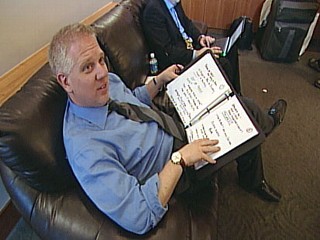
Glenn Beck beck behind scenes planning show
Glenn Beck preps backstage for his Fox News talk show. Despite its weekday-afternoon time slot, normally a ratings wasteland, the show now has a bigger audience than any prime time show on cable.
(ABC News)

He believes the word "jerk" would be the kindest way to describe him at that stage.

"I fired a guy one time for bringing me the wrong kind of pen," he said remorsefully. "I was beyond a jerk.

"I hated myself. Hated myself," he admitted. "I tried for two years to stop drinking. I'd look myself in the mirror and I'd say, 'You're not an alcoholic, you don't have a problem.'"

Beck didn't admit he had a drinking problem until one morning when he was unable to remember a bedtime story he had drunkenly told his children the night before. And so, that evening, he attended an Alcoholics Anonymous meeting.

"I don't know what I expected, but you guys don't look like alcoholics," Beck recalled telling the attendees. "This lady, she must've been 70 years old. She was wearing a sweater set and pearls. She was sitting right in front of me, and she just leaned back and she said, 'Oh, honey, we're all drunks in here.'"

n typical Glenn Beck fashion, however, he didn't stop his reformation there. He became a Mormon.

"I apologize, but guys will understand this. My wife is hot and she wouldn't have sex with me until we got married, and she wouldn't marry me unless we had a religion," he said. "I'm like, ah, you've got to be kidding me! I've got to go to church for this?"

But now he says that going to church has given him the faith to ground himself, and so he's grateful to his wife. Glenn and Tania Beck have been married now for nearly 10 years, after first meeting in a parking lot.

"I was a loser at local radio and she came up to me and she said, 'Are you Glenn Beck?'" he recalled of their first meeting. "She said, 'I used to listen to you when I was in high school. Thanks for the laughs,' and then she turned around and walked away."

Beck has been called an "idiot" who engages in a lot of "crazy talk." Does it bother his wife when people have hateful things to say about her husband?

Glenn Beck: A Big Target

"If I let every single thing bother me, you know, I would have jumped off a bridge a long time ago," she said.

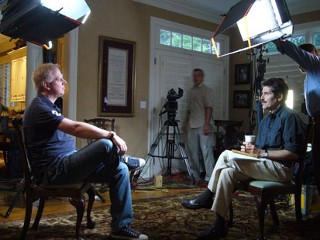
Glenn Beck with John Stossel
Glenn Beck talks with John Stossel about how he got his start in radio.
(Chris Kilmer / ABC News)

Beck has become a big target for comedians and commentators alike. Comedy Central's Stephen Colbert often mocks him, and Jon Stewart of "The Daily Show" once said of Beck, "Finally, a guy who says what people who aren't thinking are thinking."

"You can get rich making fun of me. I know. I've made a lot of money making fun of me," Beck said.

Beck is also criticized for crying on television.

"Somebody get this blubbering buffoon a Kleenex!" said journalist Tina Brown on her March 31 appearance on MSNBC's "Morning Joe." Others have accused Beck of faking the crying for entertainment purposes.

"I should be paid a lot more money if I were able to cry on will like that," he responded.

The criticism he receives from the media doesn't stop there. Al Franken wondered aloud on CNN whether Beck should be allowed on television. Keith Olbermann frequently names Beck the "Worst Person in the World."

Some even go as far as to charge that Beck's complaints about the government actually encourage violence.

"A man kills his own mother and nine others and turns out to have kept a hit list. And Glenn Beck is rationalizing it and blaming liberals for it," said Keith Olbermann on March 13.

But, does Beck actually encourage the anti-government violence of people like Timothy McVeigh?

"No. Timothy McVeigh was a coward," explained Beck. "Violence is the stupid way out. It'll discredit any real legitimate movement."

Beck added that most people who criticize him don't actually watch his show or listen to what he says.

Many in the media label Beck as a staunch Republican -- a label which he strongly disagrees with.

"Both parties only believe in the power of the party," he said. "Stand up. Throw off the shackles of the two-party system!"

He criticizes both parties for exercising more power than the Constitution intended and for abandoning what he considers to be common-sense ideas.

Glenn Beck: Freedom to...

"Look, the American experiment was about freedom," he explained. "Freedom. Freedom to be stupid. Freedom to fail. Freedom to succeed. Freedom to succeed.

"We just put General Motors in the hands of people who can't even run our own government," he added. "Our debt is -- just the interest -- a trillion dollars a year. You can't pay for that!"

Beck also compares himself to Howard Beale, the fictional anchorman from the 1976 film "Network" who famously exclaimed: "I'm as mad as hell, and I'm not going to take it anymore!"

"I am like Howard Beale," said Beck. "When he came out of the rain and he was like, none of this makes any sense. I am that guy."

And so Beck works constantly, on radio, TV and onstage, saying that a lot of life would be better if government -- Republicans and Democrats -- just left Americans alone.

"I believe that if we get out of people's way, the sky's the limit," he said. "The sky is the limit."

By JOHN STOSSEL and ANDREW KIRELL - June 10, 2009


Posted: Knowledge Creates Power


Related Resources: