
GBTV - Where the Truth Lives

Election Season 2014

And it has brought us to this trainwreck called ObamaCare and we have bankrupted our kids and grandkids!

We are now headed into the 2014 Election Season and common sense and conservatism are on the rise. Please stand-up and be counted!

Reading Collusion: How the Media Stole the 2012 Election is a great place to start!

The Founding Father's Real Reason for the Second Amendment

And remember the words of Thomas Jefferson "The strongest reason for the people to retain the right to keep and bear arms is, as a last resort, to protect themselves against tyranny in government." See Video of Suzanna Gratia-Hupp’s Congressional Testimony: What the Second Amendment is REALLY For, below (u-tube HERE).

The Leaders Are Here... Palin, Cruz, Lee, Paul, Chaffetz....

T'S A WONDERFUL LIFE

Can You Really Still Believe That None of These People Would Have Done a Better Job???

Bloggers' Rights at EFF

SIGN THE PETITION TODAY...

Showing posts with label British Healthcare. Show all posts

Tuesday, August 11, 2009

Woman in Oregon Told Healthcare Would Not Pay for Cancer Treatment But Would Pay for Assisted Suicide… Welcome to Government Controlled Healthcare

On Fox News’s O'Reilly Factor 8/10/09 a story was put forward about a lady that had cervical cancer and was denied the cancer drugs by the state (they have universal healthcare) and she was told they would pay for the drugs that would terminate her life.

Say you got cancer. Say your doctor found a treatment that could prolong your life for years. It wouldn’t cure the cancer, but it would slow it down, giving you precious time. Say the state refused to pay for your treatment, yet told you they would pay for doctor-assisted suicide.

Welcome to the Oregon Health Plan.

Perhaps, in order to find out what we can look forward to under a single-payer plan, we should look to one of our very own states: Oregon. The Oregon Health Plan (OHP) is a government run health care system for low-income residents. To be included in the plan, you currently have to win a lottery — literally. Sounds relatively simple, right? Basic care is included with little to no co-payments.

But things aren’t all butterflies and flowers in the Oregon Health Plan, nor is the health care system in place in Oregon going well. Patients who are treated under the OHP or Medicaid get the joys of rationed health care. And if you are unlucky enough to be stricken with cancer, or need a major operation to save your life, the state’s response is to tell you to just die already. And they mean that literally.

Consider the case of Barbara Wagner. She is a lung cancer patient whose doctor prescribed her a revolutionary new chemotherapy treatment, one that slows the growth of the cancer and could possibly prolong her life by years. To most people, this would be good news. To the OHP, it meant just another drain on the system. They denied Ms. Wagner’s claim, and instead offered to pay for doctor-assisted suicide. Wagner, of course, was understandably outraged.

“Treatment of advanced cancer that is meant to prolong life, or change the course of this disease, is not a covered benefit of the Oregon Health Plan,” read the letter notifying Wagner of the health plan’s decision.

Wagner says she was shocked by the decision. “To say to someone, we’ll pay for you to die, but not pay for you to live, it’s cruel,” she told the Register-Guard. “I get angry. Who do they think they are?” An OHP doctor tried to explain:

Dr. Walter Shaffer, medical director of the state Division of Medical Assistance Programs, which administers the Oregon Health Plan, attempted to defend the health plan’s decision. “We can’t cover everything for everyone,” he said. “We try to come up with polices that provide the most good for the most people.” Shaffer then addressed a priority list that had been developed to ration health care. “There’s some desire on the part of the framers of this list to not cover treatments that are futile,” he said, “or where the potential benefit to the patient is minimal in relation to the expense of providing the care.”

Under Obama’s government run health care plan, could the rest of the country be headed the same way? Be sure to read the whole thing.

Source: American Issues Project

Video: Oregon says no to chemotherapy, offers assisted suicide instead
HotAir.com ^ | 8/3/09 | Ed Morrissey

We knew it would come to this when Oregon insisted on passing its assisted-suicide laws. It doesn’t take much for assisted suicide to go from a humane option to a cost-saving device, especially when the state pays for the medical care. One patient in Oregon got a letter that made this all too clear, when in the same letter rejecting her request for life-extending chemotherapy, Oregon offered her “physician-aid-in-dying”. In other words, Oregon offered their customer a heapin’ helping of death:

Video

The doctor interviewed by the news station seems offended at the suggestion that Oregon would decide to save a few bucks by denying expensive health care and offering a case of hemlock in its place. However, saving money was the raison d’etreof single-payer systems, and the incentives all drive towards that decision. Single-payer systems have to handle medical services as a shortage market, rationing them by using “comparative effectiveness” paradigms to determine who gets medical attention, and who gets “physician-aid-in-dying” instead of it.

The woman who drew the short end of the stick in this case wonders who these people think they are. They think they know better than us who needs to live and die. Has that lesson still not been made clear?

Update: I got this link yesterday and the KATU page is undated, but this story is from 2008, which I didn’t realize until I got an e-mail about it. I wrote about this last June, and I simply didn’t recall it.

Posted on Mon Aug 03 2009 07:35:40 GMT-0700 (Pacific Daylight Time) by Crazieman

Related Posts:

Friday, August 7, 2009

Prescription for Truth – Daniel Hannan From England: HealthCare Worse for Elderly

Daniel Hannan, a British 37-year-old member of the European Parliament, says socialized medicine is worse for the elderly; long waits for services, rationing and no option to pay for better services or procedures yourself. He cannot imagine that Americans would consider trading in what we have for European-style Socialized Medicine.

Is this what you guys want? He lives with this system and wonders why the heck we would want it: They have more bureaucrats than doctors and the British Healthcare System is the 3rd largest employer in the world! ...So once we have it, there are so many bureaucratic jobs involved that there is no going back. And it is exactly that fact that makes it so enticing to Team Obama and the Dems; giant government and huge control of funds and power.

In the Unites States if you are diagnosed with prostate cancer we have a 100% minimum 5 year recovery and survival rate. In Canada it is 95% and in Britain it is only 77%.

Daniel Hannan on ObamaCare: Are you people insane?

A desperate intervention from a man who’s already seen this car crash up close, wondering why any free people would tolerate it short of a major war forcing them to. The words of one of the world’s most eloquent conservatives need no elaboration from me, but as companion reading to Beck’s point about how lame the arguments are for this boondoggle, try Ramesh Ponnuru’s piece on the paradoxes of ObamaCare in Time.

Quote:

There are two basic points about health-care reform that President Obama wants to convey. The first is that, as he put it in an ABC special in June, “the status quo is untenable.” Our health-care system is rife with “skewed incentives.” It gives us “a whole bunch of care” that “may not be making us healthier.” It generates too many specialists and not enough primary-care physicians. It is “bankrupting families,” “bankrupting businesses” and “bankrupting our government at the state and federal level. So we know things are going to have to change.”

Obama’s second major point is that–to quote from the same broadcast–”if you are happy with your plan and you are happy with your doctor, then we don’t want you to have to change … So what we’re saying is, If you are happy with your plan and your doctor, you stick with it.”

So the system is an unsustainable disaster, but you can keep your piece of it if you want. And the Democrats wonder why selling health-care reform to the public has been so hard?

Exit question: How do we get Hannan to run for office here? Seriously.

by ALLAHPUNDIT – Hot Air

Posted: Knowledge Creates Power

Sunday, August 2, 2009

The Ultimate Resting Place of Socialized Medicine?

My wife and I disagree about some of the key end-of-life issues. When such morbid subjects arise, as they must and as they have with increasing frequency as the debate over medical care rages on, she remains adamant that she does not want to linger in pain, holding on to those final months, weeks, days or moments through any extraordinary medical intervention.

On the other hand, I want to live for every additional second modern medicine or Providence might permit. Dylan Thomas summed up my feelings in his most famous poem:

Do not go gentle into that good night.
Rage, rage against the dying of the light.

As President Barack Obama and Congress discuss health care legislation, and we citizens worry over the ramifications of possible policy outcomes, there arises the haunting specter of euthanasia. My wife and I may disagree on what end-of-life decision to make, but we agree that it should be our decision, not the government's.

A proposal to cover millions more Americans with medical insurance predicated on spending less on medical care in the process perplexes enough. But for those who care about freedom -- not having government tell you how to live -- and those who wish to live as long as they can -- by definition, not having the government tell you to hang it up and die -- there is even more to fear.

It's not that Obamacare is a one-step federal government takeover of medicine. But it does qualify as another giant step in that same frightening direction.

We've known for years that the more the government picks up the tab for our doctors, nurses, and drugs, the more the government will tell us how to live our lives. What to eat. What not to eat. What not to smoke or drink. What recreations not to engage in (too dangerous), and that we need to do more leg-lifts and jumping jacks with more gusto -- like a scene I recall from 1984.

Already cities have banned trans fat. The poor, who happen to smoke or drink alcohol in larger percentages than those more well off, are increasingly crushed under sin taxes. There's talk of hiking taxes on Dr. Pepper -- and candy.

We can hope that the power of police unions can keep donuts on the market at relatively low expense.

But expect much worse. And though the excuse for ever greater nannying will always be to protect the taxpayers (forced by politicians to pay the medical bills of everyone else), it will be government experts, not taxpayers, dictating dietary and exercise mandates to the population.

Still, the issue of euthanasia is even more frightening. Older people, as their bodies deteriorate, cost more money. Putting hospitals under increased government budgetary oversight and command will not miraculously increase government budgets for hospitals. Cutting costs will become a draconian theme, never ending . . . until death.

Even now, "death by waiting" is a common rationing procedure in Britain and Canada. If you are young and living under socialized medicine, getting dialysis from government-run hospitals is fairly easy; if you are old, wait. The system's limited medical facilities, doctors and nurses practice a kind of triage. The aged are the hopeless, in this common scenario, and give up their lives for the good of the hospital budget.

This is hardly an "easy death" or "good killing" ("euthanasia" comes from euthanos or “good death”). It is death by bureaucracy. Bureaucrats love their queues,need their queues. And the impetus is clear: Saving "the taxpayers" -- not the patients.

Former Colorado Governor Dick Lamm addressed this issue decades ago when he philosophized, "We've got a duty to die and get out of the way with all of our machines and artificial hearts and everything else like that and let the other society, our kids, build a reasonable life."

Mr. Obama and the congressional architects of their new medical regime are promising to cut the overall cost of care. Are we really to believe there will be no pressure to deny expensive treatments in order to save money?

Many opponents of Obamacare are jumping on a provision in one version of this legislative work-in-progress, a directive to pay doctors to counsel the elderly -- and terminally ill patients -- on various end-of-life issues. In the New York Post, Betsy McCaughey said this mandate "invites abuse" and that "seniors could easily be pushed to refuse care."

A front-page Washington Post article, headlined "Talk Radio Campaign Frightening Seniors," reported that this controversy "undercuts what many say is the fundamental challenge of discussing sensitive costly societal questions about how to align patient wishes at the end of life with financial realities, for both the family and taxpayers."

Not getting a pacemaker at 75 years old may mean a person dies at 77 or 78, instead of at 83. What are five years of life worth? Who should decide? (And for many it means 10 ,15 or 20 additional years, and often productive years or years valued by their families.)

With the federal government in the medical care business through the so-called Public Plan, folks in Washington will have the power to decide.

If you don't like your health insurance company, you ain't seen nothing yet!

Paul Jacob :: Townhall.com Columnist by Paul Jacob – Townhall - The ultimate resting place of socialized medicine?

Related Resources:

Additional related information in Dick Morris’s Catastrophe

Posted: Knowledge Creates Power

Saturday, August 1, 2009

Healthcare: Does Canada Do It Better?

John Stossel: “Government-run health care may mean waiting in line for care!”

Link to Report (7.31.09): http://abcnews.go.com/video/playerindex?id=8227482

Go to this link and you can contact your representative directly; that way you can tell them to stop this MADNESS! Make sure they know YOU vote!

http://www.congress.org/congressorg/officials/congress/

There will be a place to enter your zip code, then a place to click to write your representatives directly; it is all free...

On June 26th, John Stossel said: “Government Controlled Health Care Means Waiting in Lines, Serious Drawbacks (in his previous special):

Canadian Health Care: A Viable Model? - http://abcnews.go.com/video/playerIndex?id=7903062

President Obama said that the government is going to "fix what is broken about health care in America." It sounds like a great idea, but often what sounds good has unintended consequences.

John Stossel discovers some dead-serious drawbacks to socialized medicine.

When the government takes over, many critics say that you may not get the care and breakthroughs you need to save your life.

"The only way they can get costs down under a government-run system is to control the amount of money that is spent on health care," says Sally Pipes of thePacific Research Institute, who was born in Canada, and is wary about government taking the reins of health care in the U.S.

"We are going to have denied care, lack of access to the latest technology, and long waiting lists, just like people do in Canada and Great Britain," she warns.

In those countries, the government pays for all health care, and bureaucrats put limits on spending in order to control costs. They determine how much doctors can be reimbursed and put caps on the amount of money that can be spent on treatments.

The result of all this cost-cutting? People wait for care.

In England, shortages of dentists have caused hundreds of people to wait in line just for an appointment. The queues can be so long that some people have resorted to pulling out their own rotting teeth, using vodka and pliers as tools. One British hospital even tried to save money by not changing bed sheets. Instead of washing them, a British newspaper reported that the staff was encouraged to simply turn the sheets over. At any given time in Great Britain, there are over half a million people waiting to get into a hospital for treatments.

But Obama has said he doesn't want a government takeover of health care.

"When you hear the naysayers claim that I'm trying to bring about government-run health care," he told the American Medical Association last week, "know this -- they're not telling the truth."

drawbacks of the Canadian health care system

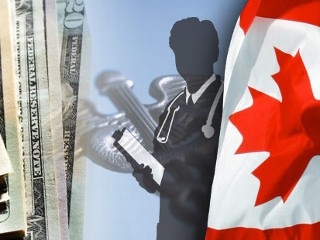
A national shortage of general practitioners means that 1.7 million Canadians don't have access to a regular doctor to go to for routine care. (ABC News Photo Illustration)

Public vs. Private Plans: Cost, Care, Competition

Canada and Great Britain have what's called a "single-payer" health care system: the government pays for everyone's health care using tax revenue. It's true that Obama says he doesn't want a health care system exactly like that.

Instead, he says he wants to set up a public insurance program run by the government that will compete alongside private insurance plans. However, critics warn that a plan like this won't allow private insurers to compete on a level playing field. They say the government will keep costs down for their public plan by setting payment rates for doctors below the market level, the same way that Medicare does now.

"What will happen in the long run is that private insurers will not be able to compete with the government on price," Pipes predicts, "so they will leave the market."

Critics like Pipes say that when the size and power of a government plan grow large enough, public insurers will crowd private insurers out of the health care market and American health care will become a de facto government-run system, like Canada or Great Britain.

"People line up for care. Some of them die. That's what happens," Dr. David Gratzer says of Canada's health care system.

Gratzer, a Canadian doctor, thought Canada's government health care system was great -- until he started treating patients.

"The more time I spent in the Canadian system, the more I came across people waiting for radiation therapy. Waiting for the knee replacement so they could finally walk up to the second floor of their house," he explained.

"You want to see your neurologist because of your stress headache? No problem! You just have to wait six months," he continued. "You want an MRI? No problem! Free as the air. You've just got to wait six months."

Many ER doctors in Canada agree that the system is broken. They say hospitals face a consistent shortage of bed space, and patients often have to wait.

While people in America also wait in emergency rooms, the wait is different in Canada. When patients go to the ER for treatment and are found to be sick enough to enter the hospital, they have to wait in the emergency room for an average of 19 hours before they can be given a hospital bed.

"We can't send these patients to other hospitals that have capacity because there is no other hospital in the area that has capacity," said Dr. Eric Letovsky, an ER doctor from Ontario. "Every other emergency department in the country is just as packed as we are."

Serious Drawbacks to Canadian Model

A national shortage of general practitioners in Canada means that 1.7 million Canadians don't have access to a regular doctor to go to for routine care.

The town of Norwood, Ontario, has only one family doctor available to serve the entire community. To ration the patient list, the town clerk holds a lottery once a month, drawing a few names out of a box that contains all of the people hoping to get on the doctor's patient list. She calls the lucky winners, but everyone else must continue to wait.

It's true that America's partly-private, profit-driven system is expensive and sometimes wasteful, but that pursuit of profit has allowed our health care system to offer rapid delivery, great doctors, and incredible lifesaving discoveries.

"This is the country of medical innovation. This is where people come when they need treatment," said Gratzer.

Thousands come from countries with government-run health care to take advantage of the advanced care in the United States. The famous Spanish tenor Jose Carreras didn't get treated for cancer in Spain -- he went to Seattle. King Hussein of Jordan came to America for treatment. So did Italian Prime Minister Silvio Berlusconi and South African Archbishop Desmond Tutu.

"Literally, we're surrounded by medical miracles. Death by cardiovascular disease has dropped by two-thirds in the last 50 years," said Gratzer. "You've got to pay a price for that type of advancement,"

The reality is that there are always trade-offs in life. Although government "universal coverage" promises great things like equal care and that no one need worry that an illness will bankrupt them, government control also means waiting in lines and sometimes going without care.

Innovations like birth control pills, cholesterol medication, robotic limbs, and many other things, would not have happened without the possibility of big profit, said Grace Marie Turner of the Galen Institute.

"I want companies to come up with cures for Parkinson's, cures for cancer, cures for Alzheimer's. Unless there is a reward for them to do that, we're not going to have those new medicines," she said.

Some of the best, most innovative treatments and most rapidly-delivered care happens through this pursuit of profit. Even in Canada, you'll find one area where they offer easy access to cutting edge technology.

CT scans and MRIs, hip and knee replacements: available 24 hours a day and without a wait.

"If I see a patient that's torn a cruciate ligament in that patient's knee, we can generally have the patient scheduled for within probably a week," said Canadian Dr. Terri Schiller.

But you have to bark or meow to get that kind of treatment. Schiller is a veterinarian and her practice makes a profit treating cats and dogs.

Want a CT scan in Canada? Private veterinary clinics said they can get a dog in the next day. For people, the waiting list is a month.

"Many clients will come here with their pets and as they're leaving, it's, 'Next time, I get sick, I want to come here. I don't want to go to the regular hospitals,'" said Schiller.

Posted: Knowledge Creates Power

Thursday, June 11, 2009

How to Stop Socialized Health Care

Five arguments Republicans must make…

It was a sobering breakfast with one of the smartest Republicans on Capitol Hill. We can fix a lot of bad stuff President Barack Obama might do, he told me. But if Mr. Obama signs into law a "public option," government-run insurance program as part of health-care reform we won't be able to undo the damage.

I'd go the Republican member of Congress one further: If Democrats enact a public-option health-insurance program, America is on the way to becoming a European-style welfare state. To prevent this from happening, there are five arguments Republicans must make.

[Karl Rove]Getty Images

The first is it's unnecessary. Advocates say a government-run insurance program is needed to provide competition for private health insurance. But 1,300 companies sell health insurance plans. That's competition enough. The results of robust private competition to provide the Medicare drug benefit underscore this. When it was approved, the Congressional Budget Office estimated it would cost $74 billion a year by 2008. Nearly 100 providers deliver the drug benefit, competing on better benefits, more choices, and lower prices. So the actual cost was $44 billion in 2008 -- nearly 41% less than predicted. No government plan was needed to guarantee competition's benefits.

Second, a public option will undercut private insurers and pass the tab to taxpayers and health providers just as it does in existing government-run programs. For example, Medicare pays hospitals 71% and doctors 81% of what private insurers pay.

Who covers the rest? Government passes the bill for the outstanding balance to providers and families not covered by government programs. This cost-shifting amounts to a forced subsidy. Families pay about $1,800 more a year for someone else's health care as a result, according to a recent study by Milliman Inc. It's also why many doctors limit how many Medicare patients they take: They can afford only so much charity care.

Fixing prices at less than market rates will continue under any public option. Sen. Edward Kennedy's proposal, for example, has Washington paying providers what Medicare does plus 10%. That will lead to health providers offering less care.

Third, government-run health insurance would crater the private insurance market, forcing most Americans onto the government plan. The Lewin Group estimates 70% of people with private insurance -- 120 million Americans -- will quickly lose what they now get from private companies and be forced onto the government-run rolls as businesses decide it is more cost-effective for them to drop coverage. They'd be happy to shift some of the expense -- and all of the administration headaches -- to Washington. And once the private insurance market has been dismantled it will be gone.

Fourth, the public option is far too expensive. The cost of Medicare -- the purest form of a government-run "public choice" for seniors -- will start exceeding its payroll-tax "trust fund" in 2017. The Obama administration estimates its health reforms will cost as much as $1.5 trillion over the next 10 years. It is no coincidence the Obama budget nearly triples the national debt over that same period.

Medicare and Medicaid cost much more than estimated when they were adopted. One reason is there's no competition for these government-run insurance programs. In the same way, Americans can expect a public option to cost far more than the Obama administration's rosy estimates.

Fifth, the public option puts government firmly in the middle of the relationship between patients and their doctors. If you think insurance companies are bad, imagine what happens when government is the insurance carrier, with little or no competition and no concern you'll change to another company.

In other words, the public option is just phony. It's a bait-and-switch tactic meant to reassure people that the president's goals are less radical than they are. Mr. Obama's real aim, as some candid Democrats admit, is a single-payer, government-run health-care system.

Health care desperately needs far-reaching reforms that put patients and their doctors in charge, bring the benefits of competition and market forces to bear, and ensure access to affordable and portable health care for every American. Republicans have plans to achieve this, and they must make their case for reform in every available forum.

Defeating the public option should be a top priority for the GOP this year. Otherwise, our nation will be changed in damaging ways almost impossible to reverse.

By Karl Rove

About Karl Rove - Karl Rove served as Senior Advisor to President George W. Bush from 2000–2007 and Deputy Chief of Staff from 2004–2007. At the White House he oversaw the Offices of Strategic Initiatives, Political Affairs, Public Liaison, and Intergovernmental Affairs and was Deputy Chief of Staff for Policy, coordinating the White House policy making process.

Before Karl became known as "The Architect" of President Bush's 2000 and 2004 campaigns, he was president of Karl Rove + Company, an Austin-based public affairs firm that worked for Republican candidates, nonpartisan causes, and nonprofit groups. His clients included over 75 Republican U.S. Senate, Congressional and gubernatorial candidates in 24 states, as well as the Moderate Party of Sweden.

Karl writes a weekly op-ed for The Wall Street Journal, is a Newsweek columnist and is now writing a book to be published by Simon & Schuster. Email the author at Karl@Rove.com or visit him on the web at Rove.com.

Or, you can send him a Tweet @karlrove.

Posted: Knowledge Creates Power

Monday, June 8, 2009

HERE COMES HEALTH CARE RATIONING

The photo op was too good to be true. Health care providers trooped out of the White House and trumpeted their goal of saving $1.7 trillion of costs over the next decade in health spending. Now these drug companies, hospitals, insurance companies, medical device manufacturers, labor unions and doctors have laid out their plans in more detail.

And right there, in plain print, is the beginning of medical care rationing. Now that the cameras have been put away and the media is no longer watching, their secret emerges: They are going to cut medical costs by cutting medical care. Right now, they cite four targets. They plan to:

1. Cut diagnostic imaging tests like MRIs and CAT scans.
2. Reduce the use of antibiotics. (This might not be a bad thing!)
3. Perform fewer Caesarean sections.
4. Cut care for management of chronic back pain

These decisions will not be medical but financial. They will not be based on a doctor's opinion of what his or her patient needs, but a bureaucrat's and an accountant’s opinion of what the new health care system can afford.

And you will not be able to bypass their rulings and pay for this care yourself. The rules laid down must be followed and private payments will not be permitted to override them. What we now call a private fee for service will metastasize into a bribe.

But this is just the very beginning of rationing. The total of health care spending now runs about $2.3 trillion a year in the United States. Over ten years, that's likely to reach $30 trillion. So a cut of $1.7 trillion is a mere drop in the bucket.

More rationing is coming, and coming soon.

In our new book (coming out on June 23rd) Catastrophe, we explain exactly what rationing will mean and what it has done to patient care in Canada.

It's not a pretty picture and Obama will bring it here soon unless we stop him. Forewarned is forearmed!

By: DICK MORRIS & EILEEN MCGANN

Go to DickMorris.com to read all of Dick's columns!

Source Daily Thought Pad

Related Resources:

Posted: Knowledge Creates Power