
GBTV - Where the Truth Lives

Election Season 2014

And it has brought us to this trainwreck called ObamaCare and we have bankrupted our kids and grandkids!

We are now headed into the 2014 Election Season and common sense and conservatism are on the rise. Please stand-up and be counted!

Reading Collusion: How the Media Stole the 2012 Election is a great place to start!

The Founding Father's Real Reason for the Second Amendment

And remember the words of Thomas Jefferson "The strongest reason for the people to retain the right to keep and bear arms is, as a last resort, to protect themselves against tyranny in government." See Video of Suzanna Gratia-Hupp’s Congressional Testimony: What the Second Amendment is REALLY For, below (u-tube HERE).

The Leaders Are Here... Palin, Cruz, Lee, Paul, Chaffetz....

T'S A WONDERFUL LIFE

Can You Really Still Believe That None of These People Would Have Done a Better Job???

Bloggers' Rights at EFF

SIGN THE PETITION TODAY...

Showing posts with label Government Controlled HealthCare. Show all posts

Wednesday, May 2, 2012

Obamacare to Herd Disabled Seniors to Bare-Bones Medicaid Plans

Dr. Scott Gottlieb, a former senior official at the Centers for Medicare and Medicaid Services in the Bush administration, warns that under Obamacare disabled seniors who are eligible for both Medicare and Medicaid will receive inferior care, according to a report by the New York Post.

Gottlieb, an American Enterprise Institute resident fellow, says these low-income people who are elderly or have disabilities will be uprooted from the tried-and-true Medicare fold and “herded” into state-run Medicaid plans as another phase of Obamacare grips the nation.

“It’s hard to see how they’ll be better off in bare-bones, and sometimes poorly-run state Medicaid plans than by getting access to Medicare options they were entitled to before Obamacare,” Dr. Gottlieb lamented on Friday.

A so-called Obamacare “demonstration” program kicking-off in January will turn over management of such “dual-eligibles,” along with the money that the federal government was spending on their medical care to any state that wants to climb aboard the latest federal money wagon.

Some cash-strapped states are jumping at the chance to capture federal Medicare dollars for their Medicaid programs, according to Gottlieb.

Indeed, some anxious states have already committed to automatically placing these folks in existing Medicaid plans. Big problem lurking here, says Gottlieb: Such plans often aren’t equipped to serve an older, sicker group of patients. “That will mean big savings for the state and worse care for the vulnerable,” he concludes.

The doctor cites significant examples:

  • New York is looking to shift 700,000 “dual-eligibles” into a capitated managed-care model or HMO-style care. The target: Corral most of the elderly poor and disabled by 2015.
  • California plans to move up to 1.1 million duals into its state-run Medicaid managed-care system.

These examples are but the tip of a huge green iceberg of big cash.
According to the Post report, Wall Street figures the entire “dual eligible” market at $350 billion a year.

While this is good news on The Street where the stocks of Medicaid HMOs are being bid skyward, Gottlieb is not consoled. “Care is likely to suffer. Many of these elderly poor also suffer from a lot of chronic ailments like diabetes and lung disease. [T]hese people have diverse medical problems, and have been most successfully served by Medicare programs that tailored services to their specific needs.”

Gottlieb’s bottom line: The Obamacare demonstration looks like an effort to shore up Medicaid by subsidizing it with Medicare dollars. “It’s another case of how Obamacare is designed to serve the existing health-care system, rather than transforming it to meet the needs of individual patients.”

Source: Newsmax.com: Expert: Obamacare to Herd Disabled Seniors to Bare-Bones Medicaid Plans

Wow… two ObamaCare death panel target groups rolled into one, the disabled and seniors.  Time for some major apologies to Sarah Palin who was soooo right!

Related:

“People 70 and Over Will Not Be Treated Under ObamaCare”… and You Thought DEATH PANELS Were Gone – Updated

Obama Embraces ‘Death Panel’ Concept in Medicare Rule

Replacing ObamaCare: True Insurance

By Daniel Anderson on April 30, 2012 - FreedomWorks

Consider this: Why does your job offer health insurance, but not auto insurance? Certainly, you need to be healthy to come into work, but most Americans also need a car to get to work. For that matter, why doesn’t your job offer home or life insurance? What makes health insurance a common, nearly-ubiquitous benefit of employment in the United States?

The prevalence of employer group-based health insurance in America is a result of World War II. During the lead-up to the war in the Great Depression, there was an enormous surplus of labor relative to demand. However, as millions of Americans were sent overseas to fight in World War II, the labor pool shrunk dramatically. At the same time, the demand for labor skyrocketed as the federal government poured enormous resources into war production, creating a massive industry that desperately needed workers.

Given these conditions, businesses would normally raise wages in order to attract workers. However, the federal government also imposed wage controls on many American industries. In order to get around these wage controls, businesses began to offer health insurance to lure in prospective employees, along with other “fringe benefits.”

Following the war, Congress created a tax code that rewarded employer group-based health insurance. If businesses provided their employees with health insurance, that insurance benefit would not be taxed. However, if businesses simply raised their employees’ wages, the wages would be taxed. Understandably, most businesses decided to offer health insurance to their employees instead of raises.

In this way, the federal government largely created the employer group-based health insurance system. This system is unique to the United States. Every other developed country has some form of government health care, whether it’s truly socialized medicine such as in Britain, or a single-payer system like in Sweden. Our system is a result of both the unforeseen consequences of government involvement in business, and the natural American aversion to big government.

For most Americans, employer-based health care works. A March 28th Reason-Rupe poll found that:

• 87% of Americans are covered by health insurance

• 63% of Americans with health insurance are covered by employer group-based plans

• 23% of Americans with health insurance are covered by Medicare or Medicaid

• 58% of Americans are satisfied with their overall health care

• 23% of Americans are dissatisfied with their overall health care

So, the vast majority of Americans have health insurance coverage, a majority of Americans with health insurance receive it through their employer, and a majority of Americans are satisfied with things as they are.

What does this mean?

Simply put, there’s little reason to dramatically alter health insurance in America as things stand. Unfortunately, the provisions in ObamaCare will force a radical, fundamental shift in health care from employer group-based health insurance to health insurance exchanges controlled by the federal government. ObamaCare won’t destroy the employer group-based system, but it will change the basic dynamics of the health insurance market.

Still, while the polling numbers strongly support the continuation of the employer group-based system, not everyone is happy with it. After all, more than a tenth of Americans lack coverage, and nearly a quarter of Americans are dissatisfied with their overall health care.

What’s the best way to respond to those numbers? Congress could follow the ObamaCare route: mandating insurance and expanding federal control of health care through government health plans. For most Americans, this unconstitutional and expensive path toward addressing the problem is unacceptable.

The solution to helping people left behind by the employer group-based health insurance system isn’t an expansion of the government group-based health insurance system. Instead, we ought to encourage true, individual insurance.

What are some of the benefits of true insurance? The main benefit is portability. For most Americans, losing or leaving their jobs means losing their health insurance as well, since the two are connected. This increases the hardship of the unemployed, while simultaneously discouraging entrepreneurial Americans from leaving their jobs and their health insurance in order to start their own businesses.

But if you purchase health insurance separately from your job, like you purchase auto or homeowner’s insurance, that insurance now stays with you regardless of your employment status. The portability of true, individual insurance helps to calm some of the anxieties that come with unemployment while also freeing up America’s entrepreneurs to start businesses and to create jobs.

True insurance’s portability also helps to deal with the problem of pre-existing conditions in health care. The problem of pre-existing conditions should not be overstated, as it only afflicts about 1% of Americans. Still, it was a key impetus behind the push for ObamaCare, and all health care policy experts who hope to implement reform must address it. While by no means a silver bullet, the ability to keep the same insurance provider throughout several jobs, and possibly throughout your entire career, helps to alleviate the pre-existing conditions problem.

Most people acquire their “pre-existing condition” during their adult life, while in the workforce. When that happens, their insurance will most likely cover the new condition, similar to other ailments. But once these people change jobs, they now suddenly have a “pre-existing condition.” The portability and continuity of true insurance would do a great deal to reduce the number of Americans who have trouble accessing health care due to their pre-existing conditions.

Finally, true insurance provides Americans with greater choice and freedom with their health care. In a sense, when you apply for a job today, you’re also applying for that job’s health plan. Unfortunately, you don’t really know the details of the health plan until you’ve already taken the job and the plan.

What if you purchase true, individual insurance? You can pick a plan that the right premium and deductible. You can ensure that the plan covers the things you want covered. In short, you can get a plan that appeals to you, instead of being forced into your employer’s pre-packaged plan, which may or may not cost what you would prefer or cover what you want covered.

So, there are several major advantages to a true insurance system. How do we encourage its growth? The most important step to growing the true insurance market is to equalize tax treatment of the employer and true insurance systems. Full deductibility of all health care expenditures would help to level the playing field in the insurance market, thereby increasing patient choice.

The employer group-based health insurance system works for most Americans, but it’s not perfect. For those Americans who would prefer something different, we ought to forgo government group-based health insurance like in ObamaCare in favor of encouraging true, individual health insurance.

TAKE ACTION: Urge your Members of Congress to cosponsor the Patient OPTION Act!

Source:  True Health Is True Wealth

Friday, December 16, 2011

"People 70 and over will not be treated under Obamacare… and you thought DEATH PANELS were gone"– Updated

Mark Levin received a phone call Tuesday night from a brain surgeon who had just been to Washington DC, learning about the requirements the government has in place with the Obama Health Care Plan. This is a must read. The surgeon says that if you are over 70, you will get “comfort care,” and that surgery can be performed “if” the government panel deems it necessary. It also reveals that the government language used to describe patients is “units.”

If you are over 70 and have a stroke, you can and will be denied surgery. The documents referred to by the caller are not public yet.

Here is the youtube of that call, posted by warrenherrick.

A transcription of that phone call appeared on Free Republic, posted by ‘Future Useless Eater.’ Thank you, FUE.

Transcript…

Caller: I heard you talking earlier about the government not knowing how to make pencils, and then you talked about brain surgeons, and I happen to be a brain surgeon, so I found your topic very interesting. And actually, I just returned from Washington DC, where we were reading over what the Obama Health Care Plan would be for advanced neurosurgery for patients over 70, which we all found quite disturbing.
…
Because as our population gets older the majority of our patients ARE getting over 70, which requires stroke therapy and aneurysm therapy, and basically what the document stated, was if you’re over 70 and you come in to an emergency room and you’re on government supported care, that you get ‘comfort care’.

Levin: wait an minute… what? what document? what’s the source for this?

Caller: This is the Obama’s new health care plan for advanced neuro-surgical care.

Levin: and who issued this? HHS?

Caller: Yes. And basically, they don’t call them patients, they call them ‘units’ and instead of… they call it ‘ethics panels’ or ‘ethics committees’ which get together and meet, and decide where the money would go for hospitals, and basically, for patients over 70 years, that advanced neuro-surgical care was not generally indicated.

Levin: So its generally going to be denied?

Caller: Yes, absolutely.

Levin: Ok, let me ask you this… is this public…? GO ahead…

Caller: If someone comes in at 70 years of age with a bleed in their brain, I can promise you I’m not going to get a bunch of administrators together on an ethics panel at two in the morning to decide that I’m ok to do surgery.

Levin: Let me ask you this… Is this published somewhere for the general public? In other words, where a pedestrian like me can get ahold of it?

Caller: Not yet, not yet.

Levin: So this was discussed just with your community, of neurosurgeons?

Caller: Yes, exactly. The AANS and CNS, the American Association of NeuroSurgeons and the Congress of NeuroSurgeons, because everybody knows cuts are coming in medicine, in reimbursement, and we’re the most expensive in all the fields of medicine, and we’re the smallest field.
But at two or three or four in the morning, we’re the ones that are in the operating room, and we will have to wait for an ethics panel to convene, and they’re not made up of physicians, they’re made of administrators, to decide whether a patient should receive our care.

Levin: So Sarah Palin was right? We ARE going to have these death panels, aren’t we?

Caller: Oh, Absolutely! I’m German by heritage, and I’ve read The Rise and Fall of the Third Reich, and basically, they dont call them patients, they call them units, and if you’re a unit above a certain age, you get comfort care, instead of advanced neurosurgical intervention.

Levin: Now this… You went to a seminar in Washington D.C?

Caller: Yes, A few of my former partners, two of them have gone to work for… One runs the VA system, and one is head of the Congress of NeuroSurgeons out of DC.

Levin: And this information is based, you’re certain, on representations and information provided by HHS and other government officials?

Caller: Yep.

Levin: And when will the rest of us become aware of it? After the election?

Caller: Ah, Probably. There are so many things that the government keeps under control, that are used in surgery called HUD devices, or Humanitarian Use Devices, that we’re allowed to use now, because they haven’t undergone full FDA approval, and they’re just used in surgery, because people know its the right thing to do.

But the government can step in at any time, like they did two months ago with a device, and said, this device hasn’t met what we want, and there’s no exact criteria, and then they can take it away from us.

Levin: And the people who are telling you what to do, they don’t even know how to make a pencil, do they?

Caller: Exactly, that’s what I’m saying. And we always joke around, “it’s not brain surgery”, but you know, I did nine years after medical school, I’ve been in training ten years, and now I have people who don’t know a THING about what I’m doing, and telling me when I can and cannot operate.

Levin: All right, please keep in contact, will you? I have to go, but this has been a very very cruical call!

Update: This caller confirms that what Obama said to Jane Sturm was exactly what was planned for in Obamacare.

by jenkuznicki @ 10:40 am on November 24, 2011. Filed under Mark Levin Audio

Related:

Seniors Left Behind?

Useless Eaters

Saturday, August 1, 2009

Healthcare: Does Canada Do It Better?

John Stossel: “Government-run health care may mean waiting in line for care!”

Link to Report (7.31.09): http://abcnews.go.com/video/playerindex?id=8227482

Go to this link and you can contact your representative directly; that way you can tell them to stop this MADNESS! Make sure they know YOU vote!

http://www.congress.org/congressorg/officials/congress/

There will be a place to enter your zip code, then a place to click to write your representatives directly; it is all free...

On June 26th, John Stossel said: “Government Controlled Health Care Means Waiting in Lines, Serious Drawbacks (in his previous special):

Canadian Health Care: A Viable Model? - http://abcnews.go.com/video/playerIndex?id=7903062

President Obama said that the government is going to "fix what is broken about health care in America." It sounds like a great idea, but often what sounds good has unintended consequences.

John Stossel discovers some dead-serious drawbacks to socialized medicine.

When the government takes over, many critics say that you may not get the care and breakthroughs you need to save your life.

"The only way they can get costs down under a government-run system is to control the amount of money that is spent on health care," says Sally Pipes of thePacific Research Institute, who was born in Canada, and is wary about government taking the reins of health care in the U.S.

"We are going to have denied care, lack of access to the latest technology, and long waiting lists, just like people do in Canada and Great Britain," she warns.

In those countries, the government pays for all health care, and bureaucrats put limits on spending in order to control costs. They determine how much doctors can be reimbursed and put caps on the amount of money that can be spent on treatments.

The result of all this cost-cutting? People wait for care.

In England, shortages of dentists have caused hundreds of people to wait in line just for an appointment. The queues can be so long that some people have resorted to pulling out their own rotting teeth, using vodka and pliers as tools. One British hospital even tried to save money by not changing bed sheets. Instead of washing them, a British newspaper reported that the staff was encouraged to simply turn the sheets over. At any given time in Great Britain, there are over half a million people waiting to get into a hospital for treatments.

But Obama has said he doesn't want a government takeover of health care.

"When you hear the naysayers claim that I'm trying to bring about government-run health care," he told the American Medical Association last week, "know this -- they're not telling the truth."

drawbacks of the Canadian health care system

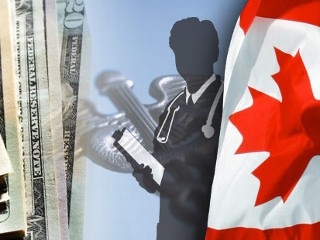
A national shortage of general practitioners means that 1.7 million Canadians don't have access to a regular doctor to go to for routine care. (ABC News Photo Illustration)

Public vs. Private Plans: Cost, Care, Competition

Canada and Great Britain have what's called a "single-payer" health care system: the government pays for everyone's health care using tax revenue. It's true that Obama says he doesn't want a health care system exactly like that.

Instead, he says he wants to set up a public insurance program run by the government that will compete alongside private insurance plans. However, critics warn that a plan like this won't allow private insurers to compete on a level playing field. They say the government will keep costs down for their public plan by setting payment rates for doctors below the market level, the same way that Medicare does now.

"What will happen in the long run is that private insurers will not be able to compete with the government on price," Pipes predicts, "so they will leave the market."

Critics like Pipes say that when the size and power of a government plan grow large enough, public insurers will crowd private insurers out of the health care market and American health care will become a de facto government-run system, like Canada or Great Britain.

"People line up for care. Some of them die. That's what happens," Dr. David Gratzer says of Canada's health care system.

Gratzer, a Canadian doctor, thought Canada's government health care system was great -- until he started treating patients.

"The more time I spent in the Canadian system, the more I came across people waiting for radiation therapy. Waiting for the knee replacement so they could finally walk up to the second floor of their house," he explained.

"You want to see your neurologist because of your stress headache? No problem! You just have to wait six months," he continued. "You want an MRI? No problem! Free as the air. You've just got to wait six months."

Many ER doctors in Canada agree that the system is broken. They say hospitals face a consistent shortage of bed space, and patients often have to wait.

While people in America also wait in emergency rooms, the wait is different in Canada. When patients go to the ER for treatment and are found to be sick enough to enter the hospital, they have to wait in the emergency room for an average of 19 hours before they can be given a hospital bed.

"We can't send these patients to other hospitals that have capacity because there is no other hospital in the area that has capacity," said Dr. Eric Letovsky, an ER doctor from Ontario. "Every other emergency department in the country is just as packed as we are."

Serious Drawbacks to Canadian Model

A national shortage of general practitioners in Canada means that 1.7 million Canadians don't have access to a regular doctor to go to for routine care.

The town of Norwood, Ontario, has only one family doctor available to serve the entire community. To ration the patient list, the town clerk holds a lottery once a month, drawing a few names out of a box that contains all of the people hoping to get on the doctor's patient list. She calls the lucky winners, but everyone else must continue to wait.

Serious Drawbacks to Canadian Model

A national shortage of general practitioners in Canada means that 1.7 million Canadians don't have access to a regular doctor to go to for routine care.

The town of Norwood, Ontario, has only one family doctor available to serve the entire community. To ration the patient list, the town clerk holds a lottery once a month, drawing a few names out of a box that contains all of the people hoping to get on the doctor's patient list. She calls the lucky winners, but everyone else must continue to wait.

It's true that America's partly-private, profit-driven system is expensive and sometimes wasteful, but that pursuit of profit has allowed our health care system to offer rapid delivery, great doctors, and incredible lifesaving discoveries.

"This is the country of medical innovation. This is where people come when they need treatment," said Gratzer.

Thousands come from countries with government-run health care to take advantage of the advanced care in the United States. The famous Spanish tenor Jose Carreras didn't get treated for cancer in Spain -- he went to Seattle. King Hussein of Jordan came to America for treatment. So did Italian Prime Minister Silvio Berlusconi and South African Archbishop Desmond Tutu.

"Literally, we're surrounded by medical miracles. Death by cardiovascular disease has dropped by two-thirds in the last 50 years," said Gratzer. "You've got to pay a price for that type of advancement,"

The reality is that there are always trade-offs in life. Although government "universal coverage" promises great things like equal care and that no one need worry that an illness will bankrupt them, government control also means waiting in lines and sometimes going without care.

Innovations like birth control pills, cholesterol medication, robotic limbs, and many other things, would not have happened without the possibility of big profit, said Grace Marie Turner of the Galen Institute.

"I want companies to come up with cures for Parkinson's, cures for cancer, cures for Alzheimer's. Unless there is a reward for them to do that, we're not going to have those new medicines," she said.

Some of the best, most innovative treatments and most rapidly-delivered care happens through this pursuit of profit. Even in Canada, you'll find one area where they offer easy access to cutting edge technology.

CT scans and MRIs, hip and knee replacements: available 24 hours a day and without a wait.

"If I see a patient that's torn a cruciate ligament in that patient's knee, we can generally have the patient scheduled for within probably a week," said Canadian Dr. Terri Schiller.

But you have to bark or meow to get that kind of treatment. Schiller is a veterinarian and her practice makes a profit treating cats and dogs.

Want a CT scan in Canada? Private veterinary clinics said they can get a dog in the next day. For people, the waiting list is a month.

"Many clients will come here with their pets and as they're leaving, it's, 'Next time, I get sick, I want to come here. I don't want to go to the regular hospitals,'" said Schiller.

Posted: Knowledge Creates Power