
GBTV - Where the Truth Lives

Election Season 2014

And it has brought us to this trainwreck called ObamaCare and we have bankrupted our kids and grandkids!

We are now headed into the 2014 Election Season and common sense and conservatism are on the rise. Please stand-up and be counted!

Reading Collusion: How the Media Stole the 2012 Election is a great place to start!

The Founding Father's Real Reason for the Second Amendment

And remember the words of Thomas Jefferson "The strongest reason for the people to retain the right to keep and bear arms is, as a last resort, to protect themselves against tyranny in government." See Video of Suzanna Gratia-Hupp’s Congressional Testimony: What the Second Amendment is REALLY For, below (u-tube HERE).

The Leaders Are Here... Palin, Cruz, Lee, Paul, Chaffetz....

T'S A WONDERFUL LIFE

Can You Really Still Believe That None of These People Would Have Done a Better Job???

Bloggers' Rights at EFF

SIGN THE PETITION TODAY...

Showing posts with label Budget Bill. Show all posts

Sunday, December 15, 2013

The Council Has Spoken!! This Weeks’ Watcher’s Council Results – 12/13/13

The House Passed the Ryan-Murray Budget, 332-94

The Budget Deal’s Sneaky Tax Increases

Boehner Attacks Conservative Groups

Boehner Declares War on the American People

It’s war! Senate gears up for epic battle as ZERO Republicans line up to support budget agreement (and Democrats need to find at least five) 

Breitbart Exclusive -- Palin: Read My Lipstick: No New Taxes

The Council has spoken, the votes have been cast and the results are in for this week’s Watcher’s Council match-up.

“The evil that men do lives after them; the good is oft interred with their bones.” – Shakespeare, “Julius Caesar”

“By the skillful and sustained use of propaganda, one can make a people see even heaven as hell or an extremely wretched life as paradise.” – Adolf Hitler on media

“What difference does it make?” – Hillary Rodham Clinton, Benghazi hearings
This week’s winner, Joshuapundit’s The Mixed Legacy Of Nelson Mandela, is my obituary for South African leader Nelson Mandela, whose death literally sparked an orgy of amnesia as both media and politicians rushed to worship at his altar. However, as I point out, his legacy was extremely mixed and comparisons to men like Gandhi, Martin Luther King Jr., George Washington and Abraham Lincoln, were ludicrous. Here’s a slice:

Former South African leader Nelson Mandela has passed away at the age of 95, from complications resulting from a lung infection.

Since he was essentially a secular saint, the hagiographies, the emotional tributes and the kicky sound bites will be in abundance. His place in history is assured, because like other secular saints, burning incense and making offerings at his altar is seen to confer virtue on the worshiper, especially if they’re white.

Nelson Mandela was an important figure in contemporary history, no doubt. But who was Nelson Mandela really? What did he accomplish? What is his legacy?

That’s a more complicated and nuanced story that you’re unlikely to hear about much in the medias frenzy over the next week or so. Because it doesn’t quite fit the script for a secular saint. And the complexity can be imagined when you learn that Mandela was the proud recipient of both the U.S. Medal of Freedom awarded to him by President Obama and the Order of Lenin, given to him by the Soviet Union, hardly a bastion of freedom or even simple human decency.

Certainly, he looked and sounded like a secular saint. A member of a family of Xhosa royalty, his tall, dignified bearing and his measured speech could almost have been cooked up by a Hollywood casting agent.

Nelson Mandela was born in Mvezo, a small village in the eastern part of South Africa’s cape province. Coming from a prominent family , he received excellent schooling in South Africa’s best schools so he could work as a councilor for the the Xhosa’s Thembu royal house. He later attended University of Fort Hare, an elite black institution in Alice, Eastern Cape. There he first got his political indoctrination in anti-colonialism and his introduction to Marxism. Traveling to Johannesburg in 1941, he first ran into the African National Congress in the person of Walter Sisulu, then a member of the fledgling African National Congress (ANC) and the Communist Party of South Africa (CPSA). In Johannesburg, Mandela was taken under the wing of Lazar Sidelsky, a Left wing Jewish lawyer sympathetic to the ANC and a partner in the law firm of Witkin, Sidelsky and Eidelman, who gave Nelson Mandela a job as a law clerk.

In those days,the ANC was essentially a non-violent social justice movement that lobbied for black rights and engaged in local politics. However, like many similar organizations in the West, it had been targeted by the Soviet Comintern and was already infiltrated by members of the CPSA as well as by actual Soviet agents.

While the evidence is mixed over whether Nelson Mandela ever joined the communist party, he frequently attended their meetings, and many of his closest associates, like Lionel ‘Rusty’ Bernstein, Joe Slovo, the long-time leader of the CPSA, his wife Ruth First, Gaur Redebe, Walter Sisulu and Nat Bregman definitely were, and some of them might have been actual Soviet agents. All of them were under ‘party discipline just as American communists were, which meant that their marching orders came directly from the Comintern and the Kremlin, no deviations allowed. Many members of CPSA became part of the ANC and the CPSA is still a part of the ANC’s political coalition today. Mandela’s openly expressed admiration and later friendship for communist dictators, his views on nationalization of South Africa’s major industries and government redistribution of wealth and his subsequently receiving the Order of Lenin from the Soviets shows that at best, he was a communist sympathizer.

After South Africa’s 1948 general election, the Afrikaner-led Herenigde Nasionale Party took power, uniting with the Afrikaner Party to form the National Party. They implemented the system of racial segregation known as apartheid. Mandela and his supporters were able to depose the existing ANC President Alfred Bitini Xuma at that time, who favored non-violence in seeking black civil rights and was an open anti-Communist. As Mandela wrote later in his memoirs, “We had now guided the ANC to a more radical and revolutionary path.”

In 1955, Mandela finally went fully over to the idea of using terrorism as as a political tool, or as he put it, the ANC “had no alternative to armed and violent resistance. ” In this, he was greatly influenced by his open admiration of the tactics of Mao Tse Tung and Fidel Castro.

In fact, the first ‘revolutionary’ act of Mandela’s was to send communist party apparatchnik and ANC member Walter Sisulu to the People’s Republic of China to obtain weapons. The PRC turned Mandela down, officially because they felt the ANC was not prepared for Mao-style guerilla warfare, but perhaps more likely because they were already deeply involved in arming and training the Viet Minh in their attempt to overthrow the Diem government in South Vietnam and similar operations with groups like the Pathet Lao elsewhere in South East Asia. They also likely underestimated Mandela and the ANC’s ability to win a war where resupply would be so difficult and no communist-controlled havens were nearby.

However, Mandela and the ANC began to collect whatever weapons and explosives they could get hold of and prepare for armed struggle on their own,while continuing to work on political agitation against the apartheid regime.

It was at this time that Mandela, inspired by Castro’s guerilla groups like 26th of July Movement and the Viet Minh founded his own terrorist elite, Umkhonto we Sizwe (“Spear of the Nation”, abbreviated as MK) with communists Walter Sisulu and Joe Slovo. The MK made their debut with 57 bombings on Dingane’s Day (16 December) 1961, followed by further attacks on New Year’s Eve.MK killed civilians and military alike, and two of their more famous operations were the Church Street bombing and the Magoo’s Bar bombing, both of which targeted civilians and were designed for maximum carnage..

The MK and an ANC group run by Mandela’s wife Winnie called the “Mandela United Football Club” were also responsible for the murder, torture and kidnapping of both whites and black political opponents and their families who opposed ‘armed struggle’. Much of this came out through Mandela’s own Truth and Reconciliation Commission, which investigated crimes committed under apartheid by both the government and the ANC. The 1998 findings of that investigation were suppressed by President Mandela.

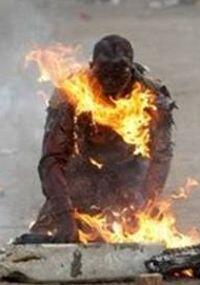
Winnie Mandela is credited with introducing the practice of using necklacing (see video), forcing a gas or oil soaked tire over the head and shoulders to pin the arms of the victim and then lighting it on fire.Her quote? “With our matches and our necklaces we will liberate this country.” She has never served a day in jail, and still sits on the ANC executive committee.

Embedded image permalink

Bob Simon says Mandela was a "normal human being?" Since I, too, want to be normal, will have to brush up on "Necklacing."

It’s worth recalling that the ANC was officially named a terrorist group by the U.S. State Department and many other western nations. That designation wasn’t rescinded officially by the State Department until 1990.

Much more at the link.

In our non-Council category, the winner was The Babalu blog with Gone is Fidel’s greatest admirer, submitted by Joshuapundit. It’s a Cuban blogger’s view of Nelson Mandela and his love affair with Fidel Castor that is must reading.

Okay, here are this week’s full results:

Council Winners

Non-Council Winners

Honorable Mentions

See you next week! Don’t forget to tune in on Monday AM for this week’s Watcher’s Forum, as the Council and their invited special guests take apart one of the provocative issues of the day with short takes and weigh in… don’t you dare miss it. And don’t forget to like us on Facebook and follow us on Twitter… ’cause we’re cool like that!

Thursday, December 13, 2012

Senator Rand Paul: Let Democrats Raise Taxes, Dig Own Grave – Voting Present would be better for GOP

Video:  Rand Paul: Voting Present On Tax Hikes Would Be Better For GOP

By Marion Algier – Cross-Posted at the NoisyRoom

Real Clear Politics: Sen. Rand Paul (R-KY) says if would be better for Republicans to vote present on President Obama's proposal to raise tax rates and allow it to pass than to go off the "fiscal cliff." Paul says that would force Democrats to take ownership of the economy's reaction to a tax hike.

Sen. Paul: If they surprise me and they call me up tonight and say, "what should we do?" Here's what we should do: We should, tomorrow, in the House, vote for what we believe in. Keeping the Bush tax rates as they are for everybody permanently, and cutting spending. Significant cuts in spending and reform entitlements. I have a bill that saves social security and saves Social Security and saves Medicare by reforming them. Let's pass some of those bills and then when the Democrats won't accept it, then let's vote present and let them raise the taxes in the House, and then when it comes to the Senate, the Republican senators vote no, and it becomes like ObamaCare: A Democrat juggernaut. They get what they want, but it will be bad for the economy. But, their fingerprints will be on it and ours won't.

Cavuto: The polls say it will be the Republicans' fingerprints on it; do you buy that?

Paul: That depends on what happens. If the Republicans all decide, let's vote for raising the taxes half as much as Obama wants, and we still have a tax increase and Republicans are for it, it kinda ruins what we stand for. What we stand for is limited government and less taxation, so I think if we go halfway and split the difference with him, I think, then, both parties have their hands on it.

Transcript of Rand Paul with Greta Van Susteren ‘On the Record’

GRETA VAN SUSTEREN, FOX NEWS HOST: Senator Rand Paul says let Democrats dig their own grave. He says let Democrats raise taxes on everybody. Senator Paul is telling Republican colleagues senator to vote present on a deal, allowing Democrats to push through their tax hikes. Why would Senator Rand Paul want to take that tactic? The senator joins us. Good evening, sir.

SEN. RAND PAUL, R-KY: Good evening, Greta.

VAN SUSTEREN: Explain to me why you think that's a good tactic.

PAUL: I think what we should do first of all is put forward what we are for. So if they are in the House, the House leadership should put something forward that extends the Bush tax cuts forever and has significant spending cuts. And I think they passed that.

The Democrats won't accept that and were unwilling to stay by our position. Then I would say let them pass a tax increase on the upper increase folks, but let it do it with their votes, not our votes. Republicans vote present in the House. Democrats can pass the tack increase with only democrat votes and then the Democrats are the parties of high taxes and the Republicans are the party of lower taxes. And I think that's the way it should be.

VAN SUSTEREN: Well, House is not going to go for that. Do you agree? The House isn't going to vote for the Democrats deal.

PAUL: I'm not saying vote for the bill to raise taxes, I'm saying that we vote first on a Bill that says we will not raise the taxes, and that is our true position. That's what we stand for. We think that you stimulate the economy by leaving more money in the economy, actually lowering taxes. That's our philosophy. That's who we are as Republican.

So I would pass that. The House has passed that previously. I would pass that again now, and that if we cannot get the president to negotiate from that position, and if they are going give in, don't give in by splitting the baby. Give in by voting present, let the Democrats pass an increase in the upper tax brackets, comes over to the Senate, Republicans vote no, and it becomes a Democrat tax increase but not a Republican/Democrat tax increase, which I think is a mistake for the Republicans.

VAN SUSTEREN: Republican Senator Ron Johnson from Wisconsin says it's not the end of the world if we go over the fiscal cliff, although there are some economists who say it could thrust us back into recession. What do you think will happen if we go over the fiscal cliff?

PAUL: I don't think there is a cliff in the sense that all of a sudden tomorrow something dramatic happens. I think stock markets sometimes react quickly, but for the most part, whether it's going to be a recession or not is a much more long, drawn-out process.

But I would say that it's not a good idea to raise anyone taxes, and that the marketplace does not differentiate whether you take the money from rich people, poor people, or middle class. The marketplace says if you are going to take $800 billion, are you taking it out of the private sector, the productive sector, and are you going to give it to the nonproductive sector in Washington, basically the sector of people who are always messing up things in the marketplace? Are you going to do that? If you are going to do that, it's a bad idea no matter whether it's rich people, middle class, or poor. It doesn't matter. If you take money out of the private sector, it's a bad idea.

VAN SUSTEREN: Well, it's not as though the taxes around going to go up on the wealthiest Americans come January 1. Maybe not to the extent the Democrats want in the income tax bracket, but certainly it's going to go up. They will pay more in Medicare under the Obama healthcare. They will pay more on their investment income, 3.8 percent if you are a high earner. So there will be additional taxes. I realize you will pay for other things besides. Taxes are going to go up for the wealthiest Americans on January 1, just not as much as Democrats want. Would you agree?

PAUL: Yes. And here's the question. How much is enough? When will they have enough? The thing is most people in a lot of these high tax states are already pagan excessive amount of their income. Look at companies now trying to get away from the tax collectors. Look at Google taking their money to Bermuda. Look at all the corporations who can't stand to pay 35 percent income tax in America that won't bring their money home. Money goes where it is welcome.

VAN SUSTEREN: Let me ask you about Google. Google managed to do tax avoidance, which is not illegal, by putting money in Bermuda and I think they saved $2 billion in tax avoid dance. What efforts are being done by the Democrats or the Republicans to discourage that type of lawful avoidance, but nonetheless a huge amount of money for a very wealthy company?

PAUL: I'm not against them doing that. In fact, I compliment them because that money stayed in the private marketplace. But I would say to folks who are doing that, don't come to Washington and agitate for higher taxes if you are avoiding taxes. By all means, continue to legally avoid as many taxes as you can because that keeps money in the private marketplace and helps to create jobs. I'm all for that. But don't at the same time come agitate for higher taxes, because we need lower taxes.

Countries around the world are finding out that this is a mistake. England raised their upper rate, and they got lower tax revenue. When the Bush tax cuts came into play we lowered tax rates and we got more revenue. So the main reason I'm opposed to what the president is doing is it's not going to work, and it may give us less revenue and less economic growth. So I'm completely opposed to the president. I was before the election and I still am after the election.

VAN SUSTEREN: If you look at Google, you say you're not opposed to that. But if you take, let's take the category, $250,000 to $3 million a year, that category, they don't hide their money, but they don't avoid taxes by using Bermuda because they don't have the structure to do that, number one. And number two is that they don't have all these lobbyists that create these payroll tax codes so that they can do that. So there's actually sort of a wealthy class that just is the billionaire class --

PAUL: That's true, and it isn't a fair tax code. The way you get a fair tax code is to lower rates and get rid of deductions so people don't have to avoid their taxes. But I will say in Google's defense, the corporate income tax in our country is 35 percent. In Canada it's 15 percent. In Bermuda I think it's nine percent. All across Europe it's in the 20s. Money goes to where it's welcome. Money is not welcome in the United States, or the president is trying to make it worse so money and people will flee. People will flee if you raise their taxes. They also won't work as hard and you'll be getting less revenue, not more, exactly the opposite of what the president wants.

VAN SUSTEREN: For years I've been hearing tax code reform. That's all I've been hearing, and maybe we'll get it sometime, but I'm not holding my breath. Senator, thank you, sir.

PAUL: Thank you.

The Political Class Base Line Budgeting Scam

TPN: “The Federal Government is like a treasure that a man discovered hidden in a field. In his excitement, he hid it again and sold everything he owned and raised as much legal or illegal campaign money to get enough money to buy the field—and to get the treasure, too!

This explanation below and above just frames perfectly what we're up against far as our debt goes. You have a central government that has welded and cemented procedures and strategies in place to forever grow the size and scope of government. A political class that directs it, and since it is not in the best interest of the political class and their families to cut their own influence and paychecks you find them spending billions every election cycle to 'keep” and “grow” their inheritance. As you read the news headlines these days you will see how people will resort to all kinds of violence if you dare to go near that field that has that self perpetuating treasure in it. And in reality that "treasure" is really a "flimsy white washed wall' and when the next strong wind comes along it's going down. So since those that are awake, know that it is a white washed wall, and we can see that their is a political class that is enriching themselves along with their supporting minions maybe we should seriously start looking back to the governments that do not have a printing press in their basements...our own states! Shouldn't we be encouraging our states to start saying "No" to what was supposedly to be a limited referee to the "Union" of states that has now become brazenly ":Unconstitutional” and has now transformed itself back into the Symbolic Manifestation of King George and Lord North or maybe more fittingly Joseph Stalin?. ...here comes another (3) $ trillion added to the political classes Inheritance....I can hear Yessss! Echoing powerfully through out Washington and reverberating through the Halls of our most "Honorable" Congress now as I hear the "Yea" votes carrying the day as we add that $3 trillion!

"Baseline budgeting" is one of those Washington terms that sounds very dry and boring. In reality, baseline budgeting is one of the most sinister ways that politicians claim to cut spending when they are actually increasing spending. The Congressional Budget Office defines the baseline as a benchmark for measuring the budgetary effects of proposed changes in federal revenue or spending, with the assumption that current budgetary policies or current services are continued without change. The baseline includes automatic adjustments for inflation and anticipated increases in program participation. Baseline, or current services, budgeting, therefore builds automatic, future spending increases into Congress's budgetary forecasts.

Baseline budgeting tilts the budget process in favor of increased spending and taxes. For example, if an agency's budget is projected to grow by $100 million, but only grows by $75 million, according to baseline budgeting, that agency sustained a $25 million cut. That is analogous to a person who expects to gain 100 pounds only gaining 75 pounds, and taking credit for losing 25 pounds. The federal government is the only place this absurd logic is employed.

Politicians often like to have it both ways. Baseline budgeting gives politicians an opportunity to deceive taxpayers by allowing them to claim that they are holding the line on spending while providing more services.

Baseline budgeting seems like a technicality and should not be such a hotbed of contention, but every round of budget negotiations involves baseline budgeting with both sides of the aisle complaining that the other side is using the process to mask spending increases. Baseline budgeting is an issue that truly separates the deficit hawks from the budget chickens.

Eliminating the inflated budget baseline will force Congress to justify and account for increased spending instead of hiding behind automatic increases. Through commonsense accounting, taxpayers would learn that spending in Washington is not under control. (Citizens against Government Waste)

Is Obama Creating a Civil War in the House to Demonize Republicans… and the Simple Solution

The Marxist Plan to Bankrupt the United States: Is History Repeating Itself?

Fighting Back… BEST SPEECH(ES) OF 2012! (BILL WHITTLE)

Tuesday, August 14, 2012

Erskine Bowles says: Ryan Budget is "Sensible...Honest, Serious"

Who is Erskine Bowles you ask? Erskine Bowles is the Democratic co-chair of President Barack Obama's National Commission on Fiscal Responsibility and Reform with Alan K. Simpson

Video: Erskine Bowles: Ryan budget is "sensible...honest, serious" (1:14 mins total)

Wait till you hear what he says about Obama's budget - and what that "cut $4 trillion over 12 years" really was.  And, what he said about Paul Ryan is fabulous!! :-)

Daily Caller – Photo: AP

Erskine Bowles is not backing away from his previous praise of Rep. Paul Ryan now that the Wisconsin congressman is on the Republican presidential ticket.

“I like him,” Bowles, the former chief of staff to President Bill Clinton and co-chairperson of the National Commission on Fiscal Responsibility and Reform, told The Daily Caller in a phone interview.

“I think he’s smart. I think he’s intellectually curious. I think he is honest, straightforward and sincere. And I think he does have a serious budget out there — it doesn’t mean I agree with it by any stretch of the imagination. But I’m not going to act like I don’t like him or that I don’t have some real respect for him.”

Bowles, who along with former Republican Wyoming Sen. Alan Simpson chaired a presidential commission that ultimately released a budget proposal to fix America’s long-term budget crisis, says that though he has disagreements with some aspects of Ryan’s budget, he believes they can be overcome.

“You know, there’s a reason he didn’t vote for our budget, and there’s a reason that, I know, that I have some disagreements with his budget,” Bowles said.

“But it doesn’t mean we couldn’t find a way to, you know, have principled compromise that would, you know, that would address this horrendous problem that we face with these deficits.”

A bipartisan group of four senators recently wrote a letter to the presidential debate commission requesting that it ask the presidential contenders about where they stand on the Simpson-Bowles debt plan. In response on Tuesday, three Democratic House members wrote to the commission asking it not to specifically ask the presidential candidates where they stand on the Simpson-Bowles plan. In a follow-up email responding to the Democrats’ letter, Bowles said, “There are lots of Democrats and Republicans that wish this whole debt/deficit talk would just go away.”

Comments:

One Term:

"Bowles says he plans on voting for President Obama in November."
…bowles and his entire massive effort to rein in the US debt were thrown under the bus by OBOZO – and yet he’ll still vote for him. NOBODY can ever say that committed d-cRAT socialists are SANE, RATIONAL or RESPONSIBLE – or act in the best interest of the country. NOBODY.

MGA:

What is wrong with these lefties? Last night on ‘On the Record’ with Greta, she interviewed Paul Ryan’s former government teacher, Sam Loizzo, who rambled on about what a great guy and great friend Paul Ryan is/has been and how Ryan was a great student, smart, hard-working and is a person of character who wins consistently in a mixed district where Gore and Obama won at the same time he won his Congressional seat race each time. He also talked about how Paul Ryan honored him on the House Floor for being a great influence on his life and how great Ryan always is wonderful with the students at home in Janesville and those that retired teacher Sam Loizzo has brought to DC on field trips over the years. He says he loves Ryan who is a great family man and a man of principle. So Greta jumped in and asked the union Democrat teacher if he will vote for Ryan as VP. And he said no, because Ryan believes in education being a local responsibility. God only knows… friendship, honesty, principle etc. can’t trump federal government money for these big government lefties. SAD!

I’m going to be writing Sam Loizzo in Janesville, WI and telling him: Shame on You!

Romney-Ryan: America’s New Dream Team and a Clear Choice

Video: Ryan eviscerates Obama on Obamacare in 6 minutes

Thursday, July 19, 2012

Why We Have No Budget and Why It Can’t Be Balanced

“We receive wake up call after wake up call and all to no avail because our government is either economically illiterate and doesn’t understand the problem of spending other people's money even after other people run out of money, or is too ideologically committed.  The best, but radical, thing that we could/should do is to cut entitlements and foreign aid immediately, knowing full well that could start rioting. And even that would be just the beginning, it will be like chipping away at an iceberg (See the video below)”  …Gary the Rat

WHEN BROKE means BROKE

We Have A Budget That Can't Be Balanced

clip_image001

CLICK clip_image002 HERE

http://www.youtube-nocookie.com/embed/EW5IdwltaAc?rel=0

And yet…

Obama Ends Welfare Reform as We Know It, Calls for $12.7 Trillion in New Welfare Spending putting us even further into debt to try and garner votes for his re-election.  President Obama has also played the smoke and mirrors game pandering to students on the backs of seniors by hiding a provision in the transportation bill covering first year college loan fees with money from the already broke social security fund.

The people we have in the White House now and most that we have in Congress are not capable or not willing to do what needs to be done to fix the problems.  And many don’t even understand the problem and are ideologically blinded.

President Obama and the Senate under the leadership of Harry Reid purposely kept this from the American people by not passing a budget or bringing on to vote in years.

All issues other than fixing the economy and jobs are diversions and secondary at this point.

In November we must clean house from President Obama on down or our ship of state will sink!

clip_image001[4]I'll take Romney's business experience over the nightmare we're experiencing in Obama's America Any Day!

Related:

Economist Ron Hera really nails it. We are ALREADY in collapse

Thursday, April 14, 2011

Here Come the Judge: Judge Napolitano on the Debt, the President and You

Today after we heard President Obama’s Election 2012 kickoff speech while expecting to hear a speech on the budget… we heard from Judge Andrew Napolitano, sitting in for Glenn Beck as he is on the road for his Elegant Eliminations Tour, and guests.  the President said that the debt really does matter. For most of his tenure, he has been subscribing to a bogus economic philosophy that government spending can spur the economy - and that the government can spend as much as it wants in order to carry out this absurd idea. So, what if anything changed with today's speech?  Can someone say election spin??

Guests include Senator Lindsey Graham (R-SC), Former Arkansas Governor Mike Huckabee, Congresswoman Michele Bachmann (R-MN), Fox News Analyst Kirsten Powers, Nancy Skinner and CATO Institute's Mark Calabria.

Video:  The Debt, the President and You


Fox’s Neil Cavuto Conducts The Most Fiery Deficit Reduction Interview Ever? 

Election On:  ‘Spinmaster’ Obama Spins Budget Speech Into First Campaign Speech of the Season

Editorial:  Obama’s Honesty Deficit

Video:  Freshman Representatives First 100 Days On FOX Part I 

Video:  Freshman Representatives First 100 Days On Fox Part II

Video:  Obama vs. JFK on Taxes

Video:  Reagan on Taxes

The Budget Compromise Was a Big Fraud?!?

Heritage Foundation:  Pentagon Warns on Cost of Obama’s Plan to Slash Defense

Paul Ryan Discussing Obama’s Speech:   Ryan: Time to "act like adults".(SLAMS Man-Child Obama's Speech!)

Obama Goes in for the Kill

Wednesday, April 13, 2011

Election On: ‘Spinmaster’ Obama Spins Budget Speech into First Campaign Speech of the 2012 Season

The American people thought they were tuning into President Obama’s speech about the budget, the upcoming budge crisis, the debt ceiling battle and his solutions and a detailed plan, or at least an outline with some details.  Instead we heard a campaign speech filled with broad stroke rhetoric and short on detail.  At first I thought maybe I was being unfair, but when the Democratic strategist and commenter on the review panel with Shannon Breen, right after the speech started with, “Campaign On!!”, I realized that I was “on” as well.

The president took the time to try and regain control of his leadership deficit instead of focusing on on America’s budgetary deficit.  He tried to connect with  the “Middle Class” where he has lost support and with seniors, using scare tactics and double speak to address their fears.  Obama also attacked Paul Ryan’s plan without using Ryan’s name.

We are beginning to hear all the right words, that will be forgotten or changed, once the election is over, as we heard from Obama in 2007 – 2008 on the campaign trail.  The question is, “Will the American people fall of it again?”  Pollster Frank Luntz says based on his polls the answer is: “NO” but the country is definitely divided.

He Still Wants to Spread the Wealth Around ... Rich 'Can Afford to Give Back a Little Bit More'

President Obama's Remarks on His Debt Plan:

"For much of the last century, our nation found a way to afford these investments and priorities with the taxes paid by its citizens. As a country that values fairness, wealthier individuals have traditionally born a greater share of this burden than the middle class or those less fortunate. This is not because we begrudge those who've done well - we rightly celebrate their success. Rather, it is a basic reflection of our belief that those who have benefitted most from our way of life can afford to give a bit more back. Moreover, this belief has not hindered the success of those at the top of the income scale, who continue to do better and better with each passing year."

"Of course, there will be those who disagree with my approach. Some will argue we shouldn't even consider raising taxes, even if only on the wealthiest Americans. It's just an article of faith for them. I say that at a time when the tax burden on the wealthy is at its lowest level in half a century, the most fortunate among us can afford to pay a little more. I don't need another tax cut. Warren Buffett doesn't need another tax cut. Not if we have to pay for it by making seniors pay more for Medicare. Or by cutting kids from Head Start. Or by taking away college scholarships that I wouldn't be here without. That some of you wouldn't be here without. And I believe that most wealthy Americans would agree with me. They want to give back to the country that's done so much for them. Washington just hasn't asked them to. "

Obama Outlines New Deficit-Reduction Plan, Slams GOP Proposal

Published April 13, 2011 | FoxNews.com

Drawing a clear line between his budget priorities and a proposal pitched by Republicans, President Obama outlined a new spending plan Wednesday which he claimed would cut the deficit by $4 trillion within 12 years with a combination of spending cuts and tax increases on the wealthy.

Obama, in a speech at George Washington University which amounted to an opening argument in the emerging 2012 presidential campaign, positioned his latest spending plan as a more "compassionate" alternative to one introduced last week by GOP Rep. Paul Ryan. He applauded Republicans for putting a plan on the table to address entitlements, but the praise stopped there.

"The way this plan achieves those goals would lead to a fundamentally different America than the one we've known certainly in my lifetime," Obama said, calling their plan "deeply pessimistic." He suggested Republicans were giving up on basic functions of government.

"It's a vision that says if our roads crumble and our bridges collapse, we can't afford to fix them. If there are bright young Americans who have the drive and the will but not the money to go to college, we can't afford to send them," Obama said of the Republican plan. "It's a vision that says America can't afford to keep the promise we've made to care for our seniors."

The president's proposal would deal with entitlements like Medicare and Medicaid, but avoid the major changes being pushed by Ryan. The president opposes turning Medicaid into a block-grant program for states and making Medicare seniors purchase government-subsidized insurance, as Ryan proposed. Rather, he vowed to make other changes he claims will extract more than $300 billion in savings from those Medicare and Medicaid over the next decade. Plus he pushed cuts in discretionary spending, including to defense.

The president drew several lines in the sand, as the latest round of the budget debate gets underway. Accusing Republicans of cutting services to seniors and poor children while cutting taxes for the rich, Obama said: "That's not right, and that's not going to happen as long as I'm president."

The White House, instead, has called for a "balance" between cuts and changes to the tax code. Though the administration refers to this as "tax reform," the plan includes a call for rolling back the Bush tax cuts for the wealthy -- meaning a tax hike for households making more than $250,000.

Republicans and Democrats had agreed to extend all the Bush tax cuts for two years, but Obama said Wednesday, "I refuse to renew them again" for the wealthy.

"The most fortunate among us can afford to pay a little more. I don't need another tax cut," he said.

Republicans, though, have roundly opposed a tax hike for anyone.

"I hope we don't have a re-do and a do-over of the tax agreement," House Republican Leader Eric Cantor, R-Va., said. "This was an issue that was litigated in the election last fall."

Having met with the president Wednesday morning before the speech, House Speaker John Boehner said that he made clear to the president that if the government is going to do something credible and meaningful, "raising taxes will not be part of that."

"The one area that we know we're not going to get very far on is that we're going to raise taxes on the very people we're counting on to ... create jobs," he said.

Obama's plan also called for a "failsafe" trigger, which would apply across-the-board spending cuts if the national debt, as a percentage of GDP, is not on the decline by 2014.

The speech effectively served as a counterproposal to the 2012 budget plan offered by Ryan. The chairman of the House Budget Committee has proposed a plan he claims will cut deficits by $4.4 trillion over the next decade, in large part by overhauling Medicare and Medicaid. He offsets the savings from some of the proposed spending cuts with tax cuts, leaving critics claiming his plan is out of balance, rewarding the wealthy while cutting programs for the poor.

While a rebuttal to Ryan's plan, Obama's speech is also a follow-up to the 2012 budget plan he put on the table earlier in the year.

Republicans have simultaneously welcomed Obama's entry into the latest debt debate while ridiculing him for waiting so long to do so.

"This is vintage Obama. He's been standing on the sidelines expecting the rest of us to make the tough decisions," Cantor said.

The new clash, just a week after the president announced he would seek re-election, ensures that the nation's fiscal health will be at the center of the 2012 presidential campaign. For the past two months, Obama has been arguing to protect his core spending priorities, including education and innovation. His turn to deficit reduction reflects the pressures he faces in a divided Congress and with a public increasingly anxious about the nation's debt, now exceeding $14 trillion.

The president is wading into a potential political thicket. Liberals fear he will propose cuts in prized Democratic programs like Medicare and Medicaid, the health care programs for older adults, the disabled and the poor, and in Social Security. Moderates worry that his plan could unravel bipartisan deficit-cutting negotiations. And Republicans already are poised to reject any proposal that includes tax increases.

A group of liberal Democrats on Wednesday described their latest budget plan, one they said was not necessarily meant as a substitute for the president's. The plan would make no cuts to entitlement programs, but would call for ending the wars in Iraq and Afghanistan and rolling back the Bush tax cuts.

For the White House, the speech at George Washington University comes as Obama pushes Congress to raise the limit on the national debt, which will permit the government to borrow more and thus meet its financial obligations. The country will reach its debt limit of $14.3 trillion by May 16. The Treasury Department has warned that failure to raise it by midsummer would drive up the cost of borrowing and destroy the economic recovery.

Obama's speech comes just before Congress votes on a $38 billion package of spending cuts that averted a government shutdown last week. Despite widespread antipathy toward the deal in both parties, House Republicans and the White House predicted the plan, which covers spending for the next six months, would pass.

The Associated Press contributed to this report.

Raise ‘Em! Obama’s Grand Plan Includes Increasing Taxes

Video: Eat the Rich

Good Plan!! Republican Paul Ryan’s Budget Proposal Is Brave, Radical, and Smart 

Text of Obama’s “Budget/Economy” Speech

Ryan Will Respond to Obama Entitlement Reform Speech

Wednesday, April 6, 2011

Good Plan!! Republican Paul Ryan's budget proposal is brave, radical, and smart.

Good Plan! 

Republican Paul Ryan's budget proposal is brave, radical, and smart

By Jacob Weisberg  -  Posted Tuesday, April 5, 2011, at 6:09 PM ET

For the past 30 years, Republicans have been hypocrites about spending. They've raged against big government without ever proposing the kinds of cuts necessary to bring federal expenditures in line with tax revenues. Democrats have been more fiscally responsible, producing an actual budget surplus during Bill Clinton's second term. But they've been little better than Republicans when it comes to confronting the nation's long-term fiscal imbalance, which is driven by the projected growth in entitlement spending.

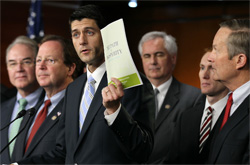
U.S. Rep. Paul Ryan holds a copy of the 2012 Republican budget proposal. Click image to expand.Rep. Paul Ryan holds a copy of the 2012 Republican budget proposal This dynamic of political evasion and reality-denial may have undergone a fundamental shift today with the release of Rep. Paul Ryan's 2012 budget resolution. The Wisconsin Republican's genuinely radical plan goes where Ronald Reagan and Newt Gingrich never did by terminating the entitlement status of Medicare and Medicaid. (It doesn't touch the third major entitlement, Social Security, though Ryan has elsewhere argued for extending its life by gradually raising the retirement age to 70.) Ryan changes Medicare into a voucher, which would be used to purchase private health insurance. He turns Medicaid into a block grant for states to spend as they choose. Though his budget committee isn't responsible for taxes, Ryan includes the boldest tax reform proposal since the 1980s, proposing to lower top individual and corporate rates to 25 percent and end deductions. While he's at it, Ryan caps domestic spending, repeals Obamacare, slashes farm subsidies, and more.

If the GOP gets behind his proposals in a serious way, it will become for the first time in modern memory an intellectually serious party—one with a coherent vision to match its rhetoric of limited government. Democrats are within their rights to point out the negative effects of Ryan's proposed cuts on future retirees, working families, and the poor. He was not specific about many of his cuts, and Democrats have a political opportunity in filling in the blanks. But the ball is now in their court, and it will be hard to take them seriously if they don't respond with their own alternative path to debt reduction and long-term solvency.

And before they reject everything in Ryan's plan, liberals might want to consider whether some of what he proposes doesn't in fact serve their own ultimate goals. Ryan's proposal to turn Medicare into a voucher provides an easy political target. But it's hard to make a principled liberal case for the program in its current form. To do so, you have to argue that government-paid health care should be a right only for people over the age of 65, and for no one else. Medicare covers doctor and hospital bills at 100 percent, regardless of income. This gives doctors and patients an incentive to maximize their use of the system and waste public resources. Choosing to pay 100 percent of Warren Buffett's medical bills while cutting Head Start reflects a strange set of social priorities, to say the least.

Ryan's alternative to Medicare hardly seems as terrible as Paul Krugman makes out. Seniors would enter the health care world the rest of us live in, with co-payments, deductibles and managed care. Eventually, cost control would require some tough decisions about end-of-life care and the rationing of high-tech treatments that have limited efficacy. But starting with a value of $15,000 per year, per senior—the amount government now spends on Medicare—Ryan's vouchers should provide excellent coverage. His change would amount to a minor amendment to the social contract, not a fundamental revision of it.

Effectively constraining the growth of Medicare could make it possible for Democrats to do a lot else that's important to them in the future. In 2010, Medicare spending was $519 billion, as compared with $666 billion for all nondefense domestic discretionary spending. Growing at more than 7 percent a year, Medicare is projected to eventually consume nearly all federal tax revenues. It is crowding out everything else that Washington does or might want to do. Conversely, cutting Medicare's growth rate to near the overall rate of the economy would do more than anything else to enable the kind of activist government liberals support—investment in kids, education, jobs, and infrastructure. Ryan's goal isn't to empower the federal government. But if your goal is a more interventionist public sector, you might find yourself on Ryan's side of the Medicare debate.

Of the alternatives we face in controlling long-term spending growth, moving Medicare to a voucher system seems only mildly unfortunate—and nothing as compared with a debt-driven economic crisis that could stem from inaction. As Ryan rightly points out, this kind of crisis could come at any time and could cast a pall over the country's entire future. Keeping Medicare as a fee-for-service program simply isn't worth that risk. If anything, liberals should go further than Ryan did in this plan, adding a means-test that would diminish Medicare subsidies for upper-income beneficiaries.

There are, of course, some sleight-of-hand tricks in Ryan's plan. What he claims would restore fiscal balance would do nothing of the kind over the next decade, leaving $400 billion in annual deficits as far as the eye can see. That's because he slips a large tax cut into his "reform," leaving government revenues perpetually two percentage points lower than spending expenditures as a share of GDP. What's needed is not more tax cuts but a modest tax increase, of the kind the Simpson-Bowles fiscal commission proposed. That failure is easily remedied, however, by adopting a top rate higher than the 25 percent he proposes, though still lower than the current 35 percent level.

Ryan also evades a lot of difficult particulars. He seldom spells out domestic spending cuts, preferring to kick the can down the road by applying "caps." He skirts the question of which deductions and tax subsidies he'd eliminate to pay for these lower rates. Unfortunately, you don't get big savings unless you eliminate mortgage interest and charitable deductions, which would be politically unpopular. Ryan includes the Heritage Foundation's projections about job growth triggered by his plan—4 percent unemployment in 2015 vs. 5.9 percent without the plan—that are a supply-side fantasy. His anti-bailout rhetoric is silly pandering. I could go on.

But more than anyone else in politics, Rep. Ryan has made a serious attempt to grapple with the long-term fiscal issue the country faces. He has a largely coherent, workable set of answers. If you don't like them, now you need to come up with something better.

Slate

Video:  Explaining Paul Ryan’s Budget Plan

But before we can even get to this budget proposal and the debt ceiling the present House and Senate have to come to an agreement on the budget that Nancy Pelosi, Harry Reid and President Obama pushed off into this year. They didn’t do their jobs to help themselves in the 2010 elections and now they are fighting the will of the people to cut spending which was the 2010 mandate and are trying to delay to make the GOP look like they are the bad guys and shut down the government… when they are only doing what they were elected to do… by the people.  Don’t buy into the smoke and mirrors of Reid, Pelosi and Obama.  That is how we got here.

And as usual, all of a sudden in the last hours Obama is looking concerned…

GOP CHICKEN RUN FATAL

If House Republicans accept a "compromise" of less than $61 billion in budget cuts, it will demonstrate that they will never really make good on their sole bargaining chip -- a government shutdown. If they don't do it over the continuing resolution (CR), they won't do it over the debt limit or the 2012 budget.

If the Republicans in the House accede to Democratic and administration demands that they accept a lesser figure in budget cuts, they will throw away all their power and be revealed as toothless and impotent, though still noisy. In this one act, they will throw away the victory of 2010.

And there is no need to cave in! The prospect of a government shutdown is not the only alternative. A targeted shutdown, which zero-funds programs we want to go away anyway and which the public will never miss, is the real option.

Don't shut down the government. Shut down the State Department and the Agency for International Development. Alone, that would generate the $61 billion in cuts. Zero-fund PBS and the Endowment for the Arts and Humanities. Zero-fund the Bonds for America Program ($12 billion). Zero-fund the stimulus programs for infrastructure construction and repair.

Senate Democrats and the Obama administration will not dare shut down the rest of the government in retaliation. If they do, the entire fight will be posed as: Do we want to eliminate foreign aid, or shut down the entire federal government to save it?

Once the Republicans win the fight in principle, they can back off the zero-funding and negotiate a CR that makes more sense and spreads the cuts more widely but still totals $61 billion. But during the shutdown phase, the shutdown must be targeted at agencies that have no popularity or domestic constituency.

Once Senate Majority Leader Harry Reid (D-Nev.) and President Obama realize that House Republicans won't pull the trigger on a government shutdown (entire or targeted), there is no reason for them to negotiate seriously with the House. The GOP's leverage will evaporate, and its capacity to fulfill any of its campaign promises will have been vitiated.

Are the Democrats seriously to believe that House Republicans will kill the debt-limit increase if their demands are not met or will close the government on Oct. 1 if their budget is not adopted? Once the House Republicans back off on the CR, there is no way they can be taken seriously.

For Speaker John Boehner (Ohio), Majority Leader Eric Cantor (Va.), Budget Committee Chairman Paul Ryan (Wis.) and Appropriations Committee Chairman Hal Rogers (Ky.), the stakes are their credibility within their own conference. The Tea Party Republicans and most of the freshmen are not going to support retreat from the $61 billion in cuts. They will be sustained by a massive outpouring of opposition to any compromise by their ground troops. By trying to do Harry Reid's work and jamming a compromise down the throats of the freshmen and Tea Party Republicans, Boehner, Cantor, Ryan and Rogers all risk a profound division in the party. In effect, they will be announcing a kind of coalition majority in the House, discarding the leftist Democrats and the Tea Party Republicans with equal disdain. The Republican House campaigns of 2012 will be riddled with primary contests and much of the establishment of the party will be swept from office in a sea of anger and outrage at their failure to keep their promises.

Any Republican who votes to compromise on the $61 billion is inviting a primary fight -- one in which I will happily participate. We elected the House Republicans to stand firm. We put them in office not to cave in. And now, we will find out what they are made of.

Dick Morris  - Former Advisor to Bill Clinton and author of: Revolt!  -  Published on TheHill.com on April 5, 2011

ALERT: Getting Our Fiscal House in Order and Changing Our ‘Normalcy Biased’ in Order to Save Ourselves, America and the World a Must!

As people left their offices in the burning Twin Towers on 9/11 after have planes strike them, they stopped to turn off their computers… as if they were actually ever coming back?  Why???  For the same reason that there are still people all across America who are not radicals and do not want their country transformed, nor believe in a One World Government, but are plodding along and even making plans as if life in America and the rest of the world had not changed… forever.  Are you one of those?  If so, time to change your ‘Normalcy Biased’ because we need you to help save this Country!!

In the video below: Beck covers the Normalcy Biased plus the federal government’s 'spending orgy' over the past two years. But now, as the election campaign season begins, we are hearing them talk tough about getting our fiscal house in order...but are they really serious about it? I think you already know the answer to that. But if not, you will after watching the program. Also, more on our favorite radicals... where was Van Jones and what exactly was he saying on September 12, 2001? Plus, Frances Fox Piven gives her own version of Glenn's "Tree of Revolution" at today's "teach-in".

Video:  Changing our Normal Biased to Save Ourselves, American and the World

Glenn Beck’s Overton Window is Today’s Chilling Story

April 5th, 2011

The following was written by Gina Miller. Her opinions don’t necessarily reflect those of ScottFactor.com, but because they’re here, they probably do.

The “elites” of the world view me as a “useless eater.”  I understand this and the evil thinking behind it.  I’m just a no-name blogger who is not only of no use to the elites, but in my writings, I am a small voice of opposition to their goals of a one world order, because I write about the virtues of true liberty with personal responsibility, the fragile preciousness of American sovereignty and the overarching truth of God’s Word.  That makes me an enemy of the state of the elites.

These thoughts are always in my mind, but recently they have been larger in my thinking after my trip back home to Texas.  My dear 82-year-old grandmother died on Tuesday, March 22, after suffering for a while with severe breathing problems.  Despite my previous vow to never fly again, especially in light of the overbearing and invasive Transportation and Safety Administration’s (TSA) excessive policies, I found it necessary to fly home for her funeral.

I was pleasantly surprised at the smooth trip.  The TSA workers were polite, and even though my city’s airport has one of those nude body scanners, it was not in use, so I did not have to choose between having my body groped and having a pornographic image made of myself.  The only thing I dealt with besides walking through the metal detector was the stupid requirement to remove my shoes, for which I had the Muslim moron Richard Reid, aka “the Shoe Bomber,” to thank.

On the return trip, I had a three-hour layover at Dallas-Fort Worth.  I had finished reading the novel I had brought along for time-killing, so I browsed a book store in the airport.  And, there they were: paperback copies of Glenn Beck’s The Overton Window.So, I thought, “I’ll bite,” and I bought a copy.

The first thing I noticed about the book was the strange depiction of the Statue of Liberty on the cover.  I immediately saw that although it looks like the Statue of Liberty, it is not an exact likeness.  This is explained in the book.  It turns out the figure is an imaginary cross between the Statue of Liberty and the Colossus of Rhodes.

Although the story is fiction, there are many true events woven in throughout the book.  After a disturbing prologue, the story opens in New York with the protagonist, a young man named Noah Gardner, who is the son of a powerful public relations magnate, Arthur Gardner.  The character of Noah’s father is loosely modeled after Edward Bernays, who was a nephew of Dr. Sigmund Freud and an American pioneer in public relations and propaganda.

Noah meets and is smitten with Molly Ross, whom we recognize as a type of Tea Partier, although she is not called a Tea Partier.  She belongs to a group called Founders’ Keepers, and she recognizes that “the America as we know it is about to be lost forever.”

The story goes from there as Noah is forced to face the hard truth of a globalist takeover of our country in the aftermath of an unheard-of attack on the United States.

I was impressed with Glenn Beck’s skill as a storyteller.  His writing style is fresh and distilled, not given to excessive descriptions or flowery words to say what he wants to say.  The story is fast-paced and intense, and it is apparent that Glenn and his team did a boatload of research in crafting the story.

The Overton Window concept is explained in the book and on the book’s back cover,

“There is a powerful technique called the Overton Window that can shape our lives, our laws, and our future.  It manipulates public perception so that ideas once seen as radical become acceptable over time.  Move the Window and you change the debate.  Change the debate and you change the country.”

I have Glenn to thank for a song being stuck in my head right now.  One of the book’s characters, a member of the Founders’ Keepers group, is a man named Danny Bailey.  As soon as I read his name in the book, Elton John’s song, “The Ballad of Danny Bailey (1909—1934)” from his Goodbye Yellow Brick Road album popped into my head and has been playing off and on ever since.  I don’t know if Glenn considered the ill-fated character in the song when naming his book’s character, but it could be that he did.

Glenn’s book highlights the long-standing plan by the globalists to assimilate America into one world governance.  It’s plain that we’re just a moment away from it, even at the door.  Many of us are waiting and watching for “the event” that plunges us into a total police state where citizen patriots are rounded up in special detainment centers—for our own good and the good of the country, of course.

The events in The Overton Window are entirely plausible.  You cannot read this book and think it can’t happen here.  Our  nation is teetering on the brink of financial collapse.  We cannot imagine a situation that makes the Great Depression look like a walk in the park, but we are being set up for just such a time.

What about a catastrophic terrorist attack?  Whether an attack is done by Islamists or shadowy globalists, the result would be the same, and our already vanishing liberties could be suddenly and completely swept away in a tide of martial law.  Our government and military have done extensive planning for just such a scenario, and Glenn includes citations in the back of his book of a few example stories.  In fact, he includes forty pages of footnote-type citations in the afterward of the book.

The elites have been hard at work for at least a hundred years in our country, determined to undermine our free republic and subvert the Constitution.  They want the United States to be like the rest of the world, where freedom exists only in theory, if at all.  While the elites have worked toward their goals, most Americans have slept and allowed the government to mutate from servant of the people to master of the people.  Glenn points this out in his book.  Glenn also illustrates in the book the fact that I mentioned in the first sentence of this column about being viewed by the elites as a “useless eater.”

As our nation has collectively turned its back on God, killed millions of our babies in the womb, and embraced all manner of sinful behavior, it should come as no surprise that we are getting the government we deserve.  In reading The Overton Window, you get a powerful sense of powerlessness in the face of global evilists—yes, there’s a nice new term for us—but it’s not written as an entirely hopeless situation.

Although the evilists in Glenn’s book do not fully succeed in implementing their age-old plans, you can see they’re on the brink of doing so.  Can we stop them?  That is the question, and I know the ultimate answer in this world is no, because the Bible tells me so.  But, that still does not mean we are without hope.  Those of us who cling to God through Jesus Christ have all the hope in the world, and we know how this story ends.  It ends very badly for the enemies of God and the kings of the world.

Glenn’s book ends on a clear “sequel forthcoming” note.  The future Overton Window book or books have many storyline possibilities, and it will be scary to read them.  Some of us occasionally read novels as a distraction from our real-world lives and problems.  The Overton Window is not a distraction from the real world, but a focus on the world as it is.  So, if you’re looking for an escape from the world, this book is not for you, but if you don’t mind looking reality in the face and staring into the eyes of the truth behind the lies of the world, I recommend a dose of The Overton Window.

Originally from Texas, Gina is a graduate of William Carey College in Gulfport, MS, with a Bachelor of Fine Arts. Gina currently presents an audio blog on News Radio 104.9 FM in Biloxi, MS. Her blogs can be heard twice weekly on the Kipp Gregory morning show.

If you have not read The Overton Window… it is a must read, for both the fiction and non-fiction fan!!

Check Out This Great New Song From The Country Group Cimmaron called "Takin' The Country Back".

Related:

Republican Paul Ryan’s Budget Proposal is Brave, Radical and Smart…  And is what needs to be done!

As Government Shutdown Looms… Obama Attends Gala in New York

Boehner:  Democrats Win in a Shutdown… Unless Americans Are Smart Enough to Figure Out That the GOP Did the Right Thing… Let’s Hope!

Reuters:  Markets Weigh Two U.S. Shutdowns:  1 Bad, 1 Awful

Video: Explaining Paul Ryan’s Budget Plan

Good Plan!!  Republican Paul Ryan’s Budget Proposal Is Brave, Radical and Smart

Tuesday, March 29, 2011

DOH! Extreme Leftist Senator Chuck Schumer (D-NY) Reveals Democrat Strategy For Budget Bill & Rubio (R-FL) on Not Raising Debt Ceiling

Jared LawPosted by Jared Law on March 29, 2011 at 10:01pm in Elections, Issues, News, & Politics

This is rich, especially coming from such an extreme, radical leftist like Chuck Schumer. Talk about the soot-encrusted pot calling the gleaming, polished-stainless steel kettle (with a solid copper bottom) black!

The fact of the matter is that the Democrats in 'leadership' positions in the U.S. Senate are hardcore, radical leftists. Many who call themselves Communists are just as far left, as Chuck Schumer, Harry Reid, Frank Lautenberg, and other 'Progressives' in the Democrat party.

It's nice to see what we all know is happening, exposed to the light of day. Those dirty, radical leftists can't hide their scheming to combine against the liberty of the American People forever; thankfully, we have examples to show potential recruits to our cause. Cold, hard evidence which cannot be explained away by the honest and honorable.
--------

On a Senate Call, a Glimpse of Marching Orders

By JENNIFER STEINHAUER | March 29, 2011, 12:30 PM 4:58 p.m. | Updated: Um, senators, ever heard of the mute button?

Moments before a conference call with reporters was scheduled to get underway on Tuesday morning, Charles E. Schumer of New York, the No. 3 Democrat in the Senate, apparently unaware that many of the reporters were already on the line, began to instruct his fellow senators on how to talk to reporters about the contentious budget process.

After thanking his colleagues — Barbara Boxer of California, Benjamin L. Cardin of Maryland, Thomas R. Carper of Delaware and Richard Blumenthal of Connecticut — for doing the budget bidding for the Senate Democrats, who are facing off against the House Republicans over how to cut spending for the rest of the fiscal year, Mr. Schumer told them to portray John A. Boehner of Ohio, the speaker of the House, as painted into a box by the Tea Party, and to decry the spending cuts that he wants as extreme. “I always use the word extreme,” Mr. Schumer said. “That is what the caucus instructed me to use this week.”

A minute or two into the talking-points tutorial, though, someone apparently figured out that reporters were listening, and silence fell.

Then the conference call began in earnest, with the Democrats right on message.

“We are urging Mr. Boehner to abandon the extreme right wing,” said Ms. Boxer, urging the House to compromise on the scale of spending cuts and to drop proposed amendments that would deny federal financing for Planned Parenthood and for government agencies like the Environmental Protection Agency.

Mr. Carper continued with the theme, referring to some House Republicans’ “right-wing extremist friends.” Mr. Cardin decried Mr. Boehner’s giving into “extremes of his party.” Mr. Blumenthal closed by speaking of the “relatively small extreme group of ideologues” who are “an anchor” dragging down the budget negotiation process.
How news is made . . .

Update: Later in the day, Mr. Schumer’s spokesman, Brian Fallon, issued this statement about the senator’s remarks: “There’s nothing wrong with reporters overhearing him calling the House Republicans’ [position] extreme, because that’s what it is. He had just given a speech on the Senate floor saying the same thing. The sooner Speaker Boehner abandons the Tea Party’s extreme demands, the sooner there can be a bipartisan deal on the budget.”

--------
CAUGHT: REPORTERS OVERHEAR DEM’S SECRET BUDGET STRATEGY — ‘ALWAYS U...

Posted on March 29, 2011 at 2:21pm by Jonathon M. Seidl
“Um, Senators, ever heard of the mute button?”
That’s how the New York Times — yes the New York Times — begins its story on how Democratic Senators were caught Tuesday morning discussing secret marching orders before a conference call. Apparently, the senators didn’t realize that several of the reporters were already logged into the call and began discussing just how they wanted to verbally paint the GOP, House Speaker John Boehner, and the Tea Party.

The instructions came from the Senate’s No. 3 Democrat, New York’s Charles Schumer. The Times explains his instructions:

After thanking his colleagues — Barbara Boxer of California, Ben Cardin of Maryland, Tom Carper of Delaware and Richard Blumenthal of Connecticut — for doing the budget bidding for the Senate Democrats, who are facing off against the House Republicans over how spending for the rest of the fiscal year, Mr. Schumer told them to portray John Boehner of Ohio, the Speaker of the House, as painted into a box by the Tea Party, and to decry the spending cuts that he wants as extreme. “I always use the word extreme,” Mr. Schumer said, “That is what the caucus instructed me to use this week.” [Emphasis added]

Eventually, it seems someone did find that mute button. But Schumer‘s instructions didn’t fall on deaf ears. As soon as the call officially started the senators accomplished their mission:

“We are urging Mr. Boehner to abandon the extreme right wing,” said Ms. Boxer, urging the House to compromise on the scale of spending cuts and to drop proposed amendments that would deny federal financing for Planned Parenthood and for government agencies like the Environmental Protection Agency.

Mr. Carper continued with the theme, referring to some House Republicans’ “right-wing extremist friends.” Mr. Cardin decried Mr. Boehner giving into “extremes of his party.” Mr. Blumenthal closed by speaking of the “relatively small extreme group of ideologues” who are “an anchor” dragging down the budget negotiation process. [Emphasis added]

Sure, this isn‘t we’re-involved-in-a-third-war shocking — securing messaging is a fact of political life. But it is, if nothing else, worth a chuckle. Especially considering the Democrats — possibly oblivious to the gaffe — said exactly what they said they were going to say.

That, folks, is how the political sausage is made.

Why I Won't Vote to Raise the Debt Limit

Everyone in Washington knows how to cut spending. The time to start is now

By MARCO RUBIO

Americans have built the single greatest nation in all of human history. But America's exceptionalism was not preordained. Every generation has had to confront and solve serious challenges and, because they did, each has left the next better off. Until now.

Our generation's greatest challenge is an economy that isn't growing, alongside a national debt that is. If we fail to confront this, our children will be the first Americans ever to inherit a country worse off than the one their parents were given.

Current federal policies make it harder for job creators to start and grow businesses. Taxes on individuals are complicated and set to rise in less than two years. Corporate taxes will soon be the highest in the industrialized world. Federal agencies torment job creators with an endless string of rules and regulations.

On top of all this, we have an unsustainable national debt. Leaders of both parties have grown our government for decades by spending money we didn't have. To pay for it, they borrowed $4 billion a day, leaving us with today's $14 trillion debt. Half of that debt is held by foreign investors, mostly China. And there is no plan to stop. In fact, President Obama's latest budget request spends more than $46 trillion over the next decade. Under this plan, public debt will equal 87% of our economy in less than 10 years. This will scare away job creators and lead to higher taxes, higher interest rates and greater inflation.

Betting on America used to be a sure thing, but job creators see the warning signs that our leaders ignore. Even the world's largest bond fund, PIMCO, recently dumped its holdings of U.S. debt.

We're therefore at a defining moment in American history. In a few weeks, we will once again reach our legal limit for borrowing, the so-called debt ceiling. The president and others want to raise this limit. They say it is the mature, responsible thing to do.

In fact, it's nothing more than putting off the tough decisions until after the next election. We cannot afford to continue waiting. This may be our last chance to force Washington to tackle the central economic issue of our time.

"Raising America's debt limit is a sign of leadership failure." So said then-Sen. Obama in 2006, when he voted against raising the debt ceiling by less than $800 billion to a new limit of $8.965 trillion. As America's debt now approaches its current $14.29 trillion limit, we are witnessing leadership failure of epic proportions.

I will vote to defeat an increase in the debt limit unless it is the last one we ever authorize and is accompanied by a plan for fundamental tax reform, an overhaul of our regulatory structure, a cut to discretionary spending, a balanced-budget amendment, and reforms to save Social Security, Medicare and Medicaid.

View Full Image

rubio

There is still time to accomplish all this. Rep. Dave Camp has already introduced proposals to lower and simplify our tax rates, close loopholes, and make permanent low rates on capital gains and dividends. Even Mr. Obama has endorsed the idea of lowering our corporate tax rate. Sen. Rand Paul, meanwhile, has a bill that would require an up-or-down vote on "major" regulations, those that cost the economy $100 million or more. And the House has already passed a spending plan this year that lowered discretionary spending by $862 billion over 10 years.

Such reductions are important, but nondefense discretionary spending is a mere 19% of the budget. Focusing on this alone would lead to draconian cuts to essential and legitimate programs. To get our debt under control, we must reform and save our entitlement programs.

No changes should be made to Medicare and Social Security for people who are currently in the system, like my mother. But people decades away from retirement, like me, must accept that reforms are necessary if we want Social Security and Medicare to exist at all by the time we are eligible for them.

Finally, instead of simply raising the debt limit, we should reassure job creators by setting a firm statutory cap on our public debt-to-GDP ratio. A comprehensive plan would wind down our debt to sustainable levels of approximately 60% within a decade and no more than half of the economy shortly thereafter. If Congress fails to meet these debt targets, automatic across-the-board spending reductions should be triggered to close the gap. These public debt caps could go in tandem with a Constitutional balanced budget amendment.

Some say we will go into default if we don't increase the debt limit. But if we simply raise it once again, without a real plan to bring spending under control and get our economy growing, America faces the very real danger of a catastrophic economic crisis.

I know that by writing this, I am inviting political attack. When I proposed reforms to Social Security during my campaign, my opponent spent millions on attack ads designed to frighten seniors. But demagoguery is the last refuge of the spineless politician willing to do anything to win the next election.

Whether they admit it or not, everyone in Washington knows how to solve these problems. What is missing is the political will to do it. I ran for the U.S. Senate because I want my children to inherit what I inherited: the greatest nation in human history. It's not too late. The 21st century can also be the American Century. Our people are ready. Now it's time for their leaders to join them.

Mr. Rubio, a Republican, is a U.S. senator from Florida.

Related:

Red Ink Rumble | The American Spectator