GBTV - Where the Truth Lives

Election Season 2014

And it has brought us to this trainwreck called ObamaCare and we have bankrupted our kids and grandkids!

We are now headed into the 2014 Election Season and common sense and conservatism are on the rise. Please stand-up and be counted!

Reading Collusion: How the Media Stole the 2012 Election is a great place to start!

The Founding Father's Real Reason for the Second Amendment

And remember the words of Thomas Jefferson "The strongest reason for the people to retain the right to keep and bear arms is, as a last resort, to protect themselves against tyranny in government." See Video of Suzanna Gratia-Hupp’s Congressional Testimony: What the Second Amendment is REALLY For, below (u-tube HERE).

The Leaders Are Here... Palin, Cruz, Lee, Paul, Chaffetz....

T'S A WONDERFUL LIFE

Can You Really Still Believe That None of These People Would Have Done a Better Job???

Bloggers' Rights at EFF

SIGN THE PETITION TODAY...

Monday, May 4, 2009

Fred Thompson: Obama Loosed 'Dogs of War' on CIA


Former Senator, TV star and presidential candidate Fred Thompson tells Newsmax that President Barack Obama is revealing his “naivete, ineptitude and arrogance” as he deals with matters of national security.

The Tennessee Republican, who now hosts a radio show on Westwood One along with his wife Jeri, also said the “dogs of war have been loosed” over left-wing attempts to single out Bush-era officials for prosecution relating to the treatment of detainees.

Newsmax.TV’s Ashley Martella cited the announcement that the Defense Department is going to release many pictures showing alleged abuse by U.S. troops in Iraq and Afghanistan, and asked Thompson what purpose that might serve.

“None, other than to serve as propaganda tools for our worst enemies,” Thompson said.

See Video: Fred Thompson Slams Obama's National Security Debacle 

“This was set in motion when the president first decided to release” CIA memos on interrogation techniques used on terrorist suspects, Thompson told Newsmax.

“There was no purpose in doing that except to make him look good internationally and to the left wing here at home,” he said. “It did a lot of damage.

“In one stroke of a pen he declassified top-secret documents that people would otherwise go to jail for releasing. It gave al-Qaida and the Taliban a blueprint as to the outer limits of our interrogation techniques.

“We have to remember that [the techniques were used] in the aftermath of 9/11. Congress was briefed on these techniques. Some of them asked if they were really going far enough to get what they needed to get, and it was approved at high levels in the administration.

“They carefully crafted them as best they could to not go too far, and to provide safeguards when they were carrying out these admittedly rough techniques on these people who had this vital information.

“So now we’re really talking about a war crimes tribunal, which this country has never done. We’ve never brought to criminal court prior administrations in this country.

“Harry Truman could have been accused of war crimes, I suppose, for dropping the bombs. President Obama authorized the killing of those three [pirates] in the Indian Ocean not too long ago. Prosecuting these people under these circumstances is something you hear about in banana republics and third-world countries, not the United States of America.

“The president’s opened up a terrible Pandora’s Box and there’s going to be a price to pay before this thing is ended.”

Martella asked if the Obama administration was acquiescing to its far-left base when it released the CIA memos on interrogation techniques.

“I think in this case, in all probability, they thought that they could cater to their left wing, appease their demands, by releasing these memos and then it might not go any further,” Thompson said.

“Because surely they were able to see that this was bad for them the way it’s going to be bad for the country.

“This is going to have ramifications that are far-reaching. They thought they could put the genie back in the bottle after they opened it, and of course appeasement never works that way.

“There was a firestorm. The attorney general’s received 250 names in a petition to urge the appointment of a special prosecutor for this. The left-wing blogs went nuts. They started running television ads and so forth.

“And then after promising that there would be no prosecutions, [Obama] acquiesced and now opened the door for that. So I think it’s a case of naivete, ineptitude and unbelievable arrogance and lack of experience.

“We elected someone who didn’t have two minutes’ worth of experience with regard to matters concerning national security. Now he’s cast in this position and he’s making decisions that are going to have far-reaching ramifications not only abroad, and not only with our enemies, but in dividing our country even further here at home in ways I don’t think we’ve ever been divided before.

“We’re going to have members of Congress testifying against each other if they go down this road.”

Martella noted that Rep. Peter King of New York has said that if Democrats do go ahead and attempt to prosecute Bush administration CIA interrogation lawyers, the Republicans should “go to war” with them.

“That just gives you an example of the atmosphere on Capitol Hill today,” Thompson observed.

“People are angry. People are upset. You’ve got people on the left, you’ve got the Democrats talking about truth commissions, talking about investigations and Congressional hearings and urging prosecution. They’re fighting among each other on the Democratic side as to just how they should go and how far they should go.”

Some of these Democrats are “the same people who were briefed on these techniques back in 2002,” Thompson said, “including Nancy Pelosi, who’s not telling the truth now, who’s trying to parse words and trying to get around the fact that she knew what was going on, as others did back when this happened.

“That creates a new level of animosity like I’ve never seen before, and I served in the Senate for eight years. The dogs of war have been loosed in this country and I don’t know what is going to happen before we see the end of it. But none of it’s going to be good.”

Thompson’s radio show is heard on weekdays from noon to 2 p.m.

By: Jim Meyers

See Video: Fred Thompson Slams Obama's National Security Debacle - http://video.newsmax.com/?assetId=V3661156

Source:  Newsmax

Related Resources:

On Torture And War Criminals

Muslims: 'We Do That On First Dates'

The West Coast Plot: An "Inconvenient Truth"

Hoekstra: Congress Knew About Memos

U.S. Presidential Libraries

Video:  Top Intelligence Republican:  Ready Fire, Aim

British HealthCare - Don't Treat The Old!! - And Senator Coburn Warns Same For USA

Don't treat the old and unhealthy, say doctors

 Daily Telegraph (London)

Doctors are calling for NHS treatment to be withheld from patients who are too old or who lead unhealthy lives.

Smokers, heavy drinkers, the obese and the elderly should be barred from receiving some operations, according to doctors, with most saying the health service cannot afford to provide free care to everyone.

 Fertility treatment and "social" abortions are also on the list of procedures that many doctors say should not be funded by the state.  

The findings of a survey conducted by Doctor magazine sparked a fierce row last night, with the British Medical Association and campaign groups describing the recommendations from family and hospital doctors as "out rageous" and "disgraceful.


About one in 10 hospitals already deny some surgery to obese patients and smokers, with restrictions most common in hospitals battling debt.


Managers defend the policies because of the higher risk of complications on the operating table for unfit patients. But critics believe that patients are being denied care simply to save money.


The Government announced plans last week to offer fat people cash incentives to diet and exercise as part of a desperate strategy to steerBritain off a course that will otherwise see half the population dangerously overweight by 2050.


Obesity costs the British taxpayer £7 billion a year. Overweight people are more likely to contract diabetes, cancer and heart disease, and to require replacement joints or stomach-stapling operations.


Meanwhile, £1.7 billion is spent treating diseases caused by smoking, such as lung cancer, bronchitis and emphysema, with a similar sum spent by the NHS on alcohol problems. Cases of cirrhosis have tripled over the past decade.

Among the survey of 870 family and hospital doctors, almost 60 per cent said the NHS could not provide full healthcare to everyone and that some individuals should pay for services.


One in three said that elderly patients should not be given free treatment if it were unlikely to do them good for long. Half thought that smokers should be denied a heart bypass, while a quarter believed that the obese should be denied hip replacements.

Tony Calland, chairman of the BMA's ethics committee, said it would be "outrageous" to limit care on age grounds. Age Concern called the doctors' views "disgraceful".


Gordon Brown promised this month that a new NHS constitution would set out people's "responsibilities" as well as their rights, a move interpreted as meaning restric tions on patients who bring health problems on themselves. The only sanction threatened so far, however, is to send patients to the bottom of the waiting list if they miss appointments.


The survey found that medical professionals wanted to go much further in denying care to patients who do not look after their bodies.


Ninety-four per cent said that an alcoholic who refused to stop drinking should not be allowed a liver transplant, while one in five said taxpayers should not pay for "social abortions" and fertility treatment.


Paul Mason, a GP in Portland,Dorset, said there were good clinical reasons for denying surgery to some patients. "The issue is: how much responsibility do people take for their health?" he said.


"If an alcoholic is going to drink themselves to death then that is really sad, but if he gets the liver transplant that is denied to someone else who could have got the chance of life then that is a tragedy." He said the case of George Best, who drank himself to death in 2005, three years after a liver transplant, had damaged the argument that drinkers deserved a second chance.


However, Roger Williams, who carried out the 2002 transplant on the former footballer, said doctors could never be sure if an alcoholic would return to drinking, although most would expect a detailed psychological assessment of patients, who would be required to abstain for six months before surgery.


Prof Williams said: "Less than five per cent of alcoholics who have a transplant return to serious drinking. George was one of them. It is actually a pretty successful rate. I think the judgment these doctors are making is nothing to do with the clinical reasons for limiting such operations and purely a moral decision.

"

Katherine Murphy, from the Patients' Association, said it would be wrong to deny treatment because of a "lifestyle" factor. "The decision taken by the doctor has to be the best clinical one, and it has to be taken individually. It is morally wrong to deny care on any other grounds," she said.


Responding to the survey's findings on the treatment of the elderly, Dr Calland, of the BMA, said: "If a patient of 90 needs a hip operation they should get one. Yes, they might peg out any time, but it's not our job to play God."

By Laura Donnelly, Health Correspondent
Last Updated: 3:02PM BST 26 Sep 2008


Sen. Coburn: 'The Disease That Infects Washington' - http://video.newsmax.com/?assetId=V3687451
Oklahoma's Tom Coburn, one of two physicians currently serving in the U.S. Senate, tells Newsmax.TV that Sen. Arlen Specter's defection to the Democrats, just to be re-elected, is precisely what's wrong with our political system and the reason he has term-limited himself. He also explains why government-run health care as being pushed by Obama and the Democrats is not only prohibitively costly and ineffective, but results in the rationing of medical care to the elderly. Sen. Coburn also explains why he voted against Kathleen Sebelius's nomination to be Health and Human Services Secretary.

Related Articles:

Sunday, May 3, 2009

Newt Gingrich gets standing ovation at AIPAC, demanding America to Lead for Freedom rather then Bow to Saudi King

The American-Israel Public Affairs Committee opted to end its plenary session (after a marathon of telemarketing-style donation appeals) with a speech from Newt Gingrich, introduced as a sort of prophet who been talking about Iran as long ago as 1994.
“A world that will destroy Israel will surely destroy the United States,” Gingrich intoned, asking for a “serious, adult conversation about reality.” That would be a comparison between the way the international community talks about Israel and the torture scenes from “1984″ and a very self-aware tour of 20th century history: “I would carry you back, as a former history teacher, to three other years that ended in nine.”
Those years were 1909, 1939, and 1979, years when the hard-headed who “described evil as evil” were right and the appeasers were wrong. About 1979: “I just released a movie about it, called ‘Ronald Reagan: A Rendezvous With Destiny’.” If Americans followed the “Reagan model” of toughness, Americans will be surprised at “the speed at which those evil regimes disappear.” If America shows leadership “it could happen without firing a shot,” like the end of the Cold War–sorry, Afghanistan.
People need to look at the model of what happened when Pope John Paul II went to Poland, “as we will do at the end of this month, we’re making a movie called ‘Nine Days That Changed the World’.” The big ideas: • “De-funding of Durban II and any future effort to organize hatred.” • “Suspend Iran’s right to vote in the United Nations.” • “Disrupting gasoline supplies” to Iran until a new regime is installed. • “Growing in Gaza” an alternative to Hamas.
This led into Gingrich’s call for what his group, American Solutions, calls for most days: more energy exploration, an “all-points system to maximize American freedom from the Middle East,” doing this “rather than bowing to the Saudi King” — which got a tremendous standing ovation
 
MITT ROMNEY FOR PRESIDENT 2012      

Mitt Romney for President 2012


SARAH PALIN FOR PRESIDENT 2012

SARAH PALIN FOR PRESIDENT 2012


BOBBY JINDAL FOR PRESIDENT '12

BOBBY JINDAL FOR PRESIDENT \


NEWT GINGRICH FOR PRESIDENT '12  -  MAYBE?

Posted:  Knowledge Creates Power

Related Articles:

Jeffrey Bell: Kemp Brought America Back from 1970s

Dole and Kemp

Bob Dole and Jack Kemp 1996 Race

Kemp and Reagan 

A Young Jack Kemp with Ronald Reagan 1967

There were two big ideas that changed the world in the 1980s: Supply-side economics and a bold strategy for winning the Cold War. One was the handiwork of Jack Kemp, the other of Ronald Reagan.

It’s important to understand that the first, introduced into American politics by a then-young Kemp in the 1970s, preceded the second. No look back on the life of Jack Kemp is complete without the recognition that, without Kemp’s success, the Reagan-led peaceful victory in the Cold War could never have happened.

Restoration of strong economic growth while ending double-digit inflation was a vital political and psychological building block to Reagan’s optimistic, pro-active strategy in the Cold War. It facilitated a massive defense buildup while generating the domestic political strength that Reagan needed during the confrontational phase of his foreign policy in the early and mid-1980s.

As the magnitude of the Reagan economic expansion became clear, it revived the worldwide charisma of capitalism from its low point in the 1970s. This unexpected resurrection of capitalism demoralized the global left. It also paved the way for Mikhail Gorbachev’s conciliatory foreign and domestic policy and his announcement in 1988, Reagan’s final year in office, that the Soviet Union would carry out a complete unilateral withdrawal from Afghanistan. Nobody predicted it at the time, but this was the critical first step in ending the Cold War and in the unraveling of the Soviet empire which quickly followed.

If Reagan had not adopted Kemp’s economic program as his own, he almost certainly would not have been elected president in the first place. More than any other factor, Jack Kemp’s agenda ended the fixation on disasters of the 1970s that had left the U. S. economy, American morale, and the Republican Party at historic lows.

Even today’s financial meltdown, painful and scary as it is, pales in comparison to the demoralizing decade of the 1970s. It’s hard to convey how bad the 1970s were to anyone born after 1950.

Kent State. Arab oil embargo. Stagflation. Watergate. Impeachment. Fall of Saigon. Interminable lines at gas stations. Explosion of the welfare rolls. Explosion of the rate of violent crime. Explosion of divorce, abortion, and births out of wedlock. Eurocommunism. Armed Communist takeovers of Nicaragua, Angola, Mozambique, Guinea-Bissau, Granada, Laos and Cambodia, as well as South Vietnam. The Red Army invasion of Afghanistan. The fall of the Shah of Iran and the subsequent imprisonment of more than 100 American foreign service officers to be publicly humiliated, every day, in Tehran for nearly 15 months.

Have I left anything out? Yes. For four years we had a president, Jimmy Carter, who presided over flop after flop, fiasco after fiasco, never showing the slightest awareness of personal accountability or the slightest alteration in a demeanor of smug, superior self-congratulation.

Because of the collapse of the Nixon administration, Republicans blamed themselves for all this. So did the vast majority of voters. Following the 1974 elections, the Republican Party had 144 representatives, 38 senators, and 12 governors. Here is the list of states that Republicans still ran in 1975, in the sense of possessing the governorship and both houses of the legislature: Kansas. Two years later, Carter completed the dismantling of the GOP by ousting Gerald Ford from the White House, while the colossal post-1974 Democratic dominance in Congress and the states stayed roughly the same.

Think the Republican Party is in bad shape today? You should have seen it then. In the wake of stagflation, Watergate, and America’s first lost war—all either starting or ending in ignominy in the Nixon-Ford years — early GOP recovery was far from a betting favorite.

It happened because of two men, Ronald Reagan and Jack Kemp. It is because of them — their leadership, their determination, their creativity — that for Republicans, the bleak 1970s turned out to be in a deep sense the best of times,

exceeded in their ultimate positive impact only by the founding of the party and the rise of Abraham Lincoln in the 1850s. I had the good fortune to work closely with both of these extraordinary men in this, their most politically creative period.

To say we now know all about Ronald Reagan is tempting, but as yet far from accurate. Although virtually no one realized it at the time — I count myself among the ignorant — in retrospect Reagan had nearly unerring political and policy judgment, yet zero desire — perhaps minus desire — to call attention to his own shrewdness. He was accused of living in a Hollywood-inspired dream world, and maybe he did. But the more we learn of him from the release of his notebooks and private papers, the more we sense that Reagan was a deeply intuitive politician who knew how to mold reality until it resembled his dreams.

Like the Hollywood movies of the 1940s, every one of Ronald Reagan’s dreams had a happy ending for America. Jack Kemp, a native of Southern California, was a star quarterback for the Buffalo Bills of the American Football League who retired after the 1969 season to run for Congress as a Republican from the blue-collar Buffalo suburbs. He upset an incumbent Democratic congressman in 1970 at the age of 35 and was easily re-elected until he vacated his seat to run for President in 1988. Defeated for the nomination, he served as Secretary of Housing and Urban Development under President George H. W. Bush from 1989 to 1993 and was the Republican Party nominee for Vice President, running unsuccessfully with Republican presidential candidate Bob Dole against President Bill Clinton in 1996.

But this thumbnail biography, impressive as it is, gives the merest hint of the impact Kemp had on his party, his country, and the world. He achieved by far the most positive impact on global economic policy of any legislator of the past century.

From his earliest days in the House of Representatives, Kemp asked penetrating questions to knowledgeable people about all sorts of issues. His interests ranged widely across foreign policy and social issues as well as economics. But as with many men and women who entered politics in the 1970s, he found himself drawn inexorably to the crisis of stagflation and monetary breakdown that overshadowed those times.

Pessimism about the free market was pervasive. In 1971, Kemp’s first year in Congress, a center-right Republican president, Richard Nixon, severed the post-World War II link of the dollar to gold, imposed wage and price controls on the economy, and proclaimed “We are all Keynesians now.” The Club of Rome issued a widely celebrated report predicting a dim global future of shrinking natural resources and limits to growth.

Kemp’s rise from working-class origins to football fame and a seat in Congress left him with a far different view of America’s economic potential. It undoubtedly helped that, like Reagan, he radiated the self-confidence of a high achiever from outside politics at a time when conventional politics had become sterile.

The backbencher from Buffalo found himself drawn to a small contrarian band of economists, journalists, and political activists. It was a group that was often at each other’s throats but was united by a desire to break free from the pessimism that pervaded conventional economics throughout the 1970s.

The late conservative Keynesian economist Herbert Stein, who had chaired Nixon’s Council of Economic Advisors and whose son is the writer and comedian Ben Stein, gave us the sobriquet “supply siders,” to distinguish us from the “demand side” views of both Keynesians and monetarists. It was not meant to be flattering, but we accepted the label anyway as a reasonable capsule of what was different about our views.

Kemp was the undisputed quarterback but proved willing on occasion to switch to the role of referee when that was needed. It often was.

From early on, supply siders focused on the need for tax cuts. An early package of Kemp tax proposals focused on multiple credits and deductions for capital investment.

But in 1976 Kemp decided to simplify things by offering an across-the-board 30 percent reduction in income tax rates. The new bill was written to mimic the Kennedy tax cut that passed and was signed into law by President Johnson in 1964 and became fully effective a few months later on New Year’s Day of 1965. Most congressional Republicans, including 1964 presidential nominee Barry Goldwater, had charged fiscal irresponsibility and opposed the tax cut, which was followed by several years of accelerated growth and higher-than-expected Federal revenues.

In 1977, the Kemp bill became Kemp-Roth by gaining the co-sponsorship of Sen. William Roth of Delaware, a member of the Senate Finance Committee. To get Roth to sign on, Kemp agreed to stretch out implementation to three years, 10 percent a year. This reassured fiscal conservatives and broadened rank-and-file congressional backing. Kemp convinced Republican national chairman Bill Brock to make Kemp-Roth a key GOP plank in the 1978 congressional elections. A diluted version of the bill actually passed Congress in 1978, only to be vetoed by President Carter. But supply siders scored their first big legislative victory when Carter was maneuvered into signing a cut in the top capital gains tax rate from 49 to 28 percent.

The tax cut had added significance because it was the handiwork of Wisconsin Congressman William Steiger, a respected young GOP moderate who had several years of seniority on Kemp. Increasingly, Kemp-Roth appeared capable of uniting the right, center and left of the Republican Party and attracting some conservative Democratic backing as well.

Getting Reagan to make it the centerpiece of his campaign, however, was a complex process that culminated with success in 1979, but left his campaign team with multiple wounds that never fully healed on the personal level.

The resistance was never from Reagan himself. He was attracted to Kemp-Roth from the moment it was unveiled, and endorsed it often in his speeches and radio commentaries. But as the frontrunner for the 1980 nomination, Reagan had attracted a cross-section of elite Republican economic advisers, nearly all of whom thought in then-prevalent demand-side terms. This translated into their fear that a massive personal income tax cut would put too many dollars into the pockets of American taxpayers, causing these taxpayers to bid up prices, which in turn would cause a damaging spike in inflation. They were dismissive of Say’s Law, promulgated by a 19th-century French economist who argued that stimulating increased supply would of itself create a corresponding demand.

Ultimately the gridlock in Reagan’s camp was broken on the political side. Reagan’s campaign manager and chief strategist was John Sears, a canny, pragmatic veteran of the 1968 Nixon campaign and manager of Reagan’s surprisingly strong 1976 primary challenge against President Ford. Sears’ greatest fear was the possibility that Kemp, at the time 44 years old to Reagan’s 68, would enter the 1980 primaries and divert conservative votes toward a younger and more programmatic alternative, potentially costing Reagan the nomination. Sears was attracted to the supply-side agenda on substantive,

future-oriented grounds, but he probably would not have overcome elite opposition to highlighting the supply-side agenda had it been a political vehicle for anyone other than the attractive and articulate Kemp. Sears persuaded Reagan to offer Kemp a prominent role in the campaign as “economic spokesman,” and Kemp endorsed Reagan as the “oldest and wisest” of those in the 1980 race.

From then on, the alliance for supply side between the movie star and the quarterback was unbreakable, and together they accomplished a reduction in the top income tax rate from 70 percent (its level in 1980) to 28 percent in 1988. As taxpayers know, Bill Clinton and now Barack Obama have done their best to push marginal income tax rates back up to as much as 40 percent, and this battle will never truly end.But one thing did end. In the wake of the Reagan-Kemp tax revolution, the steeply progressive income tax -- once as high as 91 percent in this country and as recently as 1979 still at an amazing 98 percent in Great Britain -- a cornerstone of the worldwide economic left was no longer viable. Dynamiting of this cornerstone helped end not just Soviet-style communism, but old-fashioned confiscatory socialism as a live option in the democratic world as well.

One of the most revealing tests of a historic political leader is whether major unfulfilled elements of his or her agenda stay alive following the leader’s departure from the scene. Reagan passes this test in spades, perhaps most strikingly when one of his central goals, decentralization of the Federal welfare entitlement, was signed into law by a Democratic president in 1996, nearly eight years after the end of the Reagan era.

For Jack Kemp, a major Republican failing was political outreach to minorities, particularly black and Hispanic voters. By his advocacy of tax-favored enterprise zones and urban homesteading, and his close collaboration with such prominent minority legislators as Congressmen Robert Garcia of the South Bronx and Walter Fauntroy of the District of Columbia, Kemp was a pioneer in left-right, white-black and white-Hispanic coalition building. His strategy was not to play down conservative doctrine in the manner of a liberal Republican, but to adapt conservative beliefs to the needs of these communities. At a time when minorities are a growing share of the national vote and the Republican share of this vote more dismal than ever, either Republicans will find a way to revive Kemp-style conservative outreach or resign themselves once again to their own version of minority status.

Even today’s financial crisis, on one level an undeniable threat to the revitalization of capitalism that the political achievements of Reagan, Kemp, and Margaret Thatcher made possible, is a vindication of Kemp and the supply siders of the 1970s. It is sometimes forgotten that the origin of supply-side economics was intertwined not with tax policy, but with the 1971 breakdown of the Bretton Woods monetary system which provided a residual link of the dollar to gold. It was the double-digit inflation that ignited in the wake of the Nixon administration’s “liberation” of the dollar that pushed millions of middle-class taxpayers into marginal tax brackets never designed for them. This in turn helped create the mass base of the tax revolution that took off in the late 1970s.

The most important article about early supply-side theory appeared in Irving Kristol’s Public Interest magazine in 1975. Written by Wall Street Journal editorial writer Jude Wanniski, it was titled “The Mundell-Laffer Hypothesis.”

I remember avidly reading it as a frazzled director of research at Reagan’s exploratory campaign committee in Washington, preparing issue papers for the1976 nomination fight. The article was almost exclusively about monetary policy, most immediately the dangers of fiat money in the newly created “dollar standard.” Columbia professor Robert Mundell, along with Arthur Laffer the academic godfather of the supply side, won the Nobel Prize for Economics in 1999 not for fiscal studies but for his groundbreaking work in monetary policy.

A long-time advocate of fixed currency exchange rates, the Canadian Mundell is today widely credited as the prime architect of the Euro and as a major behind-the-scenes adviser to the top economic policymakers of the People’s Republic of China. It seems logical to wonder if it is an accident that this increasingly important nation in today’s global economy, holding in Beijing dollar-denominated debt instruments in the amount of two trillion dollars as their national monetary reserve, has consistently opposed floating exchange rates and recently singled out for blame the distorting role of the dollar — a single nation’s debt — as the world’s official reserve currency.

Regardless of where this interesting new debate leads, it is patently absurd to allow Barack Obama and Lawrence Summers to treat a pure crisis of monetary policy centered in the liquidity of the global banking system as a repudiation of (take your pick) modern capitalism, American-style entrepreneurship, or of private American medicine. Jack Kemp, who lost his courageous battle with cancer amid all the prayers of his many friends, fellow agitators, and admirers, could have told you that in 1977.

By: Jeffrey Bell, a visiting fellow at the Ethics and Public Policy Center in Washington, was national campaign coordinator of Kemp for President in 1988.

Source:  Newsmax

Posted:  Knowledge Creates Power

Romney Speaks at the kickoff for National Council for a New America - Updated

Today Governor Romney is in Virginia with Eric Cantor and Jeb Bush speaking to a small group of citizens and the press about the launch of a new group the "National Council for a New America."

The group will send party leaders across the country for a series of town halls on health care, the economy, energy and national security.

Sarah Palin and other Republican leaders will be joining the campaign to revive their party and hear what Americans have to say.

Check out the website

Related Resources:

http://www.freestrongamerica.com/

jeb-cantor-romenycouncil sm

Former Massachusetts governor Mitt Romney joked about Alaska Gov. Sarah Palin’s and Rush’s    place on Time’s list of influential people, saying, “But was that the issue on the most beautiful people or the most influential people?”

In an interview on CNN’s “State of the Union” broadcast Sunday, Romney was responding to a question from the moderator as to whether Time’s inclusion of Palin and talk show host Rush Limbaugh on their list of “The World’s Most Influential People” was a positive or negative thing for the Republican Party.

Romney added, “I think there are a lot more influential Republicans than that would suggest.”  Since then that is all that is all that  anyone is reporting or  remembers hearing that Mitt said.

It was a joke… an off the cuff attempt at humor.  Have we really completely lost the ability to laugh??  If it was a political beauty contest Mitt would certainly have been in the running.

After his boss caught flak for his apparent dissing of Palin, Romney spokesman Eric Fehrnstrom spun the comment as just “a self-deprecating joke as to why there weren’t more Republicans on the list,” according to a report in Politico.

“I think there are 100 influential Republicans alone who have tremendous ideas and I hope that we can all work together to accomplish what we believe is best for America,” Palin said through a spokeswoman.

A CNN/Opinion Research Corporation poll conducted recently among 429 Republicans showed Sarah Palin with a slight edge over Mike Huckabee and Mitt Romney as the preferred GOP nominee for 2012: Palin 29 percent; former Arkansas Governor Mike Huckabee 26 percent; and Romney 21 percent.

According to the Politico report, Romney’s comments were unusually sharp – since these days GOP top officials ordinarily simply ignore Palin, leaving her off the rosters of the party’s rising stars – despite poll results such as the CNN survey cited above.

Romney let fly the zinger while appearing with House Minority Whip Eric Cantor. Both are part of a cabal of prominent Republicans seeking to enliven the GOP under the banner of the National Council for a New America.

Palin has thus far not been included on the Council -- reportedly because she didn’t respond to requests. However, her former running mate, Sen. John McCain, R-Ariz., went on the record recently saying that he hoped she would become active with the group.

Meanwhile, former Florida Governor Jeb Bush closed ranks with Romney and Cantor in presiding over the panel.

According to a Boston Globe report, Romney touted his service on the panel over the weekend, saying, “I’ve learned that when you sit in a position of responsibility as you do now and as we did once, you typically get the best ideas that really make a difference from people that you’re serving.” He cited his experience helping pass the Bay State’s universal healthcare plan.

But nothing Romney said at the conclave attracted the media attention more than his off-the- cuff Palin remarks to CNN.

As much as he and other GOP figures may want to deny it, Palin still attracts a strong following and remains the darling of the media – if not her own party.

“She’s bigger in the media than in reality,” commented GOP consultant Mike Murphy, a longtime adviser to John McCain.

“Palin,” he said, “is the only Republican politician right now who is interesting, a little different, connected to the last campaign and related to an occasional story in the National Enquirer,” according to the Politico report.

For his part, on the “State of the Union” show, Cantor was a whole lot kinder and gentler:

“You know, they [Palin and Limbaugh] are two individuals that have a lot of ideas, and our party should be about ideas. That’s what this effort is about and the National Council for a New America, and that is what they’re about. So I don't think any of us should have any monopoly on the ideas. And I know that there are some who like to make it all about personalities, but it’s about ideas. It’s about how we take this country forward.”

Source: Newsmax

When it comes to mainstream media coverage… the Republicans, Conservatives, Libertarians and Independents just can’t catch a break…

In other coverage today the question raised was, “Is the Republican Party Just Too Far to the Right?”  What is with that??  The reason they lost the last election is because McCain wasn’t right enough and the party abandoned their principles.


Fox News

Fox News is wondering if the GOP is "too conservative." Listen live to Senator Lindsey Graham's response @1:20pm ET on Fox News Radio right here: http://tinyurl.com/c8yxce

FOX News Talk

Source: tinyurl.com

Friday, May 1, 2009

Amway Co-Founder Rich DeVos Knows Power of Positivity in Tough Times

If life came down to a jump shot at the buzzer, Rich DeVos would be taking it from well outside the 3-point line.

The Amway Corp. co-founder and owner of the NBA’s Orlando Magic rarely does anything in a small way. His unbending faith and knack for finding the motivational bright spot in even the darkest of moments turned this gritty World War II veteran into a leading businessman, philanthropist, and motivational speaker. [Editor's Note: See the full Rich DeVos interview by going here now]

Since starting selling vitamins in 1959 with his partner, Jay Van Andel, he has become one of the wealthiest men in the world (Forbes tallied his net worth at $3.5 billion in 2007). His Amway empire, and parent company Alticor, spans 40 countries and generated more than $7 billion in revenues in 2007. Clearly, DeVos, 83, likes challenges. He’s not only an evangelist for his Christian faith but also for his country and its free-enterprise system.

Instead of hitting the golf links or sailing aboard his yacht, DeVos penned a new book, "Ten Powerful Phrases for Positive People," which he says offers positive medicine for Americans during tough economic times. His phrases offer more than platitudes, he says. They are powerful thoughts that can change readers' lives.

He recently sat down with Newsmax.TV’s Ashley Martella to talk about his life’s work, his beloved basketball team, and his fervent hope that even those most negatively affected by the troubled economy can find hope in our great nation’s shared values. Asked the best advice for those struggling with lost jobs and a rough economy, DeVos stays decidedly upbeat.

“You are going to do just fine,” DeVos says he tells folks. “The Lord has a way of working in our lives, and sometimes he brings us down low to bring new values back to our life. A lot of the people who are unemployed today are going to take lower-level jobs, but because they have value and worth, they are going to rise very quickly. As we recover, there is going to be great need for these people and they are going find themselves in a new and better position.”

DeVos says the timing of his book is perfect, although unintentional, given today's economic circumstances.

“Don’t forget that when we started Amway, which is exactly 50 years ago, it is when Castro took over Cuba,” DeVos tells Newsmax. “It was when Russia was on the move around the world. They were establishing bases in Africa and other parts of the world and the word was that socialism was the wave of the future, if not communism.

“We decided to become a champion for free enterprise and extol its virtues when the world was beginning to question it. That’s why this book is appropriate for this time.”

Ultimately, he says, success comes down to faith: “Faith is my foundation because you work on a faith basis that you believe God has his hand on you. As business moves forward, you realize that God has his hand on the whole business and that he brought people to you who are like-minded. It starts with faith.”

DeVos, who relishes his role as owner of the Orlando Magic, tells Newsmax.TV’s Martella that he takes tat faith-based positivity right onto the court with his players.

“I have a wonderful relationship with my players,” he says. “I am always amazed at how many guys in the NBA have never met an owner much less ever been to an owner’s house. We bought the team so that we would be able to be a positive force, so that they in turn would be a positive force to young people everywhere. “

Editor's Notes:

  • See the full Rich DeVos interview by going here now.]
  • Get your copy of Rich DeVos' new book, "Ten Powerful Phrases for Positive People" - Go Here.  -  In this most inspirational and compelling interview, Richard DeVos, who became a billionaire through faith, hard work and perseverance tells Newsmax TV how his father never gave up hope during the Great Depression even though his dad was unemployed for three years. He explains how that inspired him to start a small company he and his partner called Amway 50 years ago. He has encouraging words for victims of the current economic crisis and as a World War II veteran, for our troops in Iraq and Afghanistan. He also reveals how he's no stranger to the players of the NBA basketball team he owns.

    Source:  Newsmax


  • The Real Culture War Is Over Capitalism

    Tea parties, 'ethical populism,' and the moral case against redistribution.

    • There is a major cultural schism developing in America. But it's not over abortion, same-sex marriage or home schooling, as important as these issues are. The new divide centers on free enterprise -- the principle at the core of American culture.

    Despite President Barack Obama's early personal popularity, we can see the beginnings of this schism in the "tea parties" that have sprung up around the country. In these grass-roots protests, hundreds of thousands of ordinary Americans have joined together to make public their opposition to government deficits, unaccountable bureaucratic power, and a sense that the government is too willing to prop up those who engaged in corporate malfeasance and mortgage fraud.

    The data support the protesters' concerns. In a publication with the ironic title, "A New Era of Responsibility," the president's budget office reveals average deficits of 4.7% in the five years after this recession is over. The Congressional Budget Office predicts $9.3 trillion in new debt over the coming decade.

    And what investments justify our leaving this gargantuan bill for our children and grandchildren to pay? Absurdities, in the view of many -- from bailing out General Motors and the United Auto Workers to building an environmentally friendly Frisbee golf course in Austin, Texas. On behalf of corporate welfare, political largess and powerful special interests, government spending will grow continuously in the coming years as a percentage of the economy -- as will tax collections.

    Still, the tea parties are not based on the cold wonkery of budget data. They are based on an "ethical populism." The protesters are homeowners who didn't walk away from their mortgages, small business owners who don't want corporate welfare and bankers who kept their heads during the frenzy and don't need bailouts. They were the people who were doing the important things right -- and who are now watching elected politicians reward those who did the important things wrong.

    Voices in the media, academia, and the government will dismiss this ethical populism as a fringe movement -- maybe even dangerous extremism. In truth, free markets, limited government, and entrepreneurship are still a majoritarian taste. In March 2009, the Pew Research Center asked people if we are better off "in a free market economy even though there may be severe ups and downs from time to time." Fully 70% agreed, versus 20% who disagreed.

    Free enterprise is culturally mainstream, for the moment. Asked in a Rasmussen poll conducted this month to choose the better system between capitalism and socialism, 13% of respondents over 40 chose socialism. For those under 30, this percentage rose to 33%. (Republicans were 11 times more likely to prefer capitalism than socialism; Democrats were almost evenly split between the two systems.)

    The government has been abetting this trend for years by exempting an increasing number of Americans from federal taxation. My colleague Adam Lerrick showed in these pages last year that the percentage of American adults who have no federal income-tax liability will rise to 49% from 40% under Mr. Obama's tax plan. Another 11% will pay less than 5% of their income in federal income taxes and less than $1,000 in total.

    To put a modern twist on the old axiom, a man who is not a socialist at 20 has no heart; a man who is still a socialist at 40 either has no head, or pays no taxes. Social Democrats are working to create a society where the majority are net recipients of the "sharing economy." They are fighting a culture war of attrition with economic tools. Defenders of capitalism risk getting caught flat-footed with increasingly antiquated arguments that free enterprise is a Main Street pocketbook issue. Progressives are working relentlessly to see that it is not.

    Advocates of free enterprise must learn from the growing grass-roots protests, and make the moral case for freedom and entrepreneurship. They have to declare that it is a moral issue to confiscate more income from the minority simply because the government can. It's also a moral issue to lower the rewards for entrepreneurial success, and to spend what we don't have without regard for our children's future.

    Enterprise defenders also have to define "fairness" as protecting merit and freedom. This is more intuitively appealing to Americans than anything involving forced redistribution. Take public attitudes toward the estate tax, which only a few (who leave estates in the millions of dollars) will ever pay, but which two-thirds of Americans believe is "not fair at all," according to a 2009 Harris poll. Millions of ordinary citizens believe it is unfair for the government to be predatory -- even if the prey are wealthy.

    Political strategy aside, intellectual organizations like my own have a constructive role in the coming cultural conflict. As policymakers offer a redistributionist future to a fearful nation and a new culture war simmers, we must respond with tangible, enterprise-oriented policy alternatives. For example, it is not enough to point out that nationalized health care will make going to the doctor about as much fun as a trip to the department of motor vehicles. We need to offer specific, market-based reform solutions.

    This is an exhilarating time for proponents of freedom and individual opportunity. The last several years have brought malaise, in which the "conservative" politicians in power paid little more than lip service to free enterprise. Today, as in the late 1970s, we have an administration, Congress and media-academic complex openly working to change American culture in ways that most mainstream Americans will not like. Like the Carter era, this adversity offers the first opportunity in years for true cultural renewal.

    Mr. Brooks is president of the American Enterprise Institute.

    Source:  Wall Street Journal

    On Torture and War Criminals

    Jon Stewart says Truman was a ‘War Criminal’ because he ordered the use of the atomic bomb against Japan.  Forget that it saved hundreds of thousands of American soldiers who didn’t have to die during a land invasion of Japan.  America killed it’s enemies, and now that’s wrong.  Apparently...

    The Daily Show With Jon StewartM - Th 11p / 10c
    Cliff May Unedited Interview Pt. 2
    thedailyshow.com
    Daily Show
    Full Episodes
    Economic CrisisFirst 100 Days

    As Allah notes, “Behold the face of mindless anti-torture absolutism." Like what you see?

    For the record, during the debates, both Obama and Hillary listed Truman as among their most admired Presidents.  Who knew that Obama condoned war crimes?

    But now that Obama and the liberal Democratic Congress have opened the door to the notion that like a Banana Republic the United States should retroactively judge and prosecute former leaders and administrations instead of being the shining example that we have always been of  the smooth and perfect transfer of power after a civilized election… people like Jon Stewart think it is acceptable to judge and disparage a former wartime president that has always been praised by his peers and for generations since, for his courage and decisiveness at a time when we needed it:

    Cliff May was a guest on the Daily Show and posed a series of interesting questions to host Jon Stewart regarding interrogation, war and war crimes.  It comes at about the 5:50 mark. Cliff May asks Stewart whether Truman's use of the atomic bomb was a war crime, Stewart ruminates and then responds with an unequivocal "yes." He's certainly not the only American who would take that view, but it's a useful reminder that the most vocal and popular criticism of the Bush administration's war on terror policies comes from people who, if they were being as honest as Stewart, would also judge Lincoln (suspension of habeas), FDR (internment), and Truman (use of nuclear weapons) as war criminals or tyrants or worse.

    Stewart repeats the charge again later in the interview, but you have to wonder whether this was one of the rare times that he just got outmaneuvered on his own show. Serious people have debated Truman's decision for 60 years, but even those who disagree with that decision rarely describe it as "criminal." And if it was criminal, whatever crimes the left alleges of President Bush seem pretty trivial in comparison.

    See Video:  Cliff May Unedited Interview Pt. 2

    “Hundreds of thousands of lives were saved by averting a U.S. invasion of the Japanese home islands, and all ‘this tool’ can do is point a finger and mumble ‘yes’ in response to whether Truman’s a war criminal or not.”

    As always, it is hard to tell whether Stewart's clown nose is off or on, but it appeared to be off at that moment -- that is, he was giving a serious answer, not one intended to get laughs.

    The rapid end to the War in the Pacific was a blessing to many Americans.

    I don't believe that President Truman was a "war criminal" and the rapid end to the War in the Pacific was a blessing to many Americans.  You can bet that neither Jon Stewart’s mindless comment nor the clip will make it to the Truman Library in Independence, Missouri.

    Torture? No. Except...

    WASHINGTON -- Torture is an impermissible evil. Except under two circumstances. The first is the ticking time bomb. An innocent's life is at stake. The bad guy you have captured possesses information that could save this life. He refuses to divulge. In such a case, the choice is easy. Even John McCain, the most admirable and estimable torture opponent, says openly that in such circumstances, "You do what you have to do." And then take the responsibility.

    Some people, however, believe you never torture. Ever. They are akin to conscientious objectors who will never fight in any war under any circumstances, and for whom we correctly show respect by exempting from war duty. But we would never make one of them Centcom commander. Private principles are fine, but you don't entrust such a person with the military decisions upon which hinges the safety of the nation. It is similarly imprudent to have a person who would abjure torture in all circumstances making national security decisions upon which depends the protection of 300 million countrymen.

    The second exception to the no-torture rule is the extraction of information from a high-value enemy in possession of high-value information likely to save lives. This case lacks the black-and-white clarity of the ticking time bomb scenario. We know less about the length of the fuse or the nature of the next attack. But we do know the danger is great. We know we must act but have no idea where or how -- and we can't know that until we have information. Catch-22.

    Under those circumstances, you do what you have to do. And that includes waterboarding.

    Did it work? The current evidence is fairly compelling. George Tenet said that the "enhanced interrogation" program alone yielded more information than everything gotten from "the FBI, the Central Intelligence Agency and the National Security Agency put together."

    Michael Hayden, CIA director after waterboarding had been discontinued, writes (with former Attorney General Michael Mukasey) that "as late as 2006 ... fully half of the government's knowledge about the structure and activities of al-Qaeda came from those interrogations." Even Dennis Blair, Obama's director of national intelligence, concurs that these interrogations yielded "high value information." So much for the lazy, mindless assertion that torture never works.

    Asserts Blair's predecessor, Mike McConnell, "We have people walking around in this country that are alive today because this process happened." Of course, the morality of torture hinges on whether at the time the information was important enough, the danger great enough and our blindness about the enemy's plans severe enough to justify an exception to the moral injunction against torture.

    Judging by Nancy Pelosi and other members of Congress who were informed at the time, the answer seems to be yes. In December 2007, after a Washington Post report that she had knowledge of these procedures and did not object, she admitted that she'd been "briefed on interrogation techniques the administration was considering using in the future."

    Today Pelosi protests "we were not -- I repeat -- were not told that waterboarding or any other of these other enhanced interrogation methods were used." She imagines that this distinction between past and present, Clintonian in its parsing, is exonerating.

    On the contrary. It is self-indicting. If you are told about torture that has already occurred, you might justify silence on the grounds that what's done is done and you are simply being used in a post-facto exercise to cover the CIA's rear end. The time to protest torture, if you really are as outraged as you now pretend to be, is when the CIA tells you what it is planning to do "in the future."

    But Pelosi did nothing. No protest. No move to cut off funding. No letter to the president or the CIA chief or anyone else saying "Don't do it."

    On the contrary, notes Porter Goss, then chairman of the House Intelligence Committee: The members briefed on these techniques did not just refrain from objecting, "on a bipartisan basis, we asked if the CIA needed more support from Congress to carry out its mission against al-Qaeda."

    More support, mind you. Which makes the current spectacle of self-righteous condemnation not just cowardly but hollow. It is one thing to have disagreed at the time and said so. It is utterly contemptible, however, to have been silent then and to rise now "on a bright, sunny, safe day in April 2009" (the words are Blair's) to excoriate those who kept us safe these harrowing last eight years.

    Charles Krauthammer :: Townhall.com Columnist

    By: Charles Krauthammer - a 1987 Pulitzer Prize winner, 1984 National Magazine Award winner, and a columnist for The Washington Post since 1985.

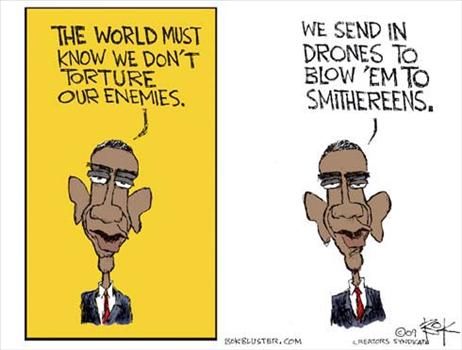
    Political Cartoon by Chip Bok

    Related Articles: